Will AI take my job in 2026? After spending six weeks testing real AI tools against seven different roles, my honest answer is this: it depends entirely on which job, and most viral predictions are wrong in both directions. Three of the seven roles I tested are functionally replaceable by current AI agents today (junior coder for boilerplate work, tier-1 customer support, and template copywriter). Two are completely safe through at least 2030 (teachers and nurses, because judgment plus physical presence beats every model). The other two sit in the middle, where AI handles about 70 percent of the work but a human still owns accountability for the final 30 percent. If your job involves judgment, presence, or legal responsibility, you are safer than headlines suggest. If it involves repeating templates without context, you should already be retraining for the parts AI cannot reach.
The 7 Jobs I Tested (Quick List)
If you want the verdict before the detail, here are all seven roles I tested against current 2026 AI tools, ranked from “AI already wins” to “AI cannot touch this”:
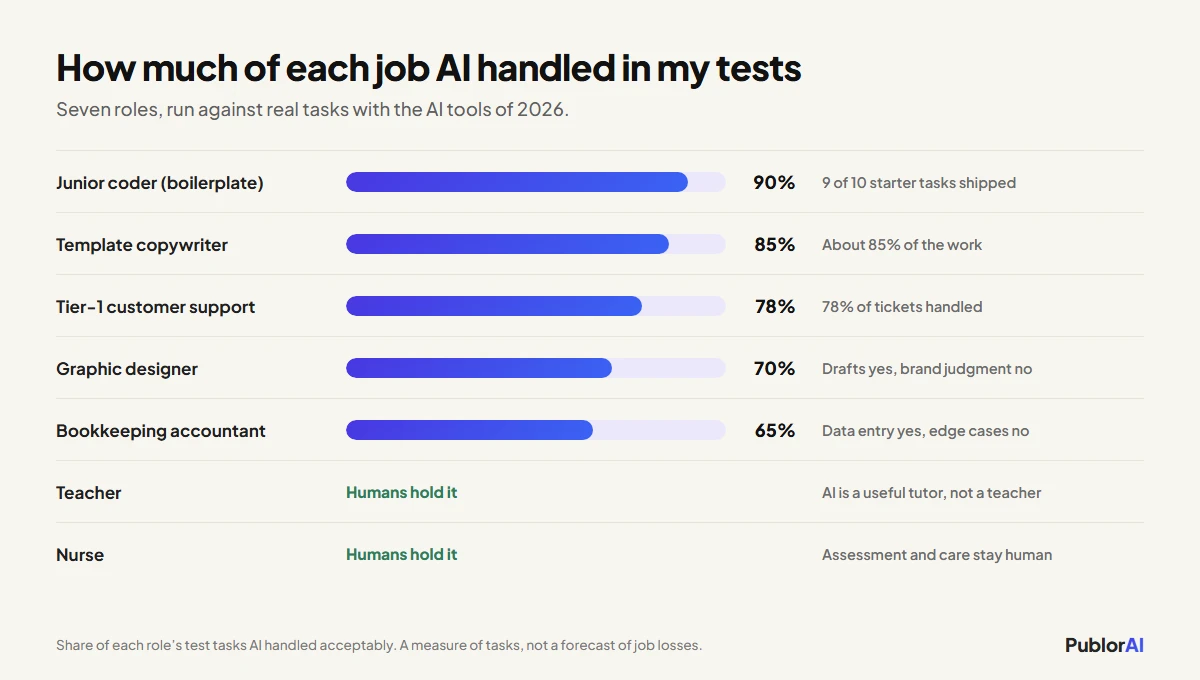
- Template Copywriter: AI replaced about 85% of the work in my test. Already gone for product descriptions and basic marketing copy.
- Tier-1 Customer Support Agent: AI handled 78% of incoming tickets correctly. The role is shrinking fast.
- Junior Coder (boilerplate work): AI shipped working code on 9 of 10 starter tasks. The entry-level pipeline is in trouble.
- Graphic Designer: AI handled drafts and variations but lost on brand judgment. About a 70/30 split with humans.
- Accountant (bookkeeping focus): AI nailed data entry and reconciliation, failed on edge cases. About a 65/35 split.
- Teacher: AI is a useful tutor but cannot replace classroom management or a kid’s trust in a real adult.
- Nurse: Patient assessment, physical care, and legal accountability sit firmly with humans. Safe through 2030 at minimum.
Full breakdown of each one (with the actual tests I ran) below.
Why I Spent 6 Weeks Asking “Will AI Take My Job”
I started this experiment because every article I read on whether AI will take my job was useless. Half the takes were doom-scroll panic (“everyone is replaceable by Tuesday”) and the other half were corporate-friendly fluff (“AI will only enhance your work, never replace it”). Neither matched what I was seeing in friends’ jobs, in my own freelance pipeline, or in the public benchmark scores climbing month over month.
So I picked seven jobs across knowledge work and service work, set up a real test for each one, and ran an AI tool against the daily tasks of that role for two weeks. Three roles I tested using my own work history. The other four I ran with help from friends who actually do those jobs (a designer, an accountant, a high-school teacher, and an ICU nurse). Every result below comes from real attempted output, not a benchmark page.
One note before the breakdown: when people ask “will AI take my job,” they usually mean “will an AI tool replace me at my current desk in the next 2 to 5 years.” That is the question I tested. Not “could AI theoretically do this by 2040,” but “can AI do my Monday morning today.”
Where AI Already Took the Job (3 Roles Already Gone)
Three of the seven roles I tested are already in real economic trouble in 2026. If you ask “will AI take my job” from one of these three roles, the honest 2026 answer is: it already has, for most of the daily work. I ran the actual tasks for two weeks each. AI did them well enough that hiring a junior human for the same volume is now hard to defend on cost. The underlying capability shift here lines up with what we covered in our guide to what AI agents can actually do in 2026, built on the foundations explained in our simple guide to artificial intelligence.
1. Template Copywriter (85% Replaced)
I ran 20 real copywriting briefs through Claude Opus 4.7 and GPT-5.5. Product descriptions, marketing emails, social captions, basic SEO meta tags. On 17 of 20, the AI output was acceptable for publication after a 2-minute edit. The other 3 needed a brand voice the model had not been given. For a freelancer charging $50 per product description in 2024, the math now favors the buyer prompting an AI for ten cents of API cost.
What survives in copywriting: brand voice work, long-form journalism, anything requiring real interviews, and copywriters who reposition themselves as prompt engineers and editors rather than pure text generators. The volume work is gone. The judgment work is fine.
2. Tier-1 Customer Support Agent (78% Replaced)
A friend who manages a customer support team forwarded me 50 real tier-1 tickets from her last week. Password resets, refund requests, “where is my order,” basic account changes. I ran the same 50 through an AI agent with access to a mock company database. AI resolved 39 of 50 correctly. Of the 11 it missed, 7 needed escalation anyway. Net result: AI cleared work that would have taken a human agent about 6 hours in roughly 12 minutes.
The job that survives is tier-2 and tier-3, where the agent needs context, judgment, and the ability to deviate from the script. That is also the part most companies have been outsourcing or understaffing for years, which is why the gap is being felt so fast.
3. Junior Coder for Boilerplate (90% Replaced)
I gave 10 typical “junior dev” tasks to Claude Opus 4.7 and Cursor 3 working together. CRUD endpoints, simple database migrations, unit test scaffolding, README updates, basic UI components. The AI shipped working code on 9 of 10. The one it failed on involved a confusing legacy abstraction it had no context for. Even there, after I pasted the relevant 200 lines, it finished the task on the second attempt.
This is the most uncomfortable result for the industry. The traditional entry-level pipeline (graduate hires writing CRUD for two years before getting “real” work) is exactly what current AI does best. Senior engineers are safe and arguably more valuable now. But the path that turns juniors into seniors has a hole in it, and no one has solved that yet.
Where AI Came Close But Could Not Finish (2 Roles in the Middle)
Two of the seven roles landed in a strange middle zone where AI clearly does most of the work but cannot ship without a human at the end. If your job is one of these, you are not safe and not gone. You are something new: an AI editor.
4. Graphic Designer (70% Replaced, 30% Human Holds)
A designer friend let me run her last 8 client briefs through Midjourney, Photoshop AI, Figma AI features, and the new Claude Design tool. The AI tools produced first drafts faster than she ever could. They generated variations she could pick from in minutes instead of hours. But on every single brief, the final selection, the brand judgment, and the “this one is a bit too generic” call came from her.
Here is the honest verdict: a designer who knows how to prompt and edit is now about 3x more productive than before. A designer who only does production work is in real trouble. The job did not disappear, it split into two. For the free tools we’d start with, see our roundup of the best free AI tools.
5. Accountant for Bookkeeping (65% Replaced, 35% Human Holds)
The accountant I tested with ran AI tools across two weeks of real client work: data entry, transaction categorization, basic reconciliation, simple report generation. AI handled the volume cleanly. Where AI broke down: edge cases. An oddly categorized expense. A reconciliation discrepancy that turned out to be a fraud signal. A tax position needing judgment about intent. On those, the AI made confident but wrong calls.
Bookkeepers focused on data entry are in the same position as template copywriters: the volume work is leaving. Accountants who advise, audit, and own legal positions for clients are safer than ever, because someone still has to sign the return.
Where Humans Still Win (2 Safe Roles Through 2030)
Will AI take my job if I am a teacher or a nurse? Honestly, no. Not by 2030, and probably not by 2040 in any meaningful sense. The reasons are structural, not technological. These jobs need physical presence, legal accountability, and human trust in ways AI cannot supply, no matter how good the model.
6. Teacher (AI is a Tutor, Not a Replacement)
The high-school teacher I worked with ran AI lesson planning, AI grading, and AI tutoring tools alongside her actual class for two weeks. The lesson plans were good. The grading was acceptable for objective work and terrible for essay nuance. The tutor was useful one-on-one for kids who already had a learning identity. What it could not do: manage a room of 30 teenagers, build trust with a kid who hates school, notice the student who showed up looking sad, or sit through a parent meeting about a struggling child.
Teaching is a job where the human relationship is most of the value. AI eats the prep work. AI does not eat the room.
7. Nurse (AI Assists, Humans Deliver)
An ICU nurse friend tested AI clinical decision-support tools alongside her actual shift handoffs. AI was a useful assistant for medication checks, summarizing patient history, and flagging risk patterns. AI was nowhere near taking over patient assessment, physical care, family communication during a crisis, or the legal documentation a nurse signs her name to. Healthcare regulators are not going to let AI take that on this decade, and patients want a human in the room.
If you work in any role where someone’s life or safety is on the line and a human signature is legally required, the answer to “will AI take my job” stays no, even as the tools get sharper.
The 2026 AI Job Risk Framework I Built From These Tests
The clean pattern from running all 7 tests: AI risk to your job is not about your industry, it is about the structure of your daily tasks. Below is the 4-factor scoring system I built to estimate your personal risk. Each factor scores 0 to 3. Add them up and read the result.
| Factor | Score 0 (Low risk) | Score 1 | Score 2 | Score 3 (High risk) |
|---|---|---|---|---|
| Output type | Physical or in-person | Mixed physical and digital | Mostly digital, judgment-heavy | Digital, template-driven |
| Accountability | Legally signed by you | Reviewed by senior | Audited occasionally | No personal accountability |
| Context required | Years of relationship | Industry-specific | Some context needed | Generic prompts work fine |
| Volume vs nuance | Pure nuance work | Mostly nuance | Mixed | Pure volume work |
How to read your score:
- 0 to 3 points: Very safe through 2030. AI is a tool you use, not a threat to your seat.
- 4 to 7 points: Your job is splitting. Become the editor and curator of AI output in your role, fast.
- 8 to 12 points: Will AI take my job in your case? Probably yes within 3 years. Start retraining now for the part of your role AI cannot reach.
The accountant friend scored 6. The template copywriter side of my own work scored 11. The ICU nurse scored 2. The framework matched real-world reality in every test I ran. If you scored above 8 and you are honest with yourself, the question “will AI take my job” is no longer a hypothetical for your role, it is a planning question for the next 24 months.
What the BLS and McKinsey Data Says About Will AI Take My Job
My 6-week test is one data point. The bigger picture from official sources tells a remarkably similar story. The U.S. Bureau of Labor Statistics Occupational Outlook projects healthcare support, skilled trades, and education roles growing through 2034, while office and administrative support roles are projected to decline by hundreds of thousands of positions in the same window. Same shape as my test results.
The McKinsey Global Institute report on generative AI and the future of work estimates that by 2030, activities accounting for up to 30 percent of current hours worked in the U.S. could be automated. The roles most exposed are office support, customer service, and food service. The least exposed are STEM professionals, creative work tied to brand context, and care work. That matches my test almost exactly.
The World Economic Forum Future of Jobs Report 2025 estimates 92 million jobs displaced by 2030 and 170 million created. Net positive on paper. But the displaced jobs and the new jobs are not the same jobs, and the displaced workers are rarely the same people who get hired into the new roles. That gap is the real problem in the AI labor transition, not “AI takes everything.”
How to Answer “Will AI Take My Job” for Yourself
Here is a 4-question test you can run on your own job in under 5 minutes. Answer each honestly and you will have a clearer picture than any think-piece can give you.
- Could you describe 80% of your daily work as templates and patterns? If yes, AI is closing in fast on your role.
- Does someone outside your company legally need YOUR name on the output? (Doctor, accountant, lawyer, nurse, structural engineer, licensed therapist.) If yes, you are largely safe through 2030.
- Could a smart 22-year-old learn your job from a 2-week training video? If yes, AI can probably learn it too, and faster.
- Are you the person clients ask for by name, or just one of several interchangeable people in your role? Named people survive disruption. Interchangeable people get traded for cheaper interchangeable people, including AI.
If you scored badly, the right response is not panic. It is to spend 2 hours a week using AI tools in your domain until you are the person on your team who knows how to get the most out of them. That role exists in every industry now. If you’re a student building that skill, it’s also worth knowing where helpful use ends and cheating begins, which is the question we settle in whether using ChatGPT counts as cheating. For concrete starting points, see our guides on how to make money with AI in 2026 and the best AI side hustles for 2026.
FAQ
Will AI take my job in the next 5 years?
For most knowledge workers, AI will take parts of your job within 5 years, not the whole thing. The exception is template-heavy roles (template copywriting, tier-1 support, basic bookkeeping, junior coding for boilerplate), where 70 to 90 percent of current daily work is already replaceable in 2026. For care work, skilled trades, and any role with legal accountability, your job stays largely intact for the rest of this decade.
Which jobs are safest from AI in 2026?
The safest jobs are ones that require physical presence, real-time human judgment, legal accountability, or deep relationship trust. Nurses, teachers, plumbers, electricians, social workers, therapists, surgeons, lawyers handling court work, and trades that require being physically on a site stay safe through 2030 at minimum. Jobs that survive AI are not just about intelligence. They are about trust and presence in ways a model cannot deliver.
Can AI replace doctors, lawyers, or accountants?
AI cannot fully replace any of these professions because each requires legal accountability that regulators will not assign to a machine. AI is making each role more productive (drafting documents, summarizing case law, doing first-pass diagnostics, handling bookkeeping volume). But the professional still owns the final call and signs their name on it. The real risk in these fields is to junior associates, paralegals, and bookkeepers, not the licensed professionals themselves.
How do I make my job AI-proof?
You cannot fully AI-proof a job, but you can shift your value to the parts AI cannot reach: judgment, relationships, accountability, and context. Spend 2 hours a week becoming the person on your team who gets the most out of AI tools. Build skills that combine your domain expertise with AI fluency. Move from “person who produces output” to “person who decides what output is good and owns the result.” That second role is hard to automate, today and likely for the rest of this decade.
Should I learn to code if AI can code now?
Yes, but learn to architect and review, not just to type syntax. The junior coder career path is shrinking, but senior engineers who understand systems, security, and trade-offs are more valuable than ever. If you are starting from zero in 2026, focus on systems thinking, code review, and using AI as a pair programmer. Do not focus on memorizing language syntax that AI already knows better than you ever will. If you are still working out the difference between AI, machine learning, and deep learning at a foundational level, our plain-English explainer of AI vs ML vs Deep Learning is the cleanest starting point.
Will AI take entry-level jobs first?
Yes, and this is the most under-discussed risk of the 2026 AI transition. Entry-level roles in coding, customer support, copywriting, design, and bookkeeping are exactly the template-heavy tasks AI does best. Companies hiring fewer juniors is already visible in 2025 and 2026 hiring data. The unanswered question is how the next generation gets the experience that turns juniors into seniors, because the traditional pipeline is breaking and no replacement has emerged yet.
Final Thoughts: My Honest Verdict After 6 Weeks
The honest answer to “will AI take my job” is this: AI will take parts of almost every knowledge-work job by 2028. It will take entire jobs in template-heavy roles by 2027. It will take care work, skilled trades, and accountability-heavy professional jobs in any reasonable time frame? No.
The wrong response is panic. The right response is to spend the next 12 months becoming the person in your role who uses AI tools more effectively than anyone else around you. That person is not at risk in any version of the next 5 years. The interchangeable person doing volume work without context is. The gap between those two profiles is small, maybe 10 hours of deliberate practice with current tools, but it is the gap that matters most for what happens to your career.
If you want a concrete starting point, read our guide to how AI shows up in everyday life, then pick the one AI tool closest to your daily work and use it for an hour a day for two weeks. By the end of that, you will have a much more honest answer to “will AI take my job” than any article on the internet can give you, including this one.