Why AI chatbots refuse questions, or tell you they “can’t help with that” on something completely ordinary, comes down to one thing nearly every time: a safety layer that reads the shape of your words instead of what you actually meant. Every major assistant now runs your prompt past a filter before it answers, and if the wording pattern-matches a short list of genuinely risky topics, the model declines, reroutes, or hedges. That filter is tuned cautiously on purpose, so once in a while it stops a harmless question by mistake. The first time one refused a recipe question for me, I assumed I’d broken a rule. I hadn’t. It had misread a single word. This guide explains why AI chatbots refuse, what actually sets the filters off, and the fastest way to get a straight answer out of ChatGPT, Claude, or Gemini when the wall goes up.
None of this means the chatbot is broken, censoring you, or quietly judging you. It’s a safety system doing its job, sitting right next to a set of plain capability limits that people constantly mistake for refusals. The behavior looks random until you see the rules underneath it, and those rules are roughly the same across every assistant. So why AI chatbots refuse one person’s question and answer the same thing for someone else usually comes down to wording, context, or which model you happen to be on. The mechanism is just pattern-matching rather than real understanding, which our explainer on how AI actually works breaks down, and once you see it, the whole thing turns from frustrating to predictable.
What This Guide Covers
This page is the hub for everything on AI refusals, so here’s the map. We start with the single mechanism behind why AI chatbots refuse anything at all, then look at why that mechanism catches innocent questions. From there we sort the five different kinds of “no” you can hit, because the right fix depends entirely on which one it is. We cover why every major chatbot now behaves this way, the narrow set of topics that actually trigger a block, the step-by-step playbook to get answered when your request is fair, and how to tell a real refusal apart from the model simply breaking. If you want the tool-specific deep dives, we have full breakdowns of why ChatGPT refuses and why Claude refuses questions that sit underneath this overview. Everything here applies whether you use ChatGPT, Claude, Gemini, or all three. By the end you’ll know not just why AI chatbots refuse, but exactly what to do the moment one does.
The One Reason Why AI Chatbots Refuse Anything
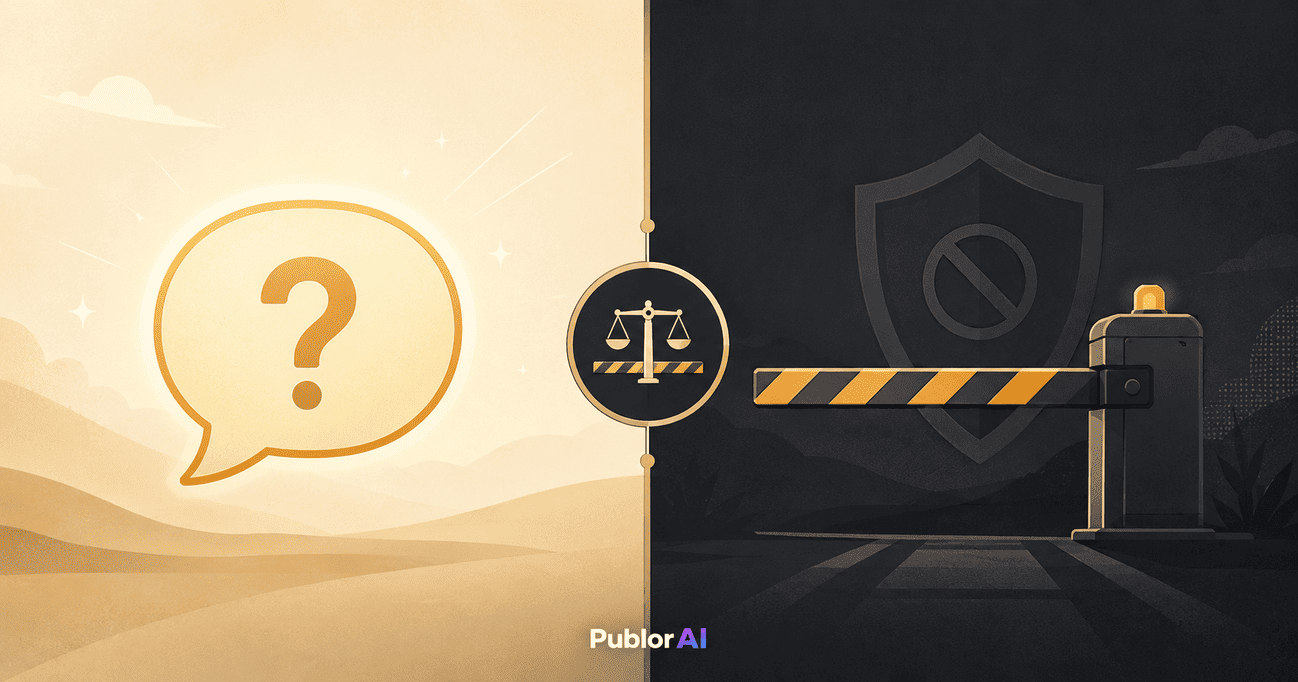
Strip away the tool names and almost every refusal traces back to the same design choice. The companies behind these models bolt a safety classifier onto the front of the assistant. Before you ever see an answer, that classifier scores your prompt against patterns it learned from examples of harmful content. Score low, and you get a normal reply. Score high enough, and the model refuses, softens its answer, or quietly hands the request to a more conservative model. That one scoring step is the root of why AI chatbots refuse questions they have no real problem with.
The catch is that the classifier reads patterns, not intent. It has no idea whether you’re a nurse, a novelist, or a curious teenager. It only sees text, and it asks a single question: does this look like the dangerous stuff I was trained to catch? It is not thinking about your purpose, because it cannot think about anything. It is matching shapes.
Picture a smoke detector. It can’t tell the difference between a kitchen fire and burnt toast, because it isn’t actually checking for fire, it’s checking for smoke. Set it sensitive enough to catch a real fire early, and it will shriek at your toast now and then. AI safety filters work the same way. Tuned to catch genuinely harmful requests, they occasionally scream at a perfectly innocent one that happens to give off the wrong signal. That trade-off, a few false alarms in exchange for catching real danger, is deliberate, and it is the whole reason why AI chatbots refuse work that a human would wave straight through.
Why AI Chatbots Refuse Harmless Questions
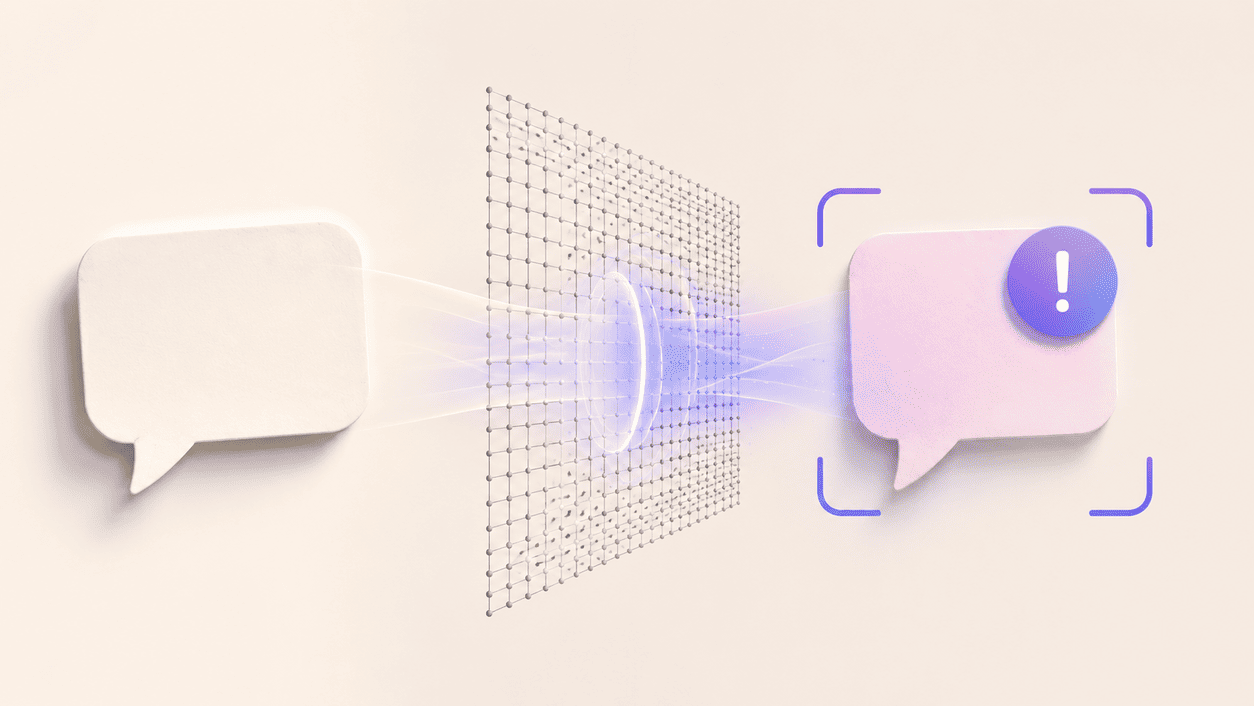
If you take only one idea from this guide, make it this one, because it explains the refusals that drive people up the wall. The danger topics are narrow, yet a recipe, a history essay, or a debugging question still gets blocked sometimes. Why? Because the filter scores patterns, not purpose, and a handful of completely legitimate prompts give off signals that overlap with the risky stuff.
Think about who gets caught. A novelist researching how a poison works for a murder mystery. A nurse asking about a dangerous drug interaction for patient safety. A developer pasting in security code to debug it. A history student asking about the mechanics of a historical atrocity. Every one of those requests is fine. Every one of those can also score high on a classifier that only sees words like “poison,” “overdose,” “exploit,” or the grim vocabulary of history. That gap between what you meant and what the filter saw is the entire story of why AI chatbots refuse things any person would clear in a second.
The encouraging part is that the providers know over-refusal is a real problem and are actively working to shrink it. The general direction across the industry is away from blunt, all-or-nothing blocks and toward giving a useful, bounded answer on a sensitive-but-legitimate topic instead of a flat wall. Refusals should get rarer and smarter over time. But the filters are still tuned cautiously today, so false alarms haven’t gone away, which is why the rest of this guide matters.
The Five Kinds of No
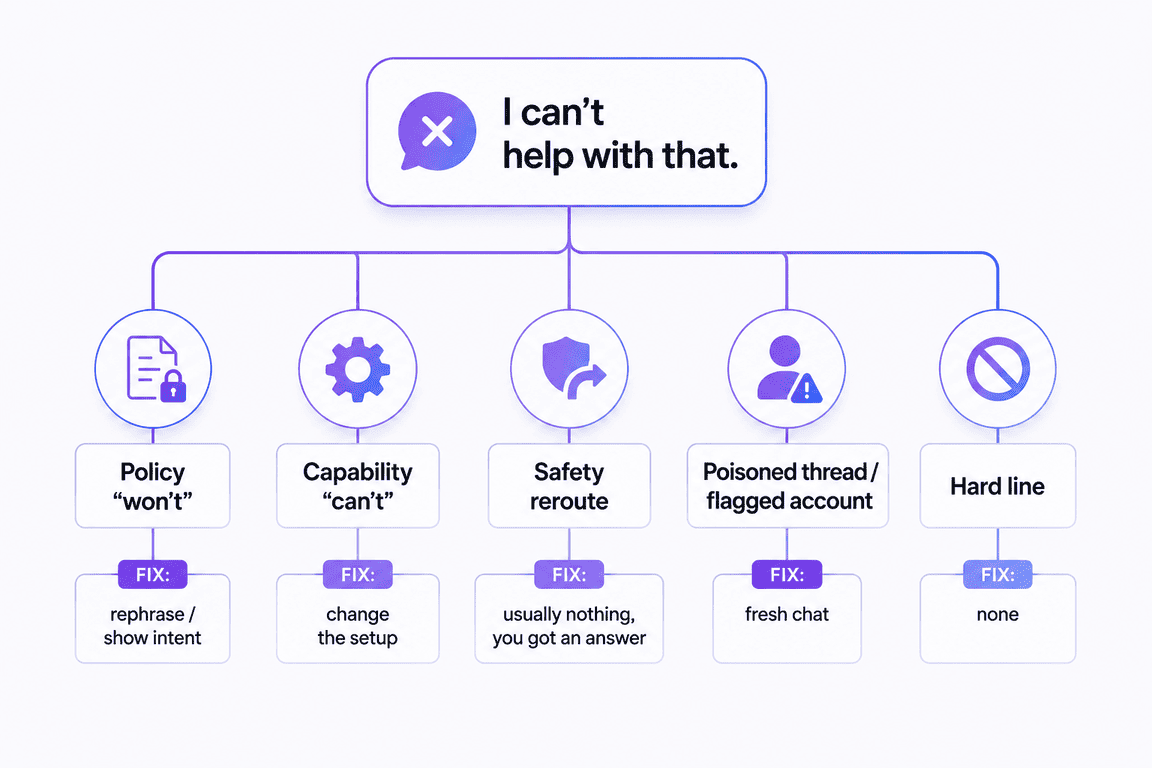
Here’s the part almost everyone misses: “I can’t help with that” is not one thing. It’s at least five different situations wearing the same vague sentence, and telling them apart is the single fastest way to know what to do next. Lump them together and you’ll waste tries rephrasing a wall that wording can’t move, or give up on a block that a five-second tweak would have cleared. These five cover essentially every refusal you’ll meet.
| The kind of “no” | What’s really happening | What actually helps |
|---|---|---|
| Policy “won’t” | The request brushes a rule the model is told not to break | Add context, rephrase, ask for the safe angle |
| Capability “can’t” | The model isn’t able to do it at all (no live web, no memory of an old image, a knowledge cutoff) | Change the setup, not the wording; paste the data in yourself |
| Safety reroute | The model hands your prompt to a more cautious model that answers in its place | Often nothing; you still got an answer, just from a stricter model |
| Poisoned thread / flagged account | An earlier refusal keeps echoing in a long chat, or repeated edgy prompts tightened your account | Start a fresh chat; ease off the hard lines |
| Hard line | Content that’s banned outright, like sexual content involving minors or clear weapon-building | Nothing. No framing clears it, and pushing risks your account |
Before you fight any refusal, ask which of these five you’re looking at. A capability “can’t” never yields to a better prompt, so rephrasing it just burns your time. A hard line never yields to anything. The rest of this guide is mostly about the policy “won’t,” because that’s the situation behind most cases of why AI chatbots refuse a fair request, and it’s the one a smarter prompt can actually fix.
Why Every Major Chatbot Refuses Now
A few years ago, chatbots would cheerfully answer almost anything, often badly. That era is over. ChatGPT, Claude, and Gemini all ship with safety layers now, and the reason is the same across the board: the models got capable enough that a wrong answer on the wrong topic became a real-world liability, not just an embarrassment. So the providers drew lines, wrote them into public policies, and trained the models to hold them. That shift, from permissive to guarded, is the broad backdrop to why AI chatbots refuse so much more than they used to.
What’s striking is how similar those lines are. Read OpenAI’s usage policies, Anthropic’s usage policy, and Google’s prohibited-use policy for Gemini side by side and you’ll see almost the same list: no help building weapons, no child sexual content, no malware or fraud, no targeted harassment, no digging up private data on real people. That overlap is exactly why AI chatbots refuse the same broad categories no matter which one you open. They aren’t copying each other so much as converging on the same small patch of genuinely dangerous territory. GPT-6 Astra is the newest data point for that convergence, gating the same short list of cyber and bio domains that Anthropic gates.
Where they differ is temperament. In practice Claude tends to be the most cautious of the three and refuses borderline-but-harmless requests more often, while ChatGPT and Gemini lean a little more permissive in the gray areas. If that difference matters to your choice, we put the two head to head in our breakdown of which one refuses more. But the underlying machinery, a classifier guarding a published list of red lines, is identical from one assistant to the next.
The Topics That Actually Trigger a Refusal
For all the frustration, real policy refusals cluster in a surprisingly small set of topics. The overwhelming majority of everyday prompts, writing, coding, study help, business, general research, never get flagged at all. When a request does get blocked on policy grounds, it’s almost always brushing one of these areas:
- Weapons and dangerous materials. Anything that reads like instructions for building a weapon, an explosive, or a bioweapon gets declined fast.
- Cybersecurity attacks. Offensive hacking, malware, and exploit code, anything that looks like an attack rather than defense.
- Sexual content. Explicit material is heavily restricted, and anything involving minors is an absolute, no-exceptions line.
- Illegal activity and fraud. Scams, phishing, breaking into someone else’s account, deception for money.
- Self-harm. The model is tuned to respond with support resources, not methods.
- Hate and harassment. Content that attacks or dehumanizes people for who they are.
- Private personal data. Assembling or digging up information about a real, identifiable person.
- Tailored professional advice. Since policy updates in late 2025, specific medical, legal, and financial advice that really needs a licensed professional leans into the line. Learning how something works in general is still fine.
Notice these map almost one-to-one onto the published policies from the last section. That’s the tell. When people ask why AI chatbots refuse a specific prompt, the honest first answer is to check whether it’s clipping one of these eight areas, even by accident. For a concrete, request-by-request look at where the lines fall in practice, our list of the things ChatGPT won’t do walks through the common ones and how to reword around each.
How to Get a Straight Answer From Any AI
When your request is legitimate and you still got refused, the goal is simple: make your intent impossible to misread. By this point, the answer to why AI chatbots refuse a reasonable request is nearly always the wording, not the subject. Most false flags clear the moment your prompt stops looking, to a pattern-matcher, like something dangerous. Here’s the order that works on ChatGPT, Claude, and Gemini alike.
- Sort the “no” first. Won’t or can’t? If it’s a capability limit, stop rephrasing and change the setup instead. No wording unlocks a thing the model genuinely can’t do.
- State who you are and why you’re asking. “I’m a nurse checking a drug interaction for patient safety,” or “I’m writing a thriller and need realistic but non-actionable detail.” Visible intent is intent the filter can clear.
- Drop the loaded keywords. Swap risky-sounding words for plain ones, and ask how something works in principle rather than for step-by-step instructions to carry it out.
- Ask for the defensive or educational angle. “How do I protect against this” clears far more often than “how do I do this.”
- Start a fresh chat. A clean thread drops the earlier refusal that may be making the model keep saying no.
- Switch models if you can. A different or older model may not carry the same classifier, and a reroute to a more conservative model usually still answers your question.
- Don’t hammer the hard lines. If a request truly crosses a red line, no rewrite is coming, and repeated attempts can flag your account.
That sequence is the practical answer to why AI chatbots refuse a fair request and how to undo it. The same playbook, worked tool by tool, is in our step-by-step guide on how to stop Claude refusing, and most of it transfers directly to the others. The deeper fix is upstream: clear, specific prompts get refused far less in the first place, which is one more reason it pays to learn how to write better AI prompts.
When It’s Not a Refusal at All
One more thing is worth ruling out, because it gets blamed on refusals constantly: sometimes the chatbot isn’t declining at all, it’s just failing. If the model stalls, spins forever, or cuts off halfway through an answer with no message saying it won’t help, that isn’t a refusal. It’s usually a connection problem, an overloaded chat, or the service having a moment, and it has a completely different fix. It’s worth separating from why AI chatbots refuse, because the two feel identical on screen but call for opposite responses. A third case again is simply running out of your plan’s usage allowance, which looks like neither.
The quick test is whether you got told no. A real refusal always says it’s declining, or visibly hands you off to another model, and on the newest Claude models that handoff is the more common of the two. Silence is a technical issue, not a safety one. If that’s what you’re hitting, our guide on what to do when ChatGPT isn’t responding walks through the fixes in order, and there are the same fixes for a Claude that has stopped working. Sorting “it refused me” from “it broke” saves a lot of pointless rephrasing, because no amount of clever wording fixes a stalled tab.
The Biggest Myths About AI Refusals
Most of what people believe about why AI chatbots refuse falls apart on a closer look. Clearing up these four takes most of the frustration out of hitting a wall.
“The chatbot is broken”
It usually isn’t. A refusal is the safety layer working as designed, and a stall is a separate technical fault entirely. Most of the time, why AI chatbots refuse has a mundane, working-as-intended explanation rather than a bug. Annoying when a harmless prompt gets caught, yes, but the model is behaving as built, not malfunctioning.
“It’s censoring or judging me”
No. The classifier scores each message against patterns. It has no memory of you and no opinion about you. A flag is a statistical match, not a verdict on who you are or what you believe.
“Everything sets it off”
Far from it. Real refusals concentrate in a handful of high-risk areas. If it feels like everything trips it, your prompts are probably clipping one of those areas by accident, or you’re stuck in a poisoned thread that a fresh chat would fix.
“A refusal means the whole topic is banned”
Rarely. Most of the time it’s the specific phrasing or the requested action that got blocked, not the subject. The same topic, asked from an educational or defensive angle, usually goes straight through.
The Bigger Picture
So why AI chatbots refuse questions you know are reasonable comes down to a few honest things: every major assistant now screens prompts for a small set of genuinely risky topics, the screen reads patterns instead of intent, and plain capability limits get mixed in under the same vague message. Sort which kind of “no” you hit, show your intent, and start fresh when a thread goes sideways, and you’ll clear the large majority of false flags in seconds.
Once you read refusals this way, they stop feeling random and start feeling predictable, which makes them easy to work around. The hard lines are there for good reason and aren’t worth fighting. Everything else is mostly a wording problem with a quick fix. From here, the tool-specific guides go deeper: why ChatGPT refuses and why Claude refuses questions cover each assistant’s quirks, and if you’re choosing between the big three, our look at how ChatGPT, Claude, and Gemini compare puts them side by side.