Is using ChatGPT cheating? Not by default, and the loud answers on both sides are both wrong. ChatGPT cheating happens only when you hide it, or when you hand in AI work as proof of a skill you were supposed to demonstrate yourself. It is not cheating when you use it openly as a tool to think, draft, or learn, the same way you’d use a calculator or a search engine. After watching how schools and employers actually handle this in 2026, I’m convinced the real line isn’t the tool at all. It’s disclosure. Most universities have quietly stopped banning AI and started treating undisclosed use as the actual violation. That shift tells you almost everything you need to know. My honest take: stop asking whether the tool is allowed, and start asking whether you’re hiding it and what you’re really being tested on.
This is a genuinely contested question, so I’ll argue both sides honestly before I tell you where I land. There is a real case that it’s cheating, and a real case that it isn’t.
The ChatGPT Cheating Question Isn’t “Is It Allowed”
Whether something counts as ChatGPT cheating depends on one thing almost nobody names: what you are actually being assessed on. If the point of the task is to measure whether you can write, reason, or solve a problem, then outsourcing that to AI and presenting it as your own work is cheating, plainly. If the task is just to produce a result and the method is open, it usually isn’t. The tool is neutral, the same as the AI behind any everyday app. The deception is the part that makes it cheating.
Think about a calculator. Using one in a mental-arithmetic test is cheating, because the test is the arithmetic. Using one in an engineering job is just doing the work. Same tool, opposite verdict, and the only thing that changed is what’s being measured. ChatGPT is the same story with higher stakes. The question was never “is the tool allowed in the universe.” It’s “is the tool allowed for this specific thing, and am I being honest about using it.”
The Case That Using ChatGPT IS Cheating
There’s a serious argument that ChatGPT cheating is real, and it deserves better than a dismissive wave. The strongest version: when you submit ChatGPT’s output as your own, you are claiming a skill you didn’t use and credit for work you didn’t do. That’s the textbook definition of academic dishonesty, and almost everyone, including most students, agrees that turning in an AI-written paper unedited crosses the line. A Stanford analysis of AI and student cheating found broad agreement on exactly that point even where people disagree on everything else.
There are three real harms behind the “yes, it’s cheating” case. First, it’s unfair to the students who did the work themselves. Second, it hollows out the credential, because a grade is supposed to certify that you can do the thing. Third, and most underrated, you rob yourself. The struggle of writing the essay or debugging the code is the part where the learning actually happens. Skip it every time and you graduate with a transcript and none of the ability it’s supposed to represent. That’s a genuine cost, and “it’s just a tool” doesn’t answer it.
The Case That It Is NOT Cheating
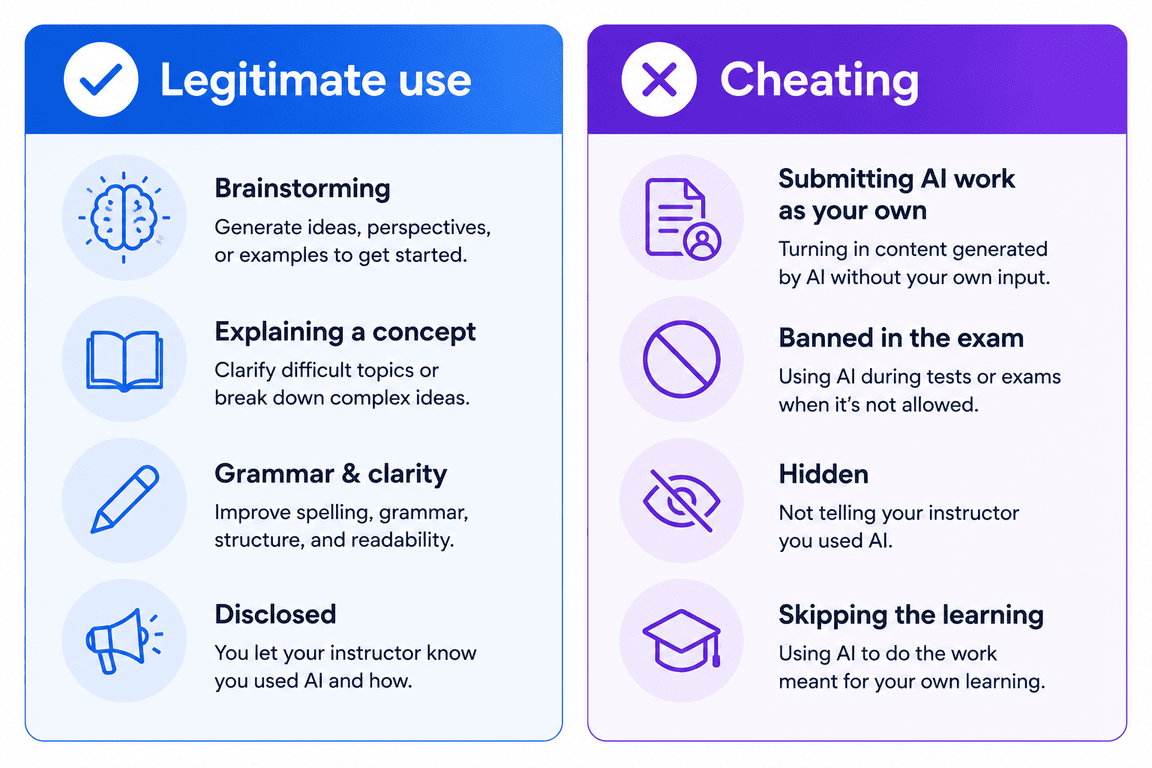
Now the other side, which is just as real. For most everyday uses, calling ChatGPT cheating is like calling a calculator, spellcheck, or Google cheating. Using it to brainstorm angles, explain a concept you’re stuck on, or tighten your grammar is not fraud. It’s how work already gets done everywhere outside the classroom. Banning it outright in 2026 looks a lot like banning calculators in 1980: a losing fight against a tool that’s about to be everywhere.
There’s also a skills argument. Knowing how to use AI well is itself becoming a core competency, the same way “can you use a computer” stopped being optional. Surveys in 2026 show the vast majority of university students now use generative AI in some form, and employers increasingly expect it. A student who never touches it isn’t more honest, they’re just less prepared for the actual job market, which is the same shift we cover in our piece on whether AI will take your job. Used well, as a thinking partner rather than a ghostwriter, ChatGPT can make you learn faster, not less. Learning to write the prompts that get there is a skill in itself, which is the whole point of our guide to writing better AI prompts.
Where I Land: It Comes Down to Disclosure
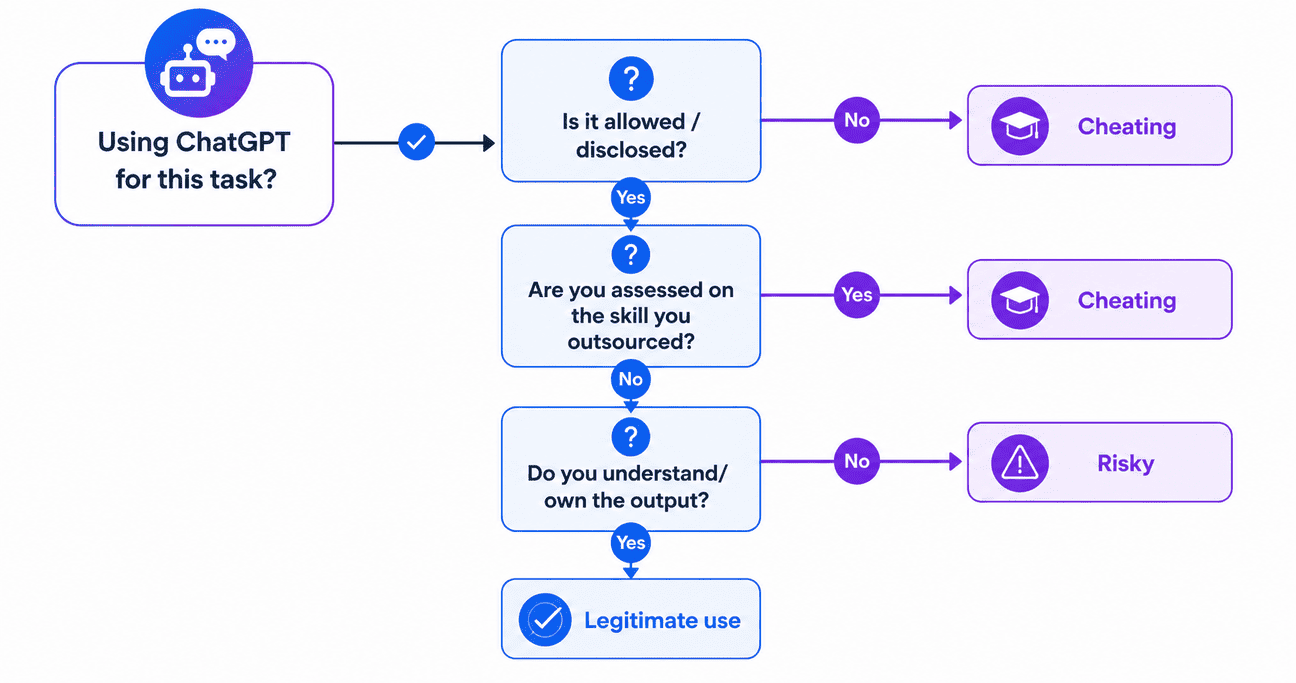
After both sides, here’s my actual position: using ChatGPT is cheating only when you hide it or when you use it to fake a skill you’re being graded on. The tool is almost never the problem. The dishonesty is. And the most telling evidence is that institutions have landed in the same place. The big 2026 policy shift in education wasn’t “ban AI,” it was “undisclosed AI use is the violation.” Schools effectively redefined ChatGPT cheating around disclosure, not the tool. Harvard, Oxford, and Princeton now broadly allow AI for brainstorming and study with disclosure, while prohibiting it in graded assessments unless a professor specifically permits it. Princeton’s guidance tells students to confirm AI is allowed and to disclose how they used it, and many university academic-integrity offices now treat hiding the use as more serious than the use itself.
So instead of asking “is using ChatGPT cheating,” ask yourself these four questions. They decide it almost every time:
- Are you hiding it? If you’d be embarrassed for your teacher or boss to see the chat, that’s your answer.
- Are you being assessed on the exact skill you outsourced? If the task exists to prove you can do it, letting AI do it is cheating.
- Do you actually understand and own the output? Can you explain and defend every line? If not, it isn’t really your work.
- Does the policy that governs you allow it? Your school’s or employer’s rule beats your opinion. Check it, don’t assume.
Run anything through those four and the gray area mostly disappears. Using ChatGPT to explain a confusing topic, then writing the essay yourself? Fine. Disclosing that you used it to outline and edit? Fine on most campuses now. Pasting a prompt, copying the output into the submission box, and saying nothing? That’s cheating, and the disclosure rule is exactly why.
What This Means for You
The same line applies on the other side of the conversation, which is why Claude declines to write work you will hand in while happily explaining the topic. For students, the safe and honest move that keeps you clear of any ChatGPT cheating accusation is simple: assume you must check and disclose. Read your course’s AI policy before the assignment, not after the accusation. Use ChatGPT to understand, outline, and pressure-test your thinking, then produce the graded work yourself so you can defend it. If you’re allowed to use it, say how you used it. That single habit keeps you on the right side of every disclosure-based policy I’ve seen.
For people at work, the rules are looser but not absent. Most jobs don’t care that you used AI to draft an email, they care about the result. The bigger risk there isn’t “cheating,” it’s privacy, because pasting sensitive material into a chatbot has its own line you shouldn’t cross, which is exactly what we cover in the things you should never tell ChatGPT. Either way, the more you understand how AI actually works, the easier it is to use it as a real tool instead of a crutch.
The Bottom Line
Is using ChatGPT cheating? Only when you make it cheating. The tool isn’t the problem, and the people insisting it always is, or never is, are both selling you a simpler answer than reality. Hiding your use and dodging the learning is cheating. Using it openly, owning the output, and respecting the rules you’re under is not. The ChatGPT cheating debate has basically been settled already: disclosure is the line.
So the real skill in 2026 isn’t avoiding AI or leaning on it. It’s using it honestly and well, the way you’ll be expected to for the rest of your career. Start there with our guide to using ChatGPT the right way, and let the tool make you better instead of making the choice for you.