If you’ve been hearing the term “artificial intelligence” everywhere but aren’t sure what it actually means, you’re in the right place. This guide breaks down what artificial intelligence is, how it works, and why it matters to you, without any technical jargon.
What Is Artificial Intelligence?
Artificial intelligence (AI) is the ability of a computer or machine to perform tasks that normally require human intelligence: things like understanding language, recognising images, making decisions, and learning from experience.
In simple terms: AI is software that thinks and learns.
When you ask Siri a question, get a product recommendation on Amazon, or see a suggested video on YouTube that’s AI working in the background. It’s already part of your daily life, whether you realise it or not. For 15 specific examples of AI in everyday life you probably use without thinking about, see our full breakdown.
A simple definition: Artificial intelligence is technology that enables machines to simulate human thinking and decision-making.
How Does AI Work?
AI works by processing large amounts of data and finding patterns within it. The more data it processes, the better it gets at making predictions and decisions. For a full walkthrough of how AI works step by step, see our dedicated explainer.
There are two key concepts behind most modern AI:
Machine Learning (ML): Instead of being manually programmed with rules, the AI is trained on data. It learns from examples just like a child learns to recognise a cat by seeing thousands of cats, not by reading a definition.
Deep Learning: A more advanced form of machine learning that uses layers of algorithms (called neural networks) inspired by the human brain. This is what powers facial recognition, voice assistants, and tools like ChatGPT. Want the full hierarchy explained without jargon? Our breakdown of AI vs machine learning vs deep learning covers exactly how the three relate.
The simple version: You feed AI data → it finds patterns → it uses those patterns to make predictions → you correct its mistakes → it improves.
Types of Artificial Intelligence
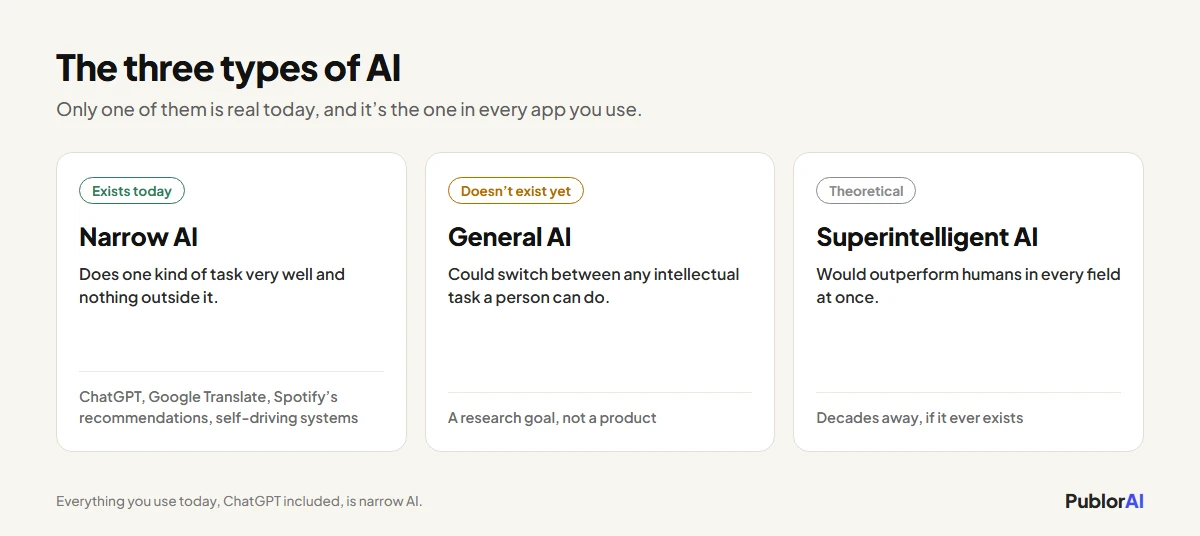
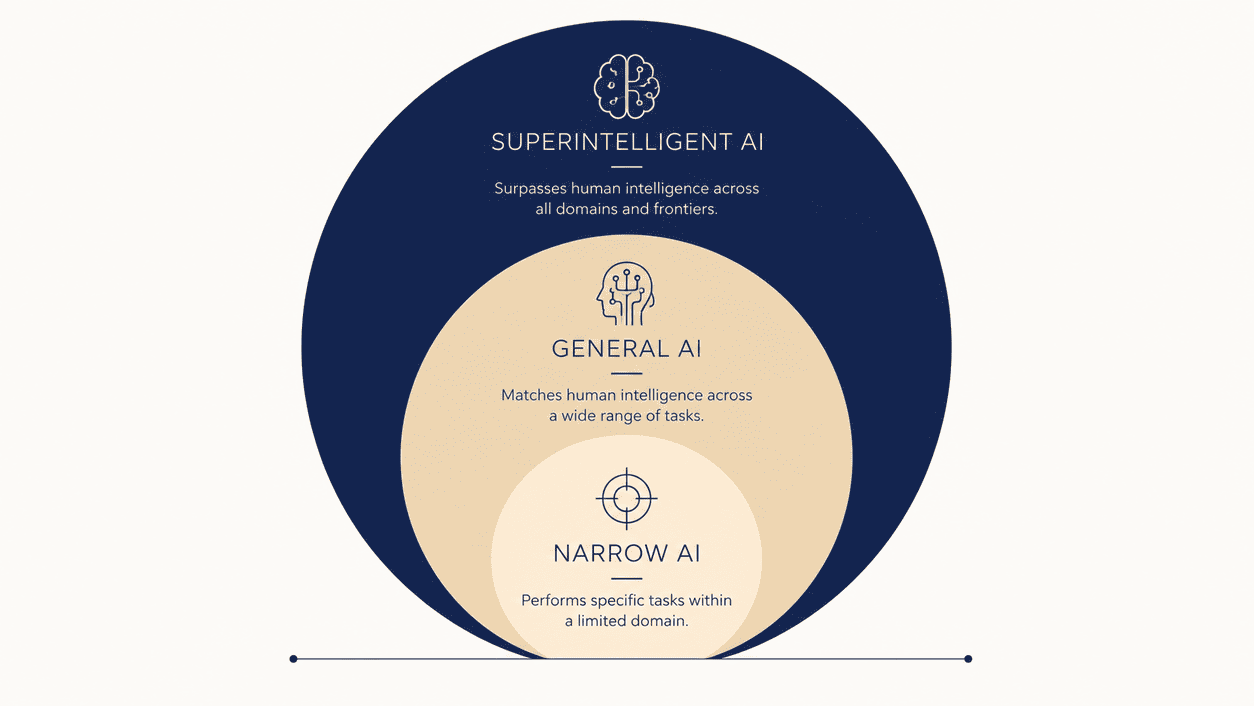
Not all AI is the same. Here are the three main types:
Narrow AI (Weak AI)
This is the only type of AI that actually exists today. Narrow AI is designed to do one specific task and do it extremely well.
Examples:
- ChatGPT: generates text
- Google Translate: translates language
- Spotify’s recommendation engine: suggests music
- Self-driving car systems: navigates roads
Narrow AI is incredibly powerful within its defined task, but it can’t think outside of it. ChatGPT can’t drive a car, and a self-driving system can’t write a poem.
General AI (Strong AI)
General AI would be a machine that can perform any intellectual task a human can, switching between writing, reasoning, planning, and learning, just like a person. This type of AI does not exist yet. It’s a theoretical goal that researchers are working toward.
Superintelligent AI
This is the stuff of science fiction: an AI that surpasses human intelligence across every field simultaneously. It remains entirely theoretical and is decades (if not more) away, if it ever exists at all.
Bottom line: When people talk about AI today, they mean Narrow AI. Everything you use (ChatGPT, image generators, recommendation systems) is Narrow AI.
Real-Life Examples of AI You Use Every Day
AI isn’t just in tech labs: it’s in your phone, your bank, and your favourite apps.
| Where | How AI Is Used |
|---|---|
| Google Search | Understands your query and ranks results |
| Netflix / YouTube | Recommends content based on your history |
| Gmail | Filters spam and suggests email replies |
| Banking apps | Detects fraudulent transactions |
| Healthcare | Analyses medical scans for early diagnosis |
| E-commerce | Shows personalised product recommendations |
| Navigation apps | Predicts traffic and suggests fastest routes |
| ChatGPT | Generates human-like text on any topic |
You interact with AI dozens of times per day without thinking about it.
Benefits of Artificial Intelligence
AI is growing fast because it delivers real, measurable value:
Speed and efficiency: AI processes information thousands of times faster than humans. A task that takes a doctor hours to analyse, an AI can process in seconds.
Consistency: AI doesn’t get tired, distracted, or emotional. It applies the same logic every time.
Cost reduction: Automating repetitive tasks reduces the need for manual labour in certain areas.
Personalisation: AI enables platforms to tailor experiences to individual users at a scale no human team could achieve.
Accessibility: AI tools like real-time translation and text-to-speech are making information accessible to more people around the world.
Challenges and Concerns
AI is powerful but it comes with real challenges worth understanding:
Job displacement: Some jobs that involve repetitive tasks are being automated. This is shifting what skills the workforce needs.
Bias in AI: If the data used to train an AI is biased, the AI will be biased too. This has caused problems in hiring tools, facial recognition, and loan approval systems.
Privacy: AI systems often rely on large amounts of personal data. How that data is collected, stored, and used is an ongoing concern. If you use chatbots like ChatGPT, knowing the things you should never tell ChatGPT is the simplest way to protect your own data.
Misinformation: AI can generate convincing text, images, and audio making it easier to create and spread false information.
Lack of transparency: It’s often difficult to understand why an AI made a particular decision, which is a problem in high-stakes areas like medicine and law.
These aren’t reasons to fear AI they’re reasons to understand it. An informed user is always in a better position.
The Future of AI
AI is developing faster than any technology in history. Here’s where things are heading:
- More powerful language models: AI that understands context, nuance, and intent even better than today’s tools
- AI in healthcare: Earlier disease detection, personalised treatment plans, drug discovery
- AI agents: Software that doesn’t just answer questions but takes actions on your behalf (booking appointments, managing emails, running research)
- Regulation: Governments worldwide are developing laws to govern how AI is developed and used
One thing is certain: AI literacy (understanding what AI is, how it works, and how to use it) is becoming one of the most valuable skills of the next decade. Tools like Claude Design are a perfect example: launched in April 2026, it lets anyone create prototypes and mockups just by describing what they want in plain text.
Frequently Asked Questions
Is AI the same as a robot?
No AI is software, a robot is a physical machine. Some robots use AI to make decisions, but most AI exists purely as software with no physical form. ChatGPT is AI. A robotic arm on a factory floor may or may not use AI.
Is AI dangerous?
Current AI tools (Narrow AI) are not dangerous in the sci-fi sense. The real risks are more practical: bias, misinformation, privacy, and job market shifts. These are serious but manageable with the right policies and awareness.
Do I need to learn coding to use AI?
No. Most AI tools today require no coding at all. ChatGPT, Canva AI, Midjourney, and hundreds of others are designed for everyday users. See our guide to the best free AI tools in 2026 for a full list of tools you can start using today.
Will AI replace humans?
AI will replace certain tasks, not entire jobs. The jobs most at risk are repetitive, rule-based tasks. Jobs requiring creativity, emotional intelligence, and complex judgement are much harder to automate. For a job-by-job breakdown of whether AI will take your specific role in 2026, we tested seven real jobs across knowledge work and care work.
Final Thoughts
Artificial intelligence is not something to fear or dismiss: it’s a tool, and like any tool, its value depends on how you use it.
You now understand what AI is, how it works, the types that exist, and where it’s heading. That puts you ahead of most people.
The next step? Start using it. The best way to understand AI is to interact with it directly.
Ready to put AI to work? Read our guide on: How to Make Money with AI in 2026and discover six practical income methods anyone can start today.