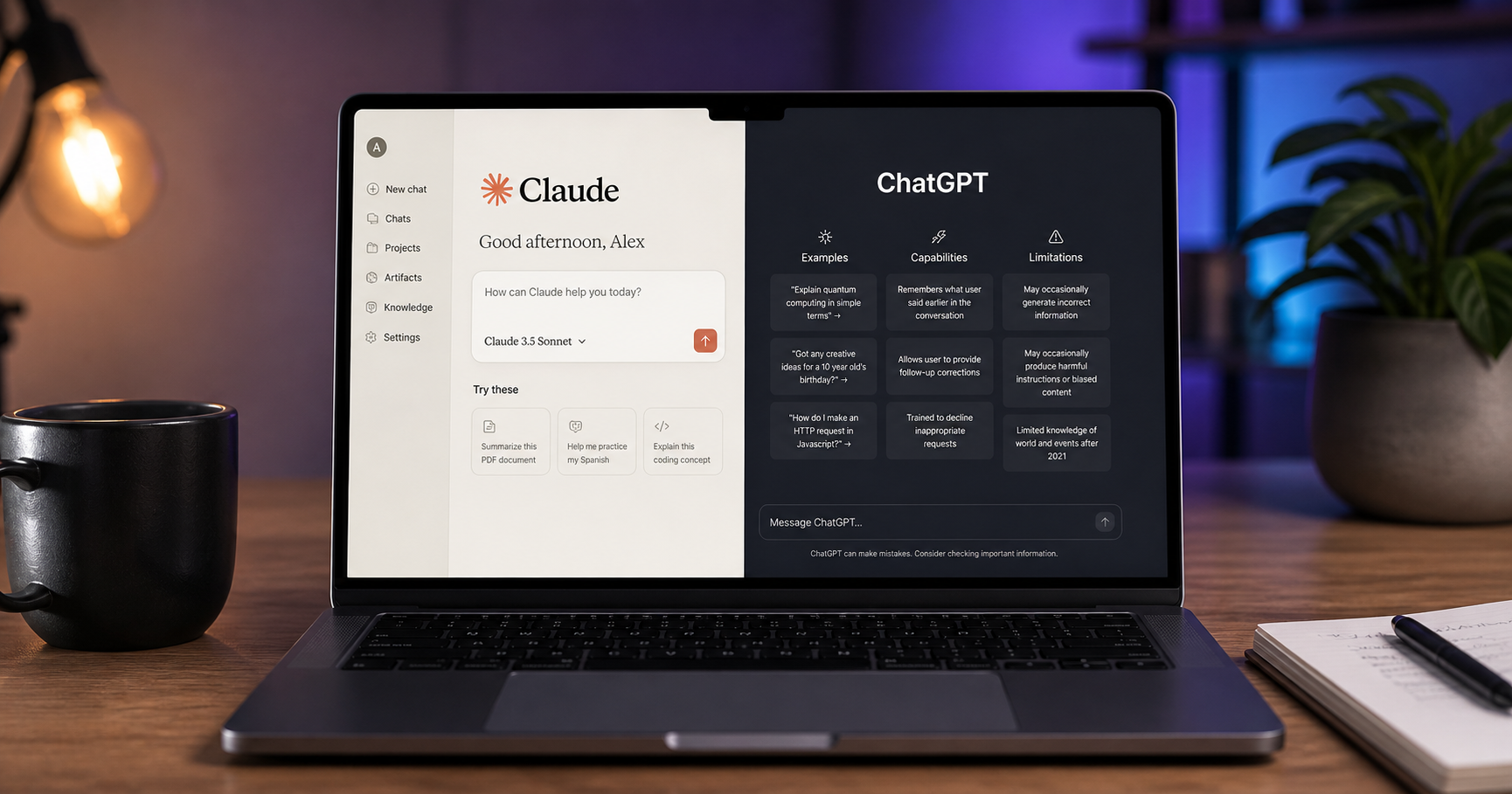
If you’re trying to figure out which AI to actually pay for in 2026, the Claude vs ChatGPT 2026 debate is the one that matters. Both cost $20 a month for the Pro tier. Both have flagship models that beat each other on different benchmarks. And both have hardcore fans who swear theirs is the best. So which one is right for you? In this honest, hands-on comparison, I’ll break down where Claude wins, where ChatGPT wins, and which one is the smarter pick based on what you actually use AI for.
The Quick Verdict (For People Who Want the Answer Now)
Neither Claude nor ChatGPT is universally better. They’re built for different strengths, and the right choice depends entirely on what you do with it.
- Pick Claude if you mostly write code, do long-form writing, work with big documents, or want the most accurate and thoughtful responses
- Pick ChatGPT if you want image generation, voice mode, real-time web search, and the biggest ecosystem of plugins and tools
- Pick both if you can afford $40/month and use AI for serious work. Many professionals run both subscriptions for different jobs
The good news: at $20/month for either, you’re not wasting money. The wrong question is “which is better?” The right question is “which fits my work?”
What Are Claude and ChatGPT? (Quick Background)
Claude (Made by Anthropic)
Claude is Anthropic’s family of AI models. It launched in 2023 and quickly became the AI that engineers and writers prefer for nuanced work. Anthropic was founded by ex-OpenAI researchers who wanted to focus on safety and reliability. That focus shows up directly in its newest models, which can decline or reroute certain prompts, the reason behind Claude’s new question refusals. The flagship at the time of writing was Claude Opus 4.7, released in April 2026. It’s the most capable Claude model and now leads most coding benchmarks.
ChatGPT (Made by OpenAI)
ChatGPT launched in November 2022 and triggered the entire modern AI boom. With over 900 million weekly users, it’s the most-used AI tool in the world. The flagship at the time of writing was GPT-5.5, released April 23, 2026. ChatGPT’s strength has always been its breadth: image generation, voice, web search, plugins, custom GPTs, and the biggest user community.
If you’re newer to AI in general and want to understand how these models actually work, our beginner’s guide to artificial intelligence is a good place to start. And once you’ve picked ChatGPT, our step-by-step guide on how to use ChatGPT covers the 7 setup steps most beginners skip.
Claude vs ChatGPT 2026: Head-to-Head Comparison
Here’s the honest side-by-side breakdown of the flagship models each company was shipping when this was written.
| Feature | Claude Opus 4.7 | ChatGPT (GPT-5.5) | Winner |
|---|---|---|---|
| Released | April 16, 2026 | April 23, 2026 | Tie |
| Context Window | 1 million tokens | 1 million tokens | Tie |
| SWE-Bench Pro (coding) | 64.3% | 58.6% | Claude |
| Terminal-Bench 2.0 | 69.4% | 82.7% | ChatGPT |
| OSWorld (computer use) | ~72% | 78.7% | ChatGPT |
| Image Generation | No | Yes (DALL-E) | ChatGPT |
| Voice Mode | No | Yes (Advanced) | ChatGPT |
| Real-Time Web Search | Limited | Full | ChatGPT |
| Coding Agent (CLI) | Claude Code (included) | Codex (separate) | Claude |
| Pro Plan Price | $20/month | $20/month | Tie |
| API Output Pricing | $25 per 1M tokens | $30 per 1M tokens | Claude |
The pattern is clear. Claude wins on coding, raw reasoning, and pricing. ChatGPT wins on multimodal features, ecosystem, and computer use. They’re not really competing on the same axis any more.
Coding: Which Is Better?
This is where the gap is biggest, and it’s tilted hard toward Claude.
In a 40-task coding test, Claude produced working first-attempt code 80% of the time. ChatGPT managed 65%. In independent tests, Claude’s functional accuracy on coding tasks sits around 95%, while ChatGPT lands closer to 85%. Surveys also show that 70% of developers now prefer Claude for coding work in 2026.
The deeper reason: Claude produces fewer hallucinated API calls, sticks more closely to documented APIs, and writes code that actually runs in production environments. ChatGPT is faster for quick fixes and rapid iteration, but Claude is the model engineers reach for when they need to ship real software.
Anthropic also includes Claude Code (a command-line coding agent) in the $20 Pro plan. It’s a full agent that can read your codebase, plan a feature, write the code, run the tests, and fix the bugs it finds. ChatGPT’s equivalent (Codex) is sold separately at higher prices. For developers, this alone often justifies switching to Claude.
For a deeper look at how Claude’s coding scores stack up, our full Claude Opus 4.7 review covers the benchmark details. For the broader picture, our ChatGPT vs Claude vs Gemini comparison brings Google’s model into the conversation too, and our Gemini vs ChatGPT head-to-head breaks down exactly how Google’s flagship stacks up against ChatGPT on its own.
Writing: Which Is Better?
This depends entirely on what kind of writing.
Claude wins for: long-form articles, technical writing, legal analysis, business documents, anything that needs to sound nuanced and human. Tom’s Guide tested both in their 2026 “AI Madness” tournament and found Claude had a “lived-in quality” that felt less robotic than ChatGPT’s more generic frameworks. Claude also handles back-and-forth iteration better, its writing improves more naturally as you guide it. For more on how to guide either model effectively, see our guide on how to write better AI prompts.
ChatGPT wins for: fast commercial copy, social posts, and anything where speed and image generation matter. ChatGPT’s ability to generate text alongside DALL-E images in one chat is genuinely useful for content creators. For literary fiction and prose quality specifically, though, Claude is the stronger pick, our Claude Opus creative writing test breaks down exactly why across 50 tested stories.
If you need to make money with AI through writing services, both are capable. Our guide on how to make money with AI in 2026 covers the freelancing angle in detail.
Research and Long Documents
Claude wins this one cleanly. With a 1 million token context window and a 91.3% score on GPQA Diamond (PhD-level reasoning), Claude handles entire research papers, legal contracts, financial reports, and lengthy codebases in a single conversation. ChatGPT’s GPT-5.5 also has a 1M context window, but Claude tends to maintain coherence and recall accuracy better across very long documents.
For students, researchers, and analysts working with academic content or large datasets, Claude is the better pick. For news research and current events, ChatGPT’s real-time web search gives it the edge. If sourced citations matter more than the writing itself, see how a dedicated search AI compares in our honest Perplexity AI review.
Pricing: Claude Pro vs ChatGPT Plus
Both Pro tiers cost the same: $20 per month. But what you actually get differs.
| What You Get | Claude Pro ($20/mo) | ChatGPT Plus ($20/mo) |
|---|---|---|
| Flagship model access | Claude Opus 4.7 | GPT-5.5 |
| Daily message limits | 5x more than free | 5x more than free |
| Image generation | No | Yes (DALL-E) |
| Voice mode | No | Yes (Advanced) |
| Real-time web search | Limited | Full |
| Coding agent (CLI) | Claude Code (included) | Sold separately |
| Custom GPTs / Plugins | No | Yes (huge library) |
| AI design tool | Claude Design (included) | No equivalent |
ChatGPT Plus packs in more features overall: image generation, voice, plugins, custom GPTs, and Code Interpreter. Claude Pro keeps the feature set narrower but adds two big developer-focused extras: Claude Code (CLI) and Claude Design (an AI design tool). Before paying for ChatGPT Plus, our ChatGPT Plus vs Free breakdown covers whether the $20 upgrade is genuinely worth it for your usage.
If you want to test both before committing, our roundup of the best free AI tools in 2026 covers what’s available without paying.
When to Use Claude (and When to Use ChatGPT)
Forget which one is “better” overall. Here’s the practical breakdown of which one fits which job.
Use Claude if you:
- Write code regularly and want the best coding model available right now
- Work with long documents (research papers, contracts, full codebases)
- Do technical or long-form writing where nuance and accuracy matter
- Want a coding agent (Claude Code) bundled into your Pro plan
- Need a model that follows instructions literally without making assumptions
- Build apps using the API and want lower output costs
Use ChatGPT if you:
- Need image generation alongside text (DALL-E in the same chat)
- Want voice mode for hands-free conversations
- Need real-time web search for news, research, and current events
- Use Custom GPTs or want access to thousands of pre-built specialized agents
- Do creative writing, storytelling, marketing copy, or social content
- Want the broadest ecosystem of integrations and plugins
Use Both if you:
- Use AI as a serious work tool and can afford $40/month
- Want Claude for coding and writing, ChatGPT for everything else
- Are a developer who also creates content or runs marketing
For ChatGPT Plus, Pro, Business, and Enterprise users, both models are available at no extra cost pricing only matters if you’re using the API directly.
Frequently Asked Questions About Claude vs ChatGPT
Is Claude better than ChatGPT in 2026?
For coding, writing, and long-document analysis, yes. For image generation, voice, real-time web search, and the broader ecosystem, ChatGPT still leads. They’re built for different strengths in 2026, so the better choice depends entirely on what you use AI for.
Is Claude Pro worth $20 a month?
Yes, especially if you write code or work with long documents. Claude Code (the CLI coding agent) and Claude Design come included, which alone are worth more than $20 if you’d otherwise pay for separate tools. For casual chat use, the free Claude plan may be enough.
Should I get ChatGPT Plus or Claude Pro?
If your work mostly involves coding, technical writing, or long documents, Claude Pro is the better $20. If you need image generation, voice mode, real-time web search, or plugins, ChatGPT Plus is the better fit. Many professionals subscribe to both at $40/month total.
Can I use Claude and ChatGPT for free?
Yes, both have free tiers. Claude.ai gives you limited daily access to Opus 4.7. ChatGPT free includes access to GPT-5.5 with daily message limits. Free is enough to test both. Most users upgrade to Pro after a week or two of regular use.
Which AI is better for students?
For research, writing essays, and analysing PDFs, Claude wins because of its superior long-document handling and writing quality. For visual projects, presentations, and creative work, ChatGPT’s image generation and Custom GPTs are more useful. Many students use the free tiers of both.
Which AI is better for coding?
Claude, by a meaningful margin. Claude Opus 4.7 scores 64.3% on SWE-bench Pro versus GPT-5.5’s 58.6%. Surveys show 70% of developers now prefer Claude for coding work in 2026. Claude Code (the included CLI agent) seals the deal for most engineers.
Final Thoughts
The honest verdict from this Claude vs ChatGPT 2026 comparison: there’s no universal winner, and anyone who tells you there is hasn’t used both. Claude is the smarter pick for coding, technical writing, research, and long documents. ChatGPT is the smarter pick for image generation, voice, real-time web search, and the broadest ecosystem of features. One difference that surprises people is how strict each one is: see the refusal gap between them.
At $20 a month each, you’re not wrong to pick either. The smartest move is to be honest about how you actually use AI. If you spend most of your time in code or long-form writing, go with Claude. If you want one tool that does a bit of everything including images and voice, go with ChatGPT. If AI is a serious part of your work, run both.
Want to see how other AI models stack up against the two giants? Our DeepSeek V4 review covers the open-source challenger that’s nearly matching both at a fraction of the API cost. And if you’re curious about what’s next, our guide to AI agents explains the next big shift in how we use these models.