Last reviewed: October 14, 2026.
Claude Opus creative writing is still the strongest prose I’ve had from an AI assistant, but which Claude you get now depends on your plan. In May 2026 I ran 50 short stories, 10 novel chapters, dialogue scenes and tone-matching tasks through Claude Opus 4.7 and ChatGPT’s GPT-5.5. Claude won clearly on sentence rhythm, subtext and holding one voice across thousands of words, while ChatGPT was better at following rigid commercial briefs. Anthropic has shipped three Opus versions since then, up to Opus 5.5 on September 22, 2026, and says the newest one writes more clearly and follows style instructions more closely. I haven’t re-run the full test on Opus 5.5, so treat my results as a May snapshot rather than a verdict on today’s model. The practical picture hasn’t moved: the free plan gives you Sonnet and Haiku, Claude Pro at $20 a month gives you Opus, and for fiction, essays and editing, Pro is the plan worth paying for.
Plans and prices are Anthropic’s on October 14, 2026. Check Claude’s pricing page before you subscribe, because both change often.
Which Claude Model You’re Writing With in 2026
On the free plan you’re writing with Sonnet or Haiku. Claude Pro at $20 a month adds Opus, and the Max plans at $100 and $200 add more of everything, including a share of Fable 5.1, the model Anthropic positions above Opus. On Pro, Fable is only reachable through paid usage credits.
The Opus line has moved fast since my test. Opus 4.7 arrived in April 2026, Opus 4.8 followed on May 28, Opus 5 came in late July, and Opus 5.5 followed on September 22. None of those launches was pitched at fiction, but Opus 5.5 is the first with a writing claim attached. According to Anthropic, as reported by DeepLearning.AI’s The Batch, it “communicates more clearly and succinctly” than Opus 5 and “follows writing style instructions more closely,” which The Batch notes addresses a common complaint about the earlier models.
So the strengths below come from Opus 4.7, and Anthropic’s own claims point the newer model in the same direction rather than away from it. If you’re on Pro today, the Opus you’re writing with is Opus 5.5.
How I Tested Claude for Fiction (May 2026)
The test ran over two weeks in May 2026, on Claude Opus 4.7 through Claude Pro and ChatGPT’s GPT-5.5 through ChatGPT Plus, both at $20 a month. I used the same prompts on both:
- 50 short stories across genres (literary, sci-fi, romance, fantasy, thriller)
- 10 novel chapters from a continuing manuscript, to test long-form consistency
- Dialogue scenes with distinct character voices
- Tone-matching exercises, where I pasted a sample and asked for more in that voice
- Editing tasks on existing human-written prose
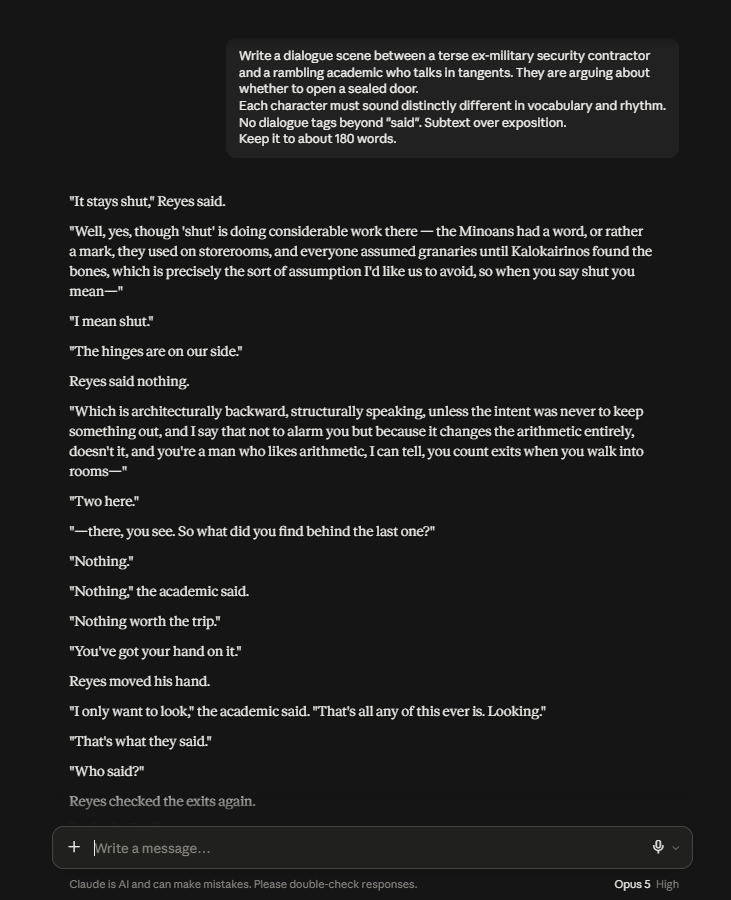
Each output was scored on prose quality, tone consistency, instruction-following and how much editing it needed before it was usable. Here’s a real passage from the Claude side of the test:
Where Claude Wins: Rhythm, Voice and Long Chapters
Claude’s clearest win was the prose itself. Its sentences varied in length the way a human writer’s do, short and punchy next to long and flowing, while ChatGPT’s ran at a steadier, more uniform rhythm that you start to notice after a page. In independent testing at the time, Opus 4.7 scored 63.2 out of 70 on prose quality, the highest of any model in that comparison.
Voice over distance. I gave both models a 5,000-word literary brief with a sardonic narrator. Claude kept that voice from the first line to the last. ChatGPT started strong and drifted toward a neutral, generic tone by the end. For novelists, this is the biggest single reason to choose Claude.
Characters who sound different. Asked for a scene between a terse ex-soldier and a rambling academic, Claude made them sound like two different people. ChatGPT made them both sound like ChatGPT.
Reading a brief. Both follow detailed briefs well, but in different ways. ChatGPT takes structural instructions more literally, which suits commercial copy with strict specs. Claude follows the spirit of a creative brief, which suits literary work where you want interpretation rather than compliance.
Where It Still Struggles
Three weak spots showed up in my testing, and the third one matters more on today’s models than it did in May.
Fantasy world-building. Keeping invented rules, names and terminology consistent across a long manuscript was Claude’s weakest area. If you write epic fantasy, neither Claude nor ChatGPT is reliable enough to draft without close oversight.
Structure creep. Opus 4.7 sometimes reached for bullet points and headers where flowing narrative was obviously wanted. Putting “write in continuous prose, no lists, no headers” in the prompt kept it in check. Anthropic’s claim that Opus 5.5 follows style instructions more closely suggests it’s easier to steer now, but I’d keep that line in your prompt anyway.
Dark scenes. A villain’s monologue, a graphic battle or a morally grey character can make Claude break character or decline, because its safety checks sometimes read fictional violence as the real thing. A clear creative frame usually clears it, as our explainer on why Claude refuses roleplay and creative writing shows. The newer Opus and Fable models also run safety classifiers that the 4.x line didn’t, and one independent test found Sonnet 5 refusing about 1% of the same set of test prompts that Opus 5 refused 11% of the time. When interruptions keep breaking up a long piece, moving that work to Sonnet is the most reliable fix, and our guide to stopping Claude refusing walks through it.
Claude vs ChatGPT for Writing, Task by Task
Claude won most rows in my May test, but not all of them. ChatGPT’s literal brief-following and speed still make it the better tool for some commercial work.
| Writing task | Better pick in my May 2026 test | Why |
|---|---|---|
| Literary fiction and short stories | Claude (Opus 4.7) | Best prose rhythm, subtext and voice |
| Long-form novel chapters | Claude (Opus 4.7) | Held one tone across 5,000+ words |
| Dialogue and character voice | Claude (Opus 4.7) | Distinct voices, less uniform |
| Editing and polishing human prose | Claude (Opus 4.7) | Lighter touch, kept the writer’s voice |
| Commercial copy with strict specs | ChatGPT (GPT-5.5) | Followed structural briefs more literally |
| Brainstorming volume | ChatGPT (GPT-5.5) | Faster, more ideas per minute |
| Fantasy and heavy world-building | Neither | Both lost track of invented rules |
If you’re weighing the two subscriptions rather than the two writers, our guide to ChatGPT Plus vs Free covers what OpenAI’s $20 plan adds now, and our Claude vs ChatGPT refusals test covers which of the two is more likely to stop you mid-scene.
Three Prompts That Got the Best Prose
Claude rewards specific prompts more than any model I tested. Vague prompts get competent but generic writing, and these three patterns produced the best results.
For prose in a specific voice: “Write in continuous literary prose (no bullet points, no headers). Voice: [paste 2-3 sentences of the target style]. Match the sentence rhythm and word choice, not just the topic. Scene: [describe].”
For dialogue: “Write a dialogue scene between [Character A: one-line description] and [Character B: one-line description]. Each character must sound distinctly different in vocabulary and rhythm. No dialogue tags beyond ‘said’. Subtext over exposition.”
For continuing a manuscript: “Here are the last 800 words of my chapter: [paste]. Continue in exactly this voice and tense for 600 words. Do not summarize or wrap up. Maintain the established tone.”
For the general rules behind these, our guide on how to write better AI prompts applies directly to creative work.

Is Claude Pro Worth $20 for Writers?
For working writers, yes. Claude Pro at $20 a month is the cheapest way to write with Opus, and one paid project covers months of it. For occasional writing, the free plan’s Sonnet is good enough, and you can upgrade the day it isn’t.
Pay for Claude Pro if:
- You write fiction, essays or literary nonfiction, where the prose itself is the product.
- You draft long work and need one voice held across thousands of words.
- You edit other people’s writing and want a model that keeps their voice instead of flattening it.
- You freelance, where one extra client covers the subscription many times over.
Stay on the free plan, or use ChatGPT, if:
- You mostly write commercial copy to strict specs, where ChatGPT’s literal brief-following is an advantage.
- You write heavy world-building fantasy, where no current AI is reliable enough to draft unsupervised.
- You write occasionally and the free plan’s limits cover you.
Claude’s limits work differently from ChatGPT’s: they reset every five hours, with a weekly cap on top, and long chapters use them up faster than short questions. Our guide to Claude’s usage limits explains how far each plan goes. And if you want to turn writing with AI into income, our guide to AI side hustles covers what freelance writers charge.
Claude Opus Creative Writing: Common Questions
Is Claude good for creative writing in 2026?
Yes. In my May 2026 test, Claude Opus beat ChatGPT clearly on prose rhythm, subtext and long-form voice, and Anthropic says the current Opus 5.5 writes more clearly and follows style instructions more closely than Opus 5. Its weak spots are fantasy world-building and occasional interruptions on dark scenes.
Which Claude model is best for writing?
On Claude Pro, Opus is the one to write with, and that’s Opus 5.5 today. The free plan gives you Sonnet and Haiku, and Sonnet is good enough for everyday writing. If safety checks keep interrupting a long piece of fiction, moving that work to Sonnet is the most reliable way through.
Is Claude better than ChatGPT for writing fiction?
For literary fiction, character voice and tone across long pieces, it was clearly better in my test. For commercial copy with strict specs, and for fast brainstorming, ChatGPT held its own or won.
Can Claude write a full novel?
It can draft strong chapters, but not a coherent novel on its own. A long manuscript needs a person keeping the plot, character arcs and continuity straight, so treat Claude as a drafting and editing partner, scene by scene or chapter by chapter.
What I’d Tell a Writer Friend
Subscribe to Claude Pro if prose is your product, learn to prompt it specifically (continuous prose, a voice sample, no structure unless you ask for it), and treat it as a drafting and editing partner rather than a replacement for your own voice. That’s the advice I gave after the May test, and nothing Anthropic has shipped since has changed it.
The one thing I’d add today: check which model you’re actually using before you judge it. A lot of disappointment with Claude’s writing comes from someone on the free plan comparing Sonnet with what they’ve read about Opus, or from a chat that quietly switched models halfway through a scene.