
Why does Claude refuse questions sometimes, or quietly hand your chat to a different model partway through? In plain terms, Claude’s newest model, Fable 5, runs each request past a set of safety filters before it replies. If your prompt touches a few specific high-risk topics, Fable 5 either declines it or passes the request to Claude Opus 4.8, a more conservative model, so you still get a useful answer instead of a flat wall. Anthropic says this affects fewer than 1 in 20 chats. The catch is that the filter is set cautiously, so now and then it stops a completely innocent question. The first time I watched Claude switch models mid-answer, I assumed something had broken. It hadn’t. Here is what is really happening, what sets it off, and how to get your answer anyway.
None of this means Claude is broken or that you did something wrong. It is a new safety layer that shipped with Fable 5, and it behaves in a way most people have never seen from a chatbot. Whether Claude is refusing your requests outright, refusing to answer a specific prompt, or quietly switching models, the cause is usually the same one. So why does Claude refuse questions it used to answer without blinking? Once you know the rules Fable 5 follows, the behavior is easy to predict and easy to work around.
What Just Changed with Claude Fable 5
Anthropic launched Claude Fable 5 on June 9, 2026 as its most capable model yet, and it shipped with something new: built-in safety classifiers that can decline a request or route it to another model. Older Claude models like Opus and Sonnet do not do this. So if Claude has started refusing or rerouting questions it used to answer, Fable 5 is almost certainly the reason.
This matters because Fable 5 is now the default in a lot of places, so you might be using it without choosing it by name. When a request trips one of its filters, Fable 5 does one of two things. It either tells you it cannot help with that specific ask, or it hands the request to Claude Opus 4.8, which answers in its place. That second behavior, the silent handoff, is the one that makes people ask why does Claude refuse questions and reroute them out of nowhere.
Why Does Claude Refuse Questions? The Plain-English Answer
Why does Claude refuse questions? Because Fable 5 checks every prompt against safety classifiers trained to catch a small set of genuinely dangerous topics, and it would rather decline or reroute than risk a harmful answer. Anthropic tuned these filters conservatively, which means they are built to err on the side of caution. The trade-off is that they sometimes flag a harmless question that happens to use risky-sounding words.
Think of it like a specialist handoff at a clinic. A general doctor (Fable 5) handles almost everything that walks in. But for a handful of sensitive cases, the clinic has a rule: pass this patient to a senior colleague (Opus 4.8) who follows stricter procedures. You still get seen. You just get seen by someone more careful. That is the cleanest way to understand why does Claude refuse questions or swap models on certain topics. It is a routing rule, not a glitch. And to get why a filter can misfire, it helps to know that AI models judge text by pattern and probability rather than real understanding, which we break down in our guide on how AI actually works.
How the Safety Fallback Actually Works
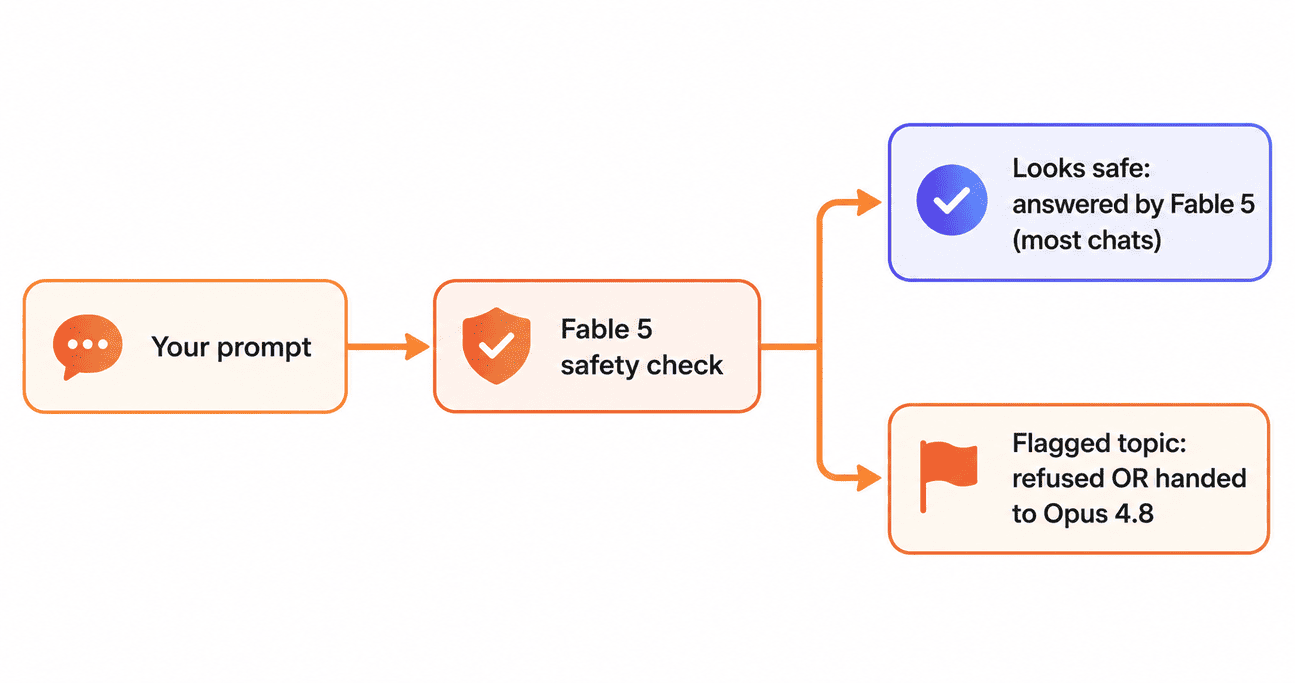
Here is the mechanic in order. Your prompt arrives, Fable 5’s classifiers scan it, and most of the time nothing happens and you get a normal Fable 5 answer. If a classifier flags the prompt, Fable 5 either returns a refusal and tells you which filter caught it, or the request falls back to Opus 4.8, which replies instead. Anthropic reports this fallback happens in fewer than 5% of sessions, so the vast majority of chats never touch it.
The flowchart above maps that path. The key detail is that a fallback is not the same as a refusal, and Anthropic made the handoff visible after early users complained they were being switched to a different answer without knowing it. Now, when Opus 4.8 answers in Fable 5’s place, you are told. That visibility is the whole reason you can even notice this behavior and start asking why does Claude refuse questions in the first place.
What Actually Triggers a Refusal or Fallback
Only three broad topic areas reliably trip Fable 5’s classifiers: cybersecurity, biology and chemistry, and model distillation. Everyday questions about writing, coding, business, study help, and general research almost never get flagged. If you are hitting refusals constantly, your prompts are probably brushing against one of these three areas, even by accident.
- Cybersecurity. Offensive hacking, exploit development, malware, and anything that reads like an attack rather than defense. A student asking how a firewall works is fine. A prompt that looks like it is building a live exploit is not. This catches security learners too: a capture-the-flag practice challenge like picoCTF can read as a real exploit, so Claude refuses to answer it until you frame it as study (“I’m solving a picoCTF challenge for practice, walk me through the concept”).
- Biology and chemistry. Bioweapon-adjacent questions and dangerous dual-use lab procedures. General biology homework is fine; synthesis routes for dangerous agents are not.
- Distillation. Attempts to extract or copy Fable 5’s own capabilities to train a rival model. This one rarely touches normal users at all.
The catch is that the filter reads patterns, not intent. So why does Claude refuse questions that are obviously harmless? Because a novelist researching a thriller, a nurse asking about a drug interaction, or a developer debugging security code can all phrase things in a way that looks risky to a classifier, even when a human would instantly see it is fine.
Why Is Claude Refusing My Requests or Refusing to Answer?
If Claude keeps refusing your requests, refusing to help on something routine, or won’t answer questions it handled fine last week, it is almost always Fable 5’s classifier reading your wording as risky, not anything you did wrong. The exact same request, reworded with clear context, usually goes straight through on the next try. One thing to rule out first: if Claude simply stops replying to your follow-ups with no refusal message at all, that is usually a different problem, most often a usage or rate limit on your plan or a very long chat hitting its context limit, rather than the safety filter declining you. A real safety refusal always tells you it is declining, or hands you a visible notice that Opus 4.8 answered in its place. The short version is that Claude can refuse questions from one person that it answers for another, and the difference is almost always the wording, not the topic.
Why Claude Refuses Roleplay and Creative Writing
For most everyday users, the place Claude refuses most often is not hacking or chemistry, it is creative writing and roleplay. A violent scene, a villain’s monologue, or a dark character persona can pattern-match to harmful content even when the work is obviously fiction, because the classifier reads patterns, not literary intent. So if Claude keeps refusing your story prompts or breaking character mid-scene, you are usually tripping the filter by accident rather than writing anything against the rules. It is the same reason Claude can refuse questions about a thriller’s plot that any reader would find perfectly harmless, and a big part of why does Claude refuse questions about fiction at all.
For violent or dark fiction, the fix is the same context-first move that clears most false flags: say up front that this is a novel, a script, or a roleplay and what the scene is for, before you paste it in. Naming the creative purpose gives the classifier the intent it needs to let legitimate writing through. There is one real exception worth knowing: sexually explicit content is a hard line in Anthropic’s usage policy, so no amount of “it’s just fiction” framing will clear it, and repeated attempts can put your account at risk. For everything else, a clear creative frame, or moving non-sensitive work to an older model like Opus or Sonnet that has no classifier, usually gets you writing again.
Claude Roleplay Refusal: Breaking Character and Blocked Story Prompts
For people who write fiction, the roleplay refusal is the single biggest answer to why does Claude refuse questions. And it is usually not a flat “I can’t help with that.” It is Claude breaking character mid-scene, softening a villain, or refusing to continue a story it was happily writing a moment ago, because one new line tripped the filter. If Claude won’t continue your story, or keeps rejecting a prompt that worked yesterday, the fix is to reset the frame: restate that this is fiction, name the genre and what the scene is for, and ask it to stay in character. For anything longer, dropping the creative work onto Opus or Sonnet, which carry no classifier, is the most reliable way to stop the interruptions for good. This is the same reason why does Claude refuse questions about a dark plot twist one day and write it the next: the wording moved, not the rules.
Refusal vs Fallback: Why They’re Not the Same Thing

A refusal and a fallback look similar but mean different things. A refusal is a hard stop: Fable 5 decides it should not answer and tells you so. A fallback is a handoff: Fable 5 steps aside and lets Opus 4.8 answer instead, so you still get a response, just from a more conservative model. Knowing which one you hit is half the answer to why does Claude refuse questions, because it tells you what to do next.
If you got a refusal, the door is closed for that exact phrasing, and your best move is to rework the request (more on that below). If you got a fallback, you actually did get an answer, it just came from Opus 4.8 rather than Fable 5. For most everyday tasks you will not notice a quality difference, since Opus 4.8 is itself a strong model. The practical upshot: a fallback is rarely worth fighting, while a refusal is usually a sign to rephrase. One thing that surprises people searching for a Claude Opus 4.8 refusal specifically: Opus 4.8 is the more cautious model in this setup, so on a genuinely sensitive prompt the fallback can still end in a refusal rather than an answer. If Opus 4.8 says no as well, the topic itself is the wall, not your wording, which is part of the answer to why does Claude refuse questions even after the handoff: a few topics are a wall for every model.
What to Do When Claude Refuses Your Question
Why does Claude refuse questions you know are harmless? Almost always it is the phrasing, so the fix is to rephrase the request until your intent is obvious. State who you are, why you are asking, and what you actually want, in plain language. Most false flags clear up the moment the prompt stops pattern-matching to something dangerous. For the full walkthrough, our guide on how to stop Claude refusing covers every fix in order.
- Add context and intent. Open with your purpose: “I’m a nurse checking a drug interaction for patient safety” or “I’m writing a thriller and need realistic but non-actionable detail.” Intent the filter can see is intent it can clear.
- Drop the risky-sounding keywords. Swap loaded words for plain ones, and ask how something works conceptually rather than for step-by-step instructions to carry it out.
- Ask for the defensive or educational angle. “How do I protect against this” clears far more often than “how do I do this.”
- Accept the Opus fallback. If you were handed to Opus 4.8 and the answer is good, you are done. There is nothing to fix.
- Switch models if you have the option. For non-sensitive work, an older model like Opus or Sonnet has no classifier and will not flag you.
Clear, specific prompts get flagged far less often, which is one more reason it pays to write good instructions in the first place. Our guide on how to write better AI prompts covers the habits that keep your requests clear to any model. And if your real worry is privacy rather than refusals, the same care applies to what you share, which we cover in things you should never tell ChatGPT.
What People Get Wrong About Claude’s Refusals
Most of what people believe about these refusals is wrong in the same four ways: that Claude is broken, that it is judging you, that a fallback means a worse answer, or that everything sets it off. None of those hold up. Clearing them up is the last piece of understanding why does Claude refuse questions, and it takes most of the worry out of it.
“Claude is broken or buggy”
It is not. The refusal and fallback behavior is a deliberate feature of Fable 5, not an error. Annoying when it misfires, yes, but it is working as designed, and the handoff to Opus 4.8 exists specifically so you are not left with nothing.
“Claude is reading and judging me”
No. The classifier scores text against patterns; it has no memory of you and no opinion about you. A flag is a statistical match, not a personal judgment. This is the same pattern-matching, not thinking, that drives every answer an AI gives.
“A fallback means you got a worse answer”
Usually not. Opus 4.8 was Anthropic’s flagship until Fable 5 arrived, so a fallback hands your question to a genuinely capable model. For the everyday tasks most people use Claude for, you would struggle to tell the difference.
“Everything triggers it”
Far from it. Anthropic puts the fallback rate under 5% of sessions, and those are concentrated in three narrow topic areas. If it feels like everything trips it, your prompts are almost certainly clipping one of those areas, and a small rephrase usually fixes it.
The Bottom Line
So, why does Claude refuse questions? Because Fable 5 now screens prompts for a few genuinely risky topics and would rather hand you to a more careful model than answer badly. It catches the occasional innocent question because it reads patterns, not intent, but a clear, specific rephrase clears most false flags in seconds. It is a safety feature having a few growing pains, not a broken product.
Once I understood the routing, the behavior stopped feeling random and started feeling predictable, which made it easy to work around. For most people the takeaway is simple: keep your prompts clear and specific, accept the occasional handoff, and you will rarely hit a wall. And if you are weighing how Claude compares to other assistants for daily use, our Claude vs ChatGPT comparison is a useful next read, or see which of the two refuses more if that is your deciding factor. ChatGPT has its own version of this behavior, which we unpack in why ChatGPT refuses questions, along with the specific things ChatGPT won’t do and how to get around each. For the big-picture view across every assistant, see our explainer on why AI chatbots refuse questions.