How does AI work? In plain terms, AI works by learning patterns from huge amounts of data instead of following step-by-step rules a human wrote by hand. You feed a model thousands, often billions, of examples. It slowly adjusts itself until it can spot the patterns that connect an input to the right answer. Then it uses those patterns to make predictions about things it has never seen before. That single loop is the engine behind ChatGPT answering a question, your bank flagging a strange charge, and Netflix guessing your next show. The part most explanations skip: AI does not “understand” anything the way you do. It is doing very fast, very sophisticated pattern-matching and probability, not thinking. Once that clicks, AI stops feeling like magic. I have spent the last couple of years using these tools daily, and this guide breaks down how AI actually works, one plain step at a time.
No maths, no code, no jargon. By the end you will have a clear answer to how does AI work, one that holds up whether you are looking at a chatbot, a self-driving car, or a spam filter.
What Does “AI” Actually Mean?
Artificial intelligence is software that performs tasks we normally associate with human intelligence: understanding language, recognising images, making decisions, and learning from experience. The key word is learning, and it is the key to how does AI work. Traditional software does exactly what a programmer told it to do, line by line. AI is different because nobody writes the rules by hand. The system works them out from examples.
Here is the cleanest way to tell the two apart. If you wanted old-school software to recognise a cat, a human would have to describe a cat in code: pointy ears, whiskers, four legs, fur. That falls apart the moment a cat is curled up or photographed from behind. AI skips the description entirely. You show it a few hundred thousand pictures labelled “cat” or “not cat,” and it figures out for itself what a cat tends to look like. For the full beginner picture of what the technology is and where it came from, our simple guide to artificial intelligence covers the foundations this post builds on.
How Does AI Work? The 5-Step Learning Cycle
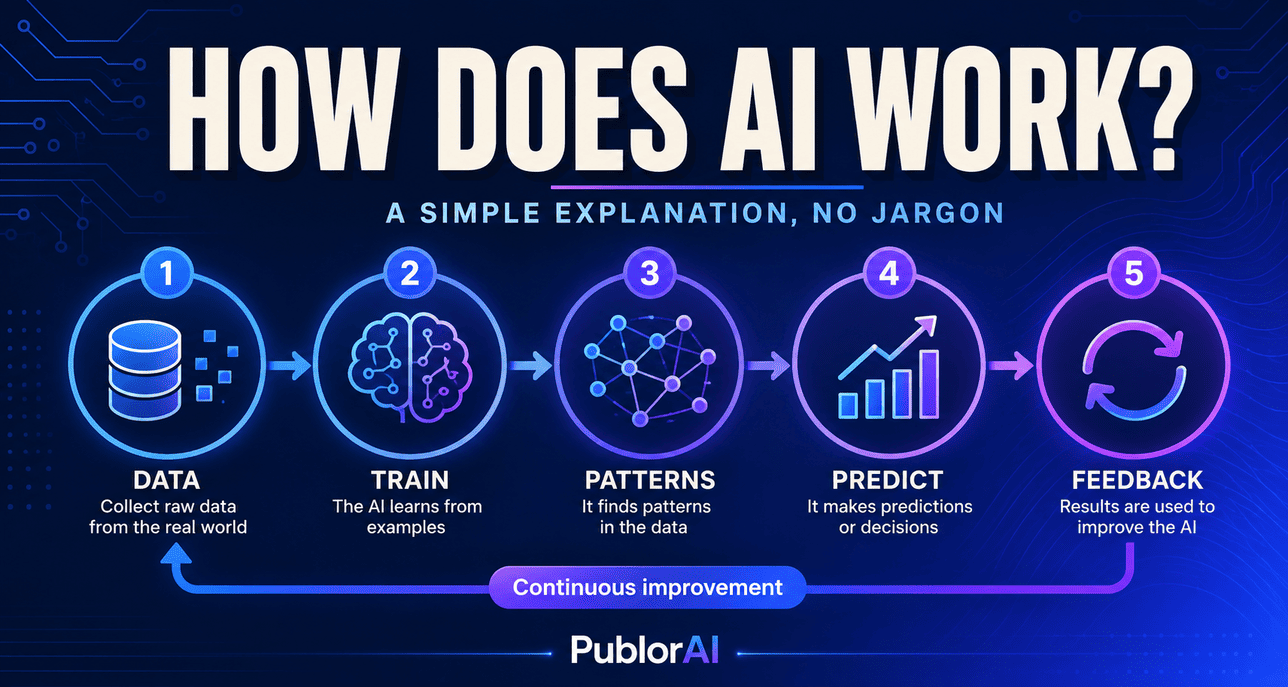
So how does AI work? At its core, it comes down to a repeating five-step cycle: collect data, train, find patterns, predict, then improve from feedback. Every modern AI system, from a chatbot to a fraud detector, runs some version of this loop. Get these five steps and you understand the engine under almost every AI tool on the market.
The easiest way to picture it is how a toddler learns. Nobody hands a two-year-old a definition of “dog.” They see dogs at the park, a parent says “dog,” they point at a cat and get gently corrected, and after enough rounds they just know. AI learns the same way, only with millions of examples instead of a few dozen, and far faster.
- Step 1, Collect data. The system is fed a large set of examples, called the training data. For a translation tool, that is millions of sentences in two languages. For a chatbot, it is a huge slice of the public internet, books, and articles. The quality and variety of this data shapes everything that follows.
- Step 2, Train the model. The model makes a guess, checks how wrong it was against the correct answer, and nudges its internal settings (called weights) a tiny bit to be less wrong next time. Repeat that billions of times. Nobody adjusts those settings by hand. The model tunes itself.
- Step 3, Find the patterns. After enough training, the model has built an internal statistical map of which inputs tend to go with which outputs. It has not memorised the examples. It has captured the patterns underneath them, which is why it can handle situations it never saw during training.
- Step 4, Make a prediction. Now you give it something new: a fresh photo, a question, a transaction. It runs that input through the patterns it learned and outputs its best guess. Every answer an AI gives is, at heart, a prediction.
- Step 5, Improve from feedback. When the model gets things wrong, corrections feed back in and sharpen it. With chatbots, real humans rate answers and that feedback trains the model to be more helpful. This is the loop that keeps tools getting better release after release.
That is genuinely the whole engine, and the honest answer to how does AI work. Feed it data, let it find patterns, ask it to predict, correct it, repeat. Everything else is detail layered on top of these five steps.
A Real Example: How AI Answers Your Question
So how does AI work the moment you ask it something? When you type a question into a chatbot, it does not look up a saved answer in a drawer. It predicts a response one word at a time, choosing whatever word is most likely to come next based on patterns from the billions of sentences it trained on. If you remember just one answer to how does AI work, make it this: every reply is built one predicted word at a time. That single idea is the most useful thing to know about tools like ChatGPT.
Here is what I mean in practice. When I ask a model to write a thank-you email, it is not pulling a template someone stored. It starts with my prompt, predicts the most likely first word, adds it, then predicts the next word given everything so far, and keeps going until the email is done. “Dear” makes “Sarah” likely, which makes “thank you” likely, and so on. String enough high-probability words together and you get fluent, sensible text that reads like a person wrote it.
This is also why AI sometimes states a wrong fact with total confidence, a quirk people call a hallucination. The model is optimising for what sounds like a plausible next word, not for what is true. Most of the time plausible and true line up. Sometimes they do not, and the model has no built-in sense of the difference. Knowing that one detail changes how you use these tools: you treat them as a fast, fluent draft engine, not an oracle. Writing better instructions helps a lot here, which is exactly what our guide on how to write better AI prompts walks through.
The Building Blocks: Machine Learning, Neural Networks, and LLMs
Most of the AI terms you hear are just layers of the same idea, and they are a big part of how does AI work under the hood. Machine learning is the broad approach of learning from data. Neural networks are the most common structure used to do that learning. And large language models are a specific, supersized kind of neural network built for text. They nest inside each other rather than competing.
You do not need a technical background to keep these straight. Here is each building block in one plain line.
| Term | What it actually means |
|---|---|
| Machine learning | The general method of teaching software by showing it examples instead of writing rules. The umbrella term for everything else here. |
| Neural network | A web of simple connected units, loosely inspired by brain cells, that data passes through. The structure that does the actual pattern-finding. |
| Deep learning | A neural network with many stacked layers. “Deep” just means lots of layers. This is what powers voice assistants and image recognition. |
| Large language model (LLM) | A very large deep-learning network trained on text to predict the next word. ChatGPT, Claude, and Gemini are all LLMs. |
If the relationship between these still feels fuzzy, that is normal, and it is the single most common point of confusion for beginners. Our breakdown of AI vs machine learning vs deep learning untangles exactly how the three fit together with diagrams and examples. The short version: all deep learning is machine learning, all machine learning is AI, but not the other way around.
Where You Already See AI Working

You almost certainly used AI several times today without noticing. It runs quietly inside apps you already trust, doing the same predict-from-patterns job described above. Spotting it in the wild is the fastest way to make how does AI work feel concrete instead of abstract.
- Email spam filters. Trained on millions of emails labelled spam or not spam, they predict whether each new message belongs in your inbox or the junk folder.
- Streaming and shopping recommendations. Netflix and Amazon learn patterns from what you and millions of others watched or bought, then predict what you will want next.
- Maps and navigation. Your phone predicts traffic and the fastest route by learning from historical and live movement data.
- Bank fraud detection. Your card provider learns your normal spending pattern and flags a transaction that breaks it, often within a second.
- Chatbots and assistants. Tools like ChatGPT, Anthropic’s Claude, and Google’s Gemini predict helpful text one word at a time.
For a fuller tour of the AI hiding in your daily routine, see our roundup of AI in everyday life examples. The newest twist is software that does not just answer but takes actions for you, like booking or researching on its own. That shift is covered in our guide to what AI agents are, and it is built on the exact same prediction engine, just pointed at tasks instead of text.
What Most People Get Wrong About How AI Works
The biggest misunderstanding about AI is treating it like a thinking mind rather than a pattern machine. Once you drop the sci-fi version, the real technology is easier to use well and far less scary. Clearing up these four mix-ups is the last step to a clear picture of how does AI work, and they are the ones I explain most often.
“AI understands what it’s saying”
It does not. An LLM has no concept of meaning, truth, or the world. It is matching patterns and predicting likely words. The output reads like understanding because it was trained on text written by people who do understand. The intelligence you sense is a reflection of its training data, not an inner mind doing the reasoning. That same pattern-matching is what safety filters use to flag risky prompts, which is why Claude refuses certain questions or hands them to another model. If a filter ever blocks something harmless, here’s how to clear those false refusals and get an answer.
“AI is objective and always right”
AI learns from human-made data, so it inherits human biases and gaps. If the training data leaned one way, the model leans that way too. It will also state wrong information confidently, because it is optimising for plausible, not for correct. Treat its answers as a strong first draft to verify, not a final source.
“AI thinks like a human brain”
Neural networks were loosely inspired by biological brains, but the resemblance is mostly a naming convention. A brain runs on living cells, electrochemistry, emotion, and lived experience. A neural network is maths running on chips. They can land on similar answers by very different roads.
“AI is conscious or alive”
Today’s AI, the only kind that actually exists, has no awareness, feelings, goals, or self. It does not want anything and is not plotting anything. It sits idle until you give it an input, runs its prediction, and stops. Every system you can use right now is this kind of narrow, task-specific AI, not the self-aware machine from the movies.
Key Takeaways
After years of using these tools daily, the mental model that finally made AI click for me is simple: it is a prediction machine that learned from examples, not a mind that thinks. Hold onto these points and you will understand how does AI work better than most people who use it every day.
- AI learns from data, not hand-written rules. That single difference is what makes it “intelligent.”
- The whole engine is a five-step loop: collect data, train, find patterns, predict, improve from feedback.
- Every answer is a prediction. That is the core of how does AI work, and it is why AI can be fluent and confidently wrong at the same time.
- Machine learning, neural networks, deep learning, and LLMs are nested layers of one idea, not rival technologies.
- Today’s AI is narrow and not conscious. It is a powerful tool, and like any tool, the value is in how well you use it.
The best way to make how does AI work stick is to go use it. Open a chatbot and watch it build an answer word by word, now that you know that is what it is doing. When you are ready for the next step, our guide on how to use ChatGPT for beginners gets you from understanding AI to actually putting it to work.