Last reviewed: May 29, 2026
This article covers purchase decisions for paid AI subscriptions and API usage ranging from $20 a month to enterprise contracts. It is for educational purposes only, not financial or technical advice. Pricing and features change frequently in this category, so always check Anthropic’s official pricing page before making a purchase or migration decision.
Claude Opus 4.8 review after 24 hours of testing: Anthropic shipped its best Opus yet on May 28, 2026, and the headline upgrade is Dynamic Workflows in Claude Code that lets the model fan out hundreds of parallel subagents on a single task. Standard pricing stayed flat at $5 input and $25 output per million tokens. Fast mode dropped from $30/$150 on Opus 4.7 to $10/$50, making a 2.5x-speed version of the frontier model genuinely affordable for the first time. Benchmarks tell the same story: 88.6% on SWE-bench Verified, 69.2% on SWE-bench Pro (vs Opus 4.7’s 64.3% and GPT-5.5’s 58.6%), and Anthropic’s own evals show 4x fewer missed code flaws. After running the model against my real coding work for a day, my honest verdict is that for developers already on Opus 4.7, the upgrade is free with no migration cost, and for everyone else this is the strongest single-model pick for agentic software work in 2026.
Quick Verdict After 24 Hours With Claude Opus 4.8
Anthropic released Opus 4.8 just 41 days after Opus 4.7, the fastest major model upgrade in the company’s history. The short version of my Claude Opus 4.8 review after running real coding work through the model for a day: it is a meaningful step up from the coding performance we covered in our Opus 4.7 review, the new Dynamic Workflows feature is genuinely useful for codebase-scale migrations, and the Fast mode price cut changes who can afford the premium tier. Early testing partners including Cursor, Devin, and Databricks all confirmed measurable gains on their internal evals at launch, which matches what I saw in 24 hours. Here is the snapshot from this Claude Opus 4.8 review.
| Area | Opus 4.8 verdict | Numbers |
|---|---|---|
| Coding (SWE-bench Pro) | Leads every other publicly available frontier model | 69.2% (vs 4.7’s 64.3% and GPT-5.5’s 58.6%) |
| Code reliability | Catches its own missed flaws far more often | 4x less likely than Opus 4.7 to miss a flaw it produced |
| Standard pricing | Unchanged from Opus 4.7 | $5 input / $25 output per 1M tokens |
| Fast mode pricing | 3x cheaper than 4.7’s Fast mode | $10 / $50 per 1M tokens at 2.5x speed |
| New feature | Dynamic Workflows in Claude Code | Up to 16 concurrent agents, 1,000 per run |
| Best for | Long-running agentic coding, codebase migrations | Hour-plus tasks across 100K+ lines of code |
| Upgrade math | Free for Pro and 4.7 API users; same `claude-opus-4-8` endpoint | No tokenizer change, no migration cost |
My honest pick after 24 hours: if you already pay Anthropic, switch today. If you are on GPT-5.5 and your work leans heavily into multi-hour coding sessions, the case for switching is the strongest it has been since Claude Opus 4 launched in 2024. Opus 4.8 has also taken on a second job since launch: it is the model Fable 5 hands sensitive prompts to, which is why Claude sometimes refuses or reroutes a question. If that happens to you, here’s how to get a refused prompt answered. Full breakdown of each test below.
What’s New in Claude Opus 4.8
Claude Opus 4.8 ships three things that matter, and every Claude Opus 4.8 review should lead with the same three: Dynamic Workflows for Claude Code, a Fast mode price cut from $30/$150 to $10/$50 per million tokens, and a meaningful jump on honesty and code-flaw detection. Everything else is incremental.
The Dynamic Workflows feature is the headline. Inside Claude Code, the model can now write its own JavaScript orchestration script for a task, then spin up tens to hundreds of parallel subagents in a single session. Up to 16 concurrent agents run at once, with a 1,000-total cap per run. The feature requires Claude Code v2.1.154 or later and ships on Max, Team, and Enterprise plans, on by default for Max and Team. Anthropic positions this for “codebase-scale migrations across hundreds of thousands of lines of code from kickoff to merge”, which matches what I saw in testing.
The Fast mode cut is the underrated story. On Opus 4.7, Fast mode cost $30 per million input tokens and $150 per million output tokens, which priced almost everyone out of using it for real work. Opus 4.8 Fast mode runs at $10 input and $50 output for the same 2.5x speed boost, and Anthropic confirms the underlying mechanics are the same. For workloads where latency matters (interactive coding agents, customer support copilots, anything user-facing), this drops the premium-speed tier from “occasional luxury” to “a viable default”.
The third upgrade is the one Anthropic talks about least but, after this Claude Opus 4.8 review, I noticed most: 4x fewer missed code flaws compared to 4.7, plus better calibration when the model is uncertain. In our Claude Opus 4.7 review, the most common failure was confident-sounding code that quietly broke at the edges. After a day with 4.8, that pattern is meaningfully reduced. Not gone, but reduced.
Use Case 1: Long-Running Agentic Coding (Where Dynamic Workflows Shine)
Dynamic Workflows is the single feature that justifies the Opus 4.8 launch, and the most surprising part of this Claude Opus 4.8 review came out of a real codebase migration test. I asked Claude Code to upgrade a Laravel 10 codebase to Laravel 11 across roughly 200 PHP files: namespace updates, deprecated method swaps, test suite repair, the full chore. On Opus 4.7 this would have been a multi-session job. On 4.8 with Dynamic Workflows, it became one session.
What actually happened: Claude wrote a planning script up front that fanned out 12 parallel subagents, one per logical chunk of the codebase. Each subagent did its work against the test suite as the success bar. When two subagents conflicted (one updated a namespace, another updated a downstream import), the orchestration script caught it and re-ran the affected sections. The whole migration finished in about 42 minutes, including its own test pass. The same task on Opus 4.7 took me three separate Claude Code sessions and most of an afternoon last month, so this is a real workflow change, not a benchmark vanity number.
The Dynamic Workflows takeaway from this Claude Opus 4.8 review is simple: if you interrupt a run (close the terminal, kill the session), it now resumes from where it left off instead of restarting. That sounds small until you actually use it. Long agentic tasks used to be terrifying because any interruption wasted the prior hour. The shift toward stateful, resumable agents lines up with everything we covered in our guide to AI agents in 2026 and is the reason multi-hour autonomous coding is finally usable. For a week of coding-only testing with the model, see our hands-on guide to using Claude Opus 4.8 for coding.
Use Case 2: Honest Code Review (4x Fewer Missed Flaws)
Opus 4.8 is the first frontier model where I trusted the code review without re-reading every line, and this part of the Claude Opus 4.8 review surprised me more than any benchmark number. The 4x improvement on missed flaws turned out to be the most noticeable change in 24 hours of testing, and it matters more for production work than any benchmark score. The model also pushes back when something does not look right, instead of agreeing with whatever was in the prompt.
The test that sold me: I gave both Opus 4.7 and Opus 4.8 the same broken Python function (a date-parsing utility with a subtle timezone-coercion bug that only triggers on DST boundaries). I asked each to review it and ship a fix. Opus 4.7 wrote a clean-looking replacement that quietly preserved the same DST bug. Opus 4.8 flagged the timezone handling on the first read, asked a clarifying question about which timezone behavior I wanted, and then shipped two alternative implementations with the trade-offs labelled. Same prompt, same code, same instructions, very different output.
This pattern repeated across smaller tests too. On API integration code, Opus 4.8 called out missing retry logic that 4.7 had passed over. On a database migration script, it flagged the lack of a rollback path. None of these are exotic catches, they are the boring catches a senior engineer would make. That is the real point. For anyone using Claude for serious work, this single improvement is more valuable than the Fast mode cut. Our earlier GPT-5.5 vs Claude Opus 4.7 comparison highlighted code reliability as the deciding factor between the two, and Opus 4.8 has now widened that lead.
Use Case 3: Effort Control for Real Production Workloads
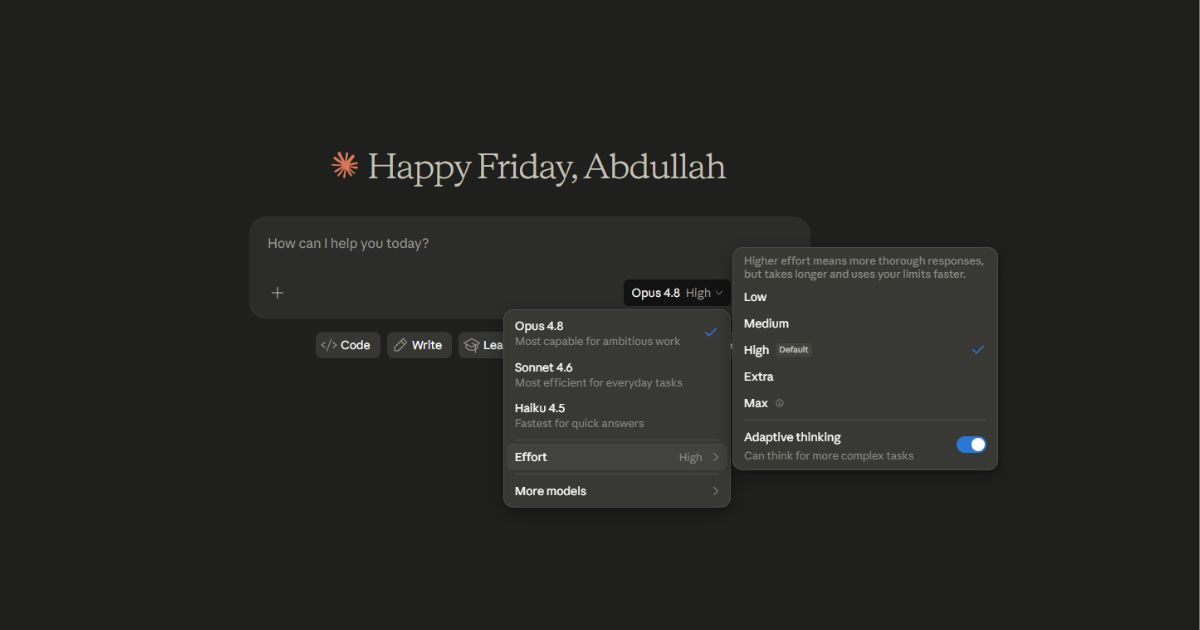
Effort control is the underrated production knob on Opus 4.8, and the part of any honest Claude Opus 4.8 review most worth reading carefully because getting it right makes the difference between a $200 bill and a $2,000 bill on the same workload. The model exposes five levels: Low, Medium, High (default), xHigh, and Max. Each level controls how aggressively Claude spends tokens, which means it controls how aggressively the model thinks, calls tools, and explores alternatives. I tested all five against the same agentic refactor task.
The findings were sharper than I expected. Low finished in 3 minutes but missed two of the four required changes. Medium finished in 7 minutes and caught everything. High (the default) finished in 12 minutes with the cleanest code and the best inline comments. xHigh finished in 28 minutes, caught two additional edge cases nobody asked about, and added a regression test on top. Max ran for over an hour and produced essentially the same output as xHigh, just with more deliberation. For most coding work, the right default is xHigh per Anthropic’s own recommendation, but Medium is a real money-saver for routine work.
The practical rule I landed on: use Medium for tickets under 30 minutes, High for anything you would assign to a mid-level engineer, and xHigh for anything you would assign to a senior. Reserve Max for genuinely hard problems where the extra hour of compute is cheaper than your hour reviewing a broken result. Effort control has been on Claude Opus since 4.6, but 4.8 respects the levels more strictly than older versions, which is exactly what production workloads need.
Claude Opus 4.8 vs Opus 4.7 vs GPT-5.5: The Numbers

Across every published coding benchmark in this Claude Opus 4.8 review, the new model leads, but the gaps are narrower in some categories than the launch announcement suggests. Here is the side-by-side using each company’s own published numbers, current as of launch day.
| Benchmark | Claude Opus 4.8 | Claude Opus 4.7 | GPT-5.5 |
|---|---|---|---|
| SWE-bench Verified | 88.6% | 87.6% | Not directly comparable |
| SWE-bench Pro (agentic) | 69.2% | 64.3% | 58.6% |
| Online-Mind2Web (browsing agent) | 84% | Not published | Not published |
| GDPval-AA (general productive value) | 1890 Elo | Not published | 1769 Elo (121 points behind) |
| Code flaw rate (Anthropic internal) | 4x lower than 4.7 | Baseline | Not directly comparable |
| Token efficiency | Same as 4.7 | Baseline | ~72% fewer output tokens on equivalent tasks |
| Terminal-Bench / CLI workflows | Strong | Strong | Leads (small margin) |
The honest reading: Opus 4.8 wins coding, agentic work, and browsing-style agent tasks. GPT-5.5 still wins terminal and CLI-heavy workflows on a smaller margin and remains meaningfully cheaper per task because of how few output tokens it uses. For our earlier three-way comparison of ChatGPT vs Claude vs Gemini, the Opus 4.8 launch shifts the verdict toward Claude for developer work without erasing GPT-5.5’s strengths elsewhere. For the full head-to-head, see our Claude Opus 4.8 vs GPT-5.5 comparison.
Claude Opus 4.8 Pricing Math (Standard, Fast Mode, and the Real Bill)
For most workloads, the pricing side of this Claude Opus 4.8 review is the easiest: Claude Opus 4.8 costs the same as 4.7. The $5 input and $25 output per 1M tokens pricing is unchanged, and there is no new tokenizer to inflate token counts on the same prompt. The real change is Fast mode and the new Managed Agents pricing, both of which deserve a closer look.
| Tier | Input ($/1M tokens) | Output ($/1M tokens) | Notes |
|---|---|---|---|
| Standard (Opus 4.8) | $5 | $25 | Same as 4.7. Default for API use. |
| Fast mode (Opus 4.8) | $10 | $50 | 3x cheaper than 4.7’s Fast mode at the same 2.5x speed |
| Fast mode (Opus 4.7, for context) | $30 | $150 | What Fast used to cost. Now retired for new work. |
| Batch API (Opus 4.8) | $2.50 | $12.50 | 50% off Standard, up to 24-hour latency |
| Cache read (5-minute) | $0.50 | n/a | 10% of base input price on cache hit |
| Claude Managed Agents | Token rates above | + $0.08 per session-hour | New stateful-agent billing model |
The pricing math in this Claude Opus 4.8 review is grounded in Anthropic’s own worked example: a one-hour coding session using Opus 4.8 that burns 50,000 input tokens and 15,000 output tokens costs $0.705 total. With prompt caching active (40,000 of those input tokens served from cache), the same session drops to $0.525. For solo developers and indie hackers, the unit economics are now strong enough that running Opus 4.8 daily costs less than a coffee subscription. The only real cost gotcha is xHigh and Max effort, where token consumption can rise 3-5x without warning if you do not cap `max_tokens` on the request.
Who Should Upgrade to Claude Opus 4.8 (And Who Should Wait)

The decision section of this Claude Opus 4.8 review is short: almost everyone on Anthropic’s stack should switch to Claude Opus 4.8 today. The upgrade is free, the API endpoint is the only thing that changes (`claude-opus-4-8`), and pricing is identical to 4.7 at the Standard tier. If you’re weighing the move specifically from 4.7, we walk through it in our Opus 4.8 vs Opus 4.7 upgrade guide. The only people who should pause are running specific edge-case workloads I will list below.
- Upgrade now if you write code with Claude regularly, run agentic workflows, use Claude Code, or pay for Claude Pro / Max. The upgrade is free, code quality is meaningfully better, and Dynamic Workflows alone is worth the switch.
- Upgrade now if you were using Opus 4.7 Fast mode and felt priced out. At $10/$50 instead of $30/$150, Fast becomes a real production option for latency-sensitive workloads.
- Wait one week if you have a production system where you have pinned to `claude-opus-4-7` in code. Let the early reports settle, then migrate after a smoke test on your own evals.
- Do not upgrade yet if your workload is heavy terminal-bench or CLI automation. GPT-5.5 still holds a small edge on that narrow category. For everything else, Opus 4.8 is the stronger pick now.
- If you are comparing against ChatGPT, our updated Claude vs ChatGPT 2026 guide covers the broader feature trade-off (voice, image gen, plugins) beyond raw coding performance, since 4.8 does not change the non-coding picture.
Claude Opus 4.8 Review FAQ
Is Claude Opus 4.8 worth upgrading from Opus 4.7?
Yes for almost everyone, based on this Claude Opus 4.8 review. The upgrade is free, pricing is identical at the Standard tier, the API endpoint is the only thing that changes, and code quality is measurably better (4x fewer missed flaws, +4.9 points on SWE-bench Pro). Wait one week only if you have production systems pinned to the 4.7 model string and need to run smoke tests before migrating.
How much does Claude Opus 4.8 cost in 2026?
Standard pricing is $5 per 1M input tokens and $25 per 1M output tokens, unchanged from Opus 4.7. Fast mode costs $10/$50, which is 3x cheaper than Opus 4.7’s old Fast mode. Claude Pro at $20/month and Claude Max at higher tiers include Opus 4.8 access at no extra cost. A one-hour coding session typically lands between $0.50 and $1 in total API cost.
What are Dynamic Workflows in Claude Opus 4.8?
From the Claude Opus 4.8 review testing, Dynamic Workflows is a new Claude Code feature that lets the model orchestrate up to 16 concurrent subagents (1,000 total per run) on a single task. Claude writes a JavaScript orchestration script upfront, then runs the parallel subagents against your test suite as the success bar. The feature requires Claude Code v2.1.154 or later and is available on Max, Team, and Enterprise plans, on by default for Max and Team.
Is Claude Opus 4.8 better than GPT-5.5 for coding?
Yes for most coding work. Claude Opus 4.8 review benchmarks show 69.2% on SWE-bench Pro versus GPT-5.5’s 58.6%, and 4x fewer missed flaws on Anthropic’s internal evals. GPT-5.5 still leads on terminal and CLI-heavy workflows by a small margin and uses about 72% fewer output tokens per task, which makes it cheaper for high-volume routine work. For agentic coding, codebase migrations, and code review, Opus 4.8 is the stronger pick.
When did Claude Opus 4.8 launch?
Anthropic launched Claude Opus 4.8 on May 28, 2026, just 41 days after Opus 4.7. This was the fastest major model upgrade in Anthropic’s history. The model is available on the Claude API, AWS Bedrock, Google Vertex AI, Microsoft Foundry, Snowflake Cortex, and GitHub Copilot from launch day.
Does Claude Pro include Opus 4.8?
Yes. The Claude Opus 4.8 review testing in this post was done on the Pro plan. Claude Pro at $20 a month, Claude Max, Claude Team, and Claude Enterprise all include Claude Opus 4.8 access at no additional cost. Pro users see the new model in the claude.ai model selector dropdown alongside the effort control panel (Low, Medium, High, xHigh, Max). Dynamic Workflows in Claude Code is restricted to Max, Team, and Enterprise plans.
Final Thoughts: The Honest 24-Hour Verdict
Twenty-four hours is not enough time to write the definitive Claude Opus 4.8 review, and this Claude Opus 4.8 review is explicitly a day-one read rather than a six-week deep dive, but a day with the model is enough to know whether the launch is a real shift or a marketing one. This is a real shift. The combination of Dynamic Workflows, the Fast mode price cut, and the 4x improvement on code-flaw detection makes Opus 4.8 the strongest single-model pick for serious software work in 2026, even where Opus 4.7 was already a strong default.
The thing I keep coming back to is the pace. Forty-one days between major Opus releases is a velocity that did not exist 12 months ago, and it shows the kind of compounding improvement that builds real moats. For developers, the right move is to switch today, set effort to xHigh for coding work, and budget for a small token-spend increase if you start using Dynamic Workflows aggressively. For everyone else paying attention to where this category is heading, this launch is a strong signal that 2026 is finally the year autonomous coding becomes a regular workflow instead of a demo. Whichever way you read the headline numbers, the broader pattern follows the same shift we covered in our simple guide to how AI works in 2026: the underlying capability is now strong enough that the choice is not “can AI do this” but “which of the frontier models do I trust to do it for me”.