Last reviewed: August 29, 2026
This article is for educational purposes only and is not financial advice. Plan prices and usage allowances are set by Anthropic and change without notice. Every figure below was checked against Anthropic’s own pages on the review date above, but confirm current pricing yourself before you subscribe or upgrade.
Claude usage limits run on two clocks at once, and that’s the part almost nobody explains. There’s a session limit that resets every five hours, and a separate weekly limit that applies across all models. Anthropic publishes no message counts for either one, on any plan, anywhere in its documentation. I went looking specifically for that number and it doesn’t exist, so every blog quoting you “225 messages on Max” is guessing. What Anthropic does publish is multipliers. Pro at $20 a month gives at least five times the session usage of the free tier, Max 5x at $100 gives five times Pro, and Max 20x at $200 gives twenty times Pro. Run the division and something odd falls out: Max 5x costs exactly the same per unit of usage as Pro does. Only Max 20x actually buys you a discount.
If you’ve ever been mid task when Claude told you to come back in a few hours, you already know why people search for this. The frustrating part is that the answers out there are confidently wrong. This guide covers what Claude usage limits actually are, what each plan costs and gives you, what drains your allowance fastest, and the honest math on whether upgrading is worth it.
Claude Usage Limits Are Two Limits, Not One
Most people picture a single bucket that empties and refills. It isn’t one bucket. It’s two, running on different schedules.
The first is the session limit. Anthropic’s help centre states that your session based usage limit resets every five hours. This is the one you hit on a heavy afternoon, and it clears on its own if you go and do something else for a while.
The second is the weekly limit, described as a weekly usage limit that applies across all models, resetting at a fixed time each week. This one is quieter and much more annoying, because it doesn’t care how patient you are. You can wait out a five hour session limit before lunch. You cannot wait out a weekly cap on a Thursday.
Anthropic is also explicit that it reserves room to move. In its own words, to manage capacity and ensure fair access to all users, it may limit your usage in other ways, such as weekly and monthly caps or model and feature usage, at its discretion. That sentence is doing a lot of work, and it’s the honest reason no fixed number exists.
One thing to separate out early: Claude usage limits are not the same thing as Claude being broken. If Claude is erroring, hanging, or refusing to load rather than telling you that you’ve reached a limit, that’s a different problem with a different fix, and our guide on what to do when Claude isn’t working walks through how to tell the two apart in about sixty seconds.
Free vs Pro vs Max: What Each Plan Actually Costs
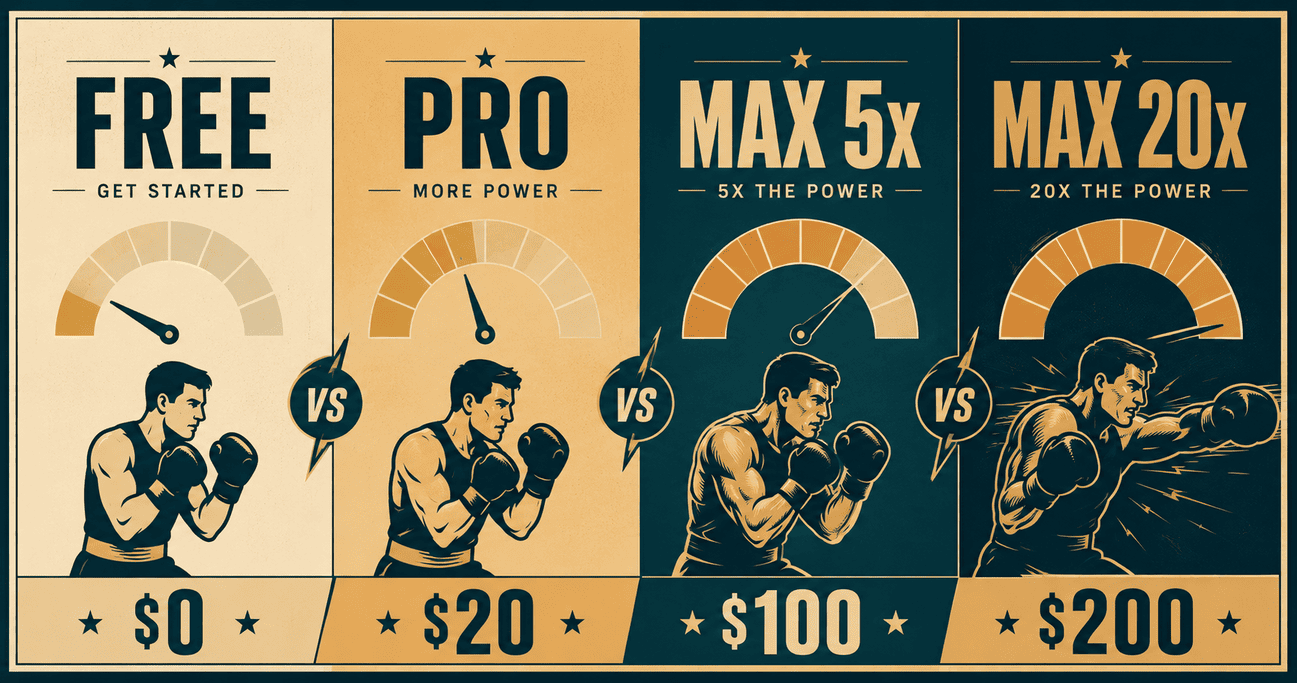
Claude costs nothing on Free, $20 a month on Pro, $100 on Max 5x and $200 on Max 20x. The paid tiers reach the same everyday models, so most of what extra money buys is headroom. The one real exception is Fable, which Free cannot use at all and which Pro reaches only through usage credits. Beyond that, Claude usage limits are what separates the plans.
Here’s every consumer tier in full, with figures taken straight from Anthropic’s pricing page and its Max plan help article on the review date.
| Plan | Price | Session usage (per 5 hours) | Weekly cap | Usage credits |
|---|---|---|---|---|
| Free | $0 | Baseline | Yes | No |
| Pro | $20/month, or $17/month billed annually at $200 up front | At least 5x the free tier | Yes, across all models | Yes |
| Max 5x | $100/month | 5x Pro | Yes, across all models | Yes |
| Max 20x | $200/month | 20x Pro | Yes, across all models | Yes |
The model line up is not identical across tiers, which is the detail most comparisons get wrong. Free runs Sonnet and Haiku. Pro and both Max tiers add Opus. Fable is the real divider: Anthropic states that it is not available on Free at all, that on Pro it sits outside your plan’s usage limits and has to be paid for with usage credits, and that on Max it is included, up to 50% of your weekly limits at no extra cost. So on the everyday models you are paying for headroom, and on Fable you are paying for access. Our Claude usage calculator keeps the current per-plan figures.
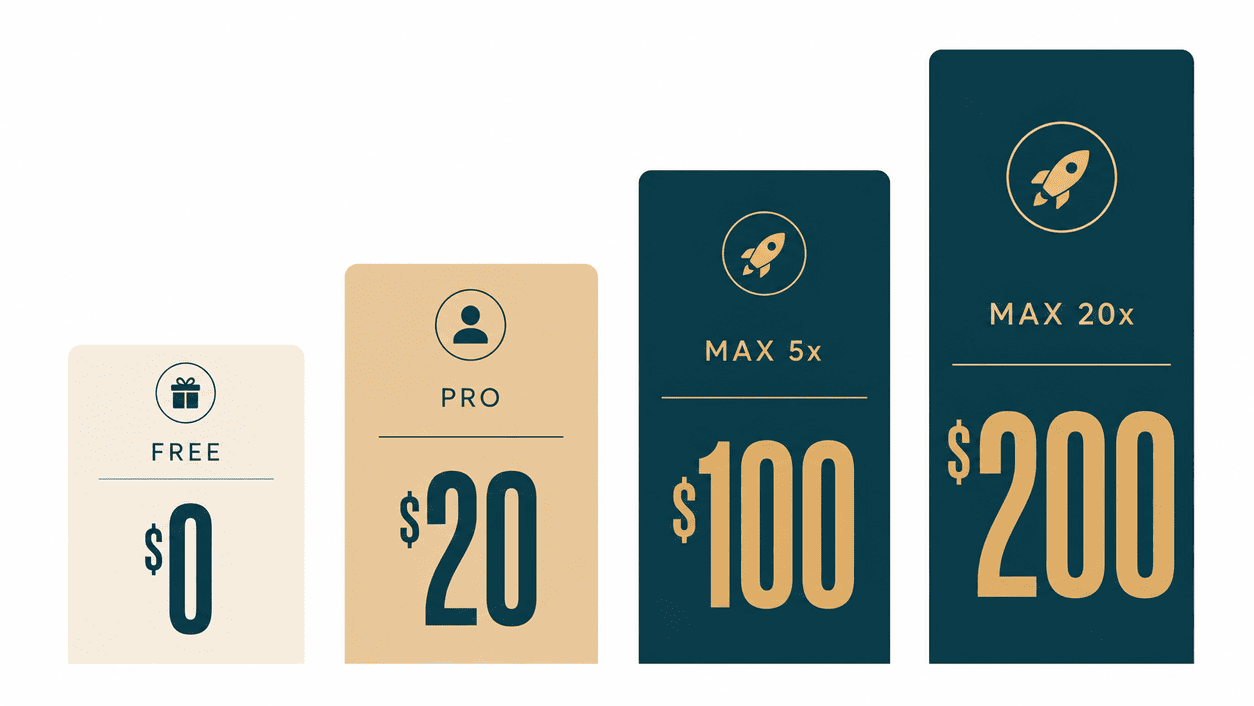
Now the calculation nobody seems to run. Take each plan’s price, divide by the session usage it buys relative to Pro, and you get a cost per unit:
| Plan | Price | Session usage vs Pro | Cost per unit of Pro usage |
|---|---|---|---|
| Pro | $20 | 1x | $20 |
| Max 5x | $100 | 5x | $20 |
| Max 20x | $200 | 20x | $10 |
Max 5x and Pro cost the identical amount per unit of session usage. You’re not buying a better rate at $100, you’re buying the same rate in a bigger container. What the extra $80 actually gets you is fewer interruptions, which is a real benefit if your work keeps stalling, but it isn’t a discount and it shouldn’t be read as one.
Max 20x is the only tier where the multiplier outruns the price. At $10 per unit it’s genuinely half the rate of everything below it. That’s an unusual shape for a pricing ladder, and it tells you a lot about who each tier is really built for.
One caveat I want to be straight about: this math describes session capacity only, because the session multiplier is the only number Anthropic publishes. The weekly half of Claude usage limits sits on top of all of it, and isn’t expressed as a multiple of anything.
Why Nobody Can Tell You How Many Messages You Get
Because Anthropic doesn’t publish message counts, for any plan, anywhere. There is no official Claude message limit to quote, so every precise figure you’ve seen was invented somewhere downstream of the company.
Search Claude usage limits and you’ll find those numbers everywhere anyway. Two hundred and twenty five messages on Max 5x. Nine hundred on Max 20x. Forty five on Pro. They’re all over the first page of results.
I went through Anthropic’s help centre article by article looking for the source of those figures. There isn’t one. The company’s own page on how usage and length limits work deliberately declines to give message counts, session durations, or per plan totals. It says only that your usage is affected by the length and complexity of your conversations, the features you use, which model you’re chatting with, and the effort level you’ve selected.
So where do the numbers come from? They’re extrapolations, mostly from old community reports, repeated until they sound official. A blog quotes a Reddit thread, a second blog quotes the first blog, and by the fourth repetition it reads like documentation.
This matters more than it sounds. If you upgrade to Max expecting nine hundred messages and your work involves long documents, you won’t get anything close to that, and you’ll feel cheated by a number Anthropic never promised. Claude usage limits aren’t just unpublished as message counts. They’re genuinely unpublishable that way, because the same subscription delivers wildly different totals depending on what you do with it.
What Actually Burns Through Your Limit
Conversation length is the biggest drain, followed by large attachments and heavy features like Research and web search. Since there’s no fixed count to budget against, this is the list that actually matters. Anthropic names six factors that make Claude usage limits drain faster:
- Message length. Longer prompts cost more than short ones.
- File attachment size. A forty page PDF is not a free addition to a question.
- Current conversation length. This is the big one, and I’ll come back to it.
- Tool usage. Research and web search both consume more.
- Model choice. Heavier models cost more per exchange.
- Effort level. Higher effort settings draw down faster.
Conversation length deserves its own paragraph because of how it compounds. Your current conversation length counts toward consumption, which means every new message in a long thread carries the weight of everything above it. Message fifty in one continuous chat costs far more than message fifty spread across ten fresh chats. People burn a whole session inside one sprawling thread and conclude the limit is broken, when what actually happened is they paid for the same history forty nine times over.
The genuinely useful tip is buried in Anthropic’s own best practices page, and I almost missed it. Projects cache what you upload. Documents added to a Project are stored for future use, so when you reference that content again, only the new or uncached portions count against your limits. Attaching the same reference document to eight separate chats bills you eight times. Putting it in a Project bills you roughly once. That single habit change does more for your Claude usage limits than most of the advice written on this topic.
Model choice is the other lever, and it overlaps with something we’ve covered before. Newer models don’t just cost more of your allowance, they also behave differently, which is the thread we pulled on in our guide to getting Claude to stop refusing your requests. If you’re switching models to stretch your allowance, it’s worth knowing what else changes.
The Weekly Cap Is the One That Catches People
The weekly cap is the half of Claude usage limits that actually hurts, and it’s the least documented. Session limits are survivable: you get told to wait, you make coffee, you come back. The weekly one doesn’t work like that.
What we know officially is narrow. It exists on Pro and both Max tiers, it applies across all models, and it resets at a fixed time each week rather than rolling. That last detail is the practical one. Because the reset is fixed rather than rolling, a heavy Monday and Tuesday can leave you rationing until the reset lands, no matter how quiet the rest of your week turns out to be.
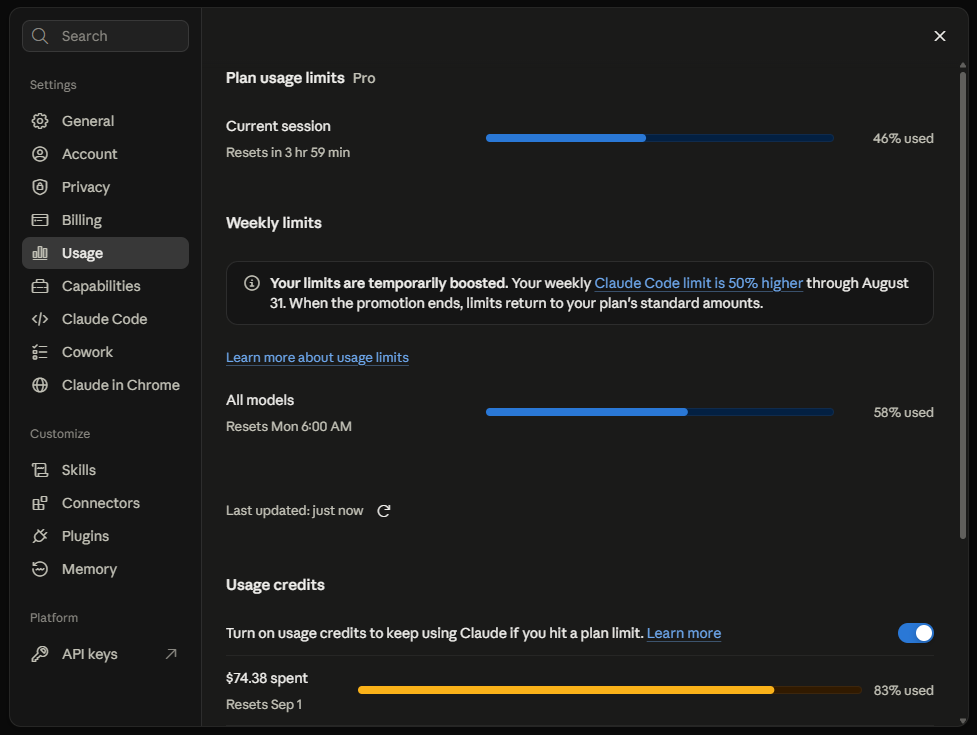
The one reliable way to know where you stand is your own account. Settings, then Usage, shows your current consumption and your next reset time. Anthropic points users there rather than to any published table, which is itself a strong hint that no published table exists.
There’s a diagnostic point worth holding onto here. A limit message is a specific, worded notification telling you that you’ve reached a limit and when it resets. You’ll find Anthropic’s exact wording for each one in our decoder of Claude error messages. If Claude is instead declining one particular request while working normally on everything else, that’s a refusal, not a limit, and the cause is completely different. We broke that distinction down in our explainer on why Claude refuses questions.
Usage Credits Quietly Changed the Upgrade Math
Usage credits let you keep working past your included limit, billed at standard API rates, so hitting a ceiling no longer means stopping for the day. That turns the upgrade question from “pay more or stop” into “pay more, or pay only for what you overflow.” It’s the most recent shift in how Claude usage limits work, and it reshapes the whole decision.
Usage credits let Pro, Max 5x and Max 20x subscribers keep working after they hit their included limits, with the overflow billed at standard API rates. Your session limits still reset every five hours as normal, the credits just stop the wall from being a wall. There’s a daily redemption ceiling of $2,000, which tells you these are aimed at people with real workloads rather than casual overflow.
Here’s why it matters. The upgrade question used to be “pay more or stop working.” It isn’t anymore. It’s now “pay $80 more every month, or pay API rates on just the overflow.” For most people the second option is cheaper, because most people don’t overflow every month. They overflow in bursts, during one heavy project week, and then go quiet.
So the honest test is no longer “have I ever hit my limit.” Almost everyone has. It’s “do I hit it predictably, most weeks.” If your overflow is occasional, credits on Pro will cost you less than $100 a month. If you’re hitting the wall by Wednesday every single week, you’re not overflowing anymore, you’re under-provisioned, and the subscription becomes the cheaper instrument.
It’s the same shape of decision we worked through for ChatGPT Plus versus the free tier, where the answer also came down to frequency rather than to whether a ceiling exists at all.
Who Should Pick Which Plan
Most people belong on Free or Pro, and almost nobody should buy Max 5x. That’s the short version, and the per-unit math above is the reason. Here’s how I’d sort it.
Stay on Free if you use Claude a few times a week for short questions. You’ll meet the ceiling occasionally and it’ll clear in a few hours. No paid tier changes which models you can reach, so there’s no feature you’re locked out of, only headroom you don’t yet need. Claude usage limits only become a real cost once they interrupt paid work.
Take Pro at $20 if you use Claude most days, or if you’ve started hitting the free ceiling during ordinary work rather than during an unusual push. At least five times the session usage for $20 is the steepest jump in value on the whole ladder. If you’re confident you’ll still be using it in a year, the annual rate drops it to $17 a month, though that’s $200 up front, which is the same as one single month of Max 20x. That comparison alone tells you how the tiers are positioned.
Take Max 5x at $100 only if interruptions are genuinely costing you more than $80 a month in lost momentum, and you’ve already tried Projects, shorter threads and lighter models. Remember it’s the same $20 per unit that Pro charges. You’re buying convenience, not efficiency, and that’s a perfectly legitimate purchase as long as you know that’s what it is.
Take Max 20x at $200 if Claude usage limits are biting most weeks and Claude is load bearing in your actual work. This is the only tier where the rate genuinely improves, at $10 per unit. If you’re leaving Pro for volume reasons rather than convenience reasons, skipping straight past 5x to 20x is the mathematically sounder move.
Turn on usage credits instead of upgrading if your overflow is spiky. A couple of heavy weeks a quarter almost never justifies $960 a year in extra subscription.
Questions People Ask About Claude Usage Limits
How many messages do you get on Claude Pro?
There’s no published answer, and any specific number you see quoted was invented downstream of Anthropic. Pro gives at least five times the free tier’s session usage, but the real message count depends on your prompt lengths, attachments, conversation length, model and effort level. Two people on the same plan can legitimately see very different totals.
When do Claude usage limits reset?
Session limits reset every five hours. The weekly limit resets at a fixed time each week, not on a rolling basis. Your exact next reset time is shown under Settings, then Usage.
Does Claude Max remove the limit completely?
No. Max raises the session ceiling by 5x or 20x over Pro, but Claude usage limits still apply on both Max tiers, including a weekly cap across all models, and Anthropic reserves the right to add further caps at its discretion. There’s no unlimited consumer tier at any price.
Is Claude Pro worth $20 a month?
If you’re hitting the free ceiling during normal work rather than during an unusual push, yes. It’s the largest proportional jump on the ladder, and it unlocks usage credits, which turn the next ceiling into a cost rather than a full stop.
Why did I hit my limit so much faster today?
Usually one of three things: you were deep in one very long conversation, you attached large files, or you had research and web search running. Conversation length is the most common culprit, because every message re-bills the history above it.
What I’d Actually Do
If I were deciding today, I’d refuse to buy anything for a week and fix my habits first. Move reference documents into a Project so they’re cached rather than re-sent. Start a fresh chat when the topic changes instead of scrolling one endless thread. Drop to a lighter model for routine work. Those three changes are free, and for a lot of people they move the ceiling further than $80 a month would.
If the limits still bite after that, turn on usage credits before upgrading. Give it a month and look at what the overflow actually cost. That number is the only honest input to the upgrade decision, and it’s specific to how you work rather than to what a pricing page implies.
And if the credits bill comes back consistently high, go to Max 20x rather than Max 5x. The per unit math is unambiguous. Max 5x charges Pro’s rate for a bigger container, and Max 20x is the only tier that actually reduces what you pay per unit of work.
The broader point is that Claude usage limits aren’t really a restriction to beat. They’re a pricing mechanism, and the people who get the most out of a subscription are the ones who understand what’s being metered, not the ones who pay the most. If you’re weighing Claude against ChatGPT entirely, our Claude vs ChatGPT refusals comparison covers which of the two says no more often. And if the limits turn out not to be your real problem, our pillar guide on why AI chatbots refuse covers the behaviour that most often gets mistaken for one.