Last reviewed: May 8, 2026.
Note: This review is for informational purposes only. Pricing and features may change. Always check xAI’s official site before purchasing.
This Grok 4.3 review comes from two weeks I spent testing what was then xAI’s newest model, after it hit general availability on April 30, 2026. Grok 4.3 is fast. It’s opinionated. It scores 53 on the Artificial Analysis Intelligence Index, well above the 36 median and a clear jump from Grok 4. The honest verdict: Grok 4.3 is a real upgrade if you already use Grok, and a legitimate alternative to ChatGPT and Claude for specific tasks. It wins on real-time data from X, video file analysis up to 5 minutes, a 1 million token context window, and aggressive API pricing at $1.25 input per million tokens. It loses on general writing quality and mainstream ecosystem support. SuperGrok at $30 per month gets you full access. SuperGrok Heavy at $300 is for power users only. For most people, the free X Premium tier is enough to test it first.
The Quick Verdict After Two Weeks of Testing
What this Grok 4.3 review confirms after two weeks of daily use: Grok 4.3 is the strongest version of Grok xAI has shipped so far. It’s not the absolute best AI model on every benchmark, but it’s the first Grok release that’s a genuine alternative to ChatGPT or Claude for specific work, not just a curiosity for X power users.
The biggest changes I noticed: a 1 million token context window that actually holds together across long documents, video file analysis built into the chat, native PDF and PowerPoint generation, and dramatically lower API costs. According to Artificial Analysis benchmarks, pricing dropped 37.5% on input tokens and 58.3% on output tokens versus Grok 4.20.
If you’re already on SuperGrok or X Premium+, the upgrade is automatic and worth using. If you’re a ChatGPT or Claude subscriber wondering whether to switch, the answer is more nuanced. For research with current information and long-context work, Grok 4.3 holds its own. For creative writing and complex coding, Claude and ChatGPT are still the safer bets. Our Claude vs ChatGPT 2026 comparison covers that side of the choice.
What Grok 4.3 Actually Is
Grok 4.3 is xAI’s newest flagship AI model, launched in beta on April 17, 2026 (locked to SuperGrok Heavy subscribers initially) and rolled out to the API on April 30, 2026. SuperGrok and X Premium+ users gained chat access in stages after that.
What sets Grok apart from ChatGPT and Claude has always been its tight integration with X (formerly Twitter). Grok pulls real-time data from X posts, trends, and conversations, which makes it genuinely useful for journalists, researchers, marketers, and anyone tracking breaking news or public sentiment. Grok 4.3 keeps that advantage and adds the multimodal and document features that previous Grok versions were missing.
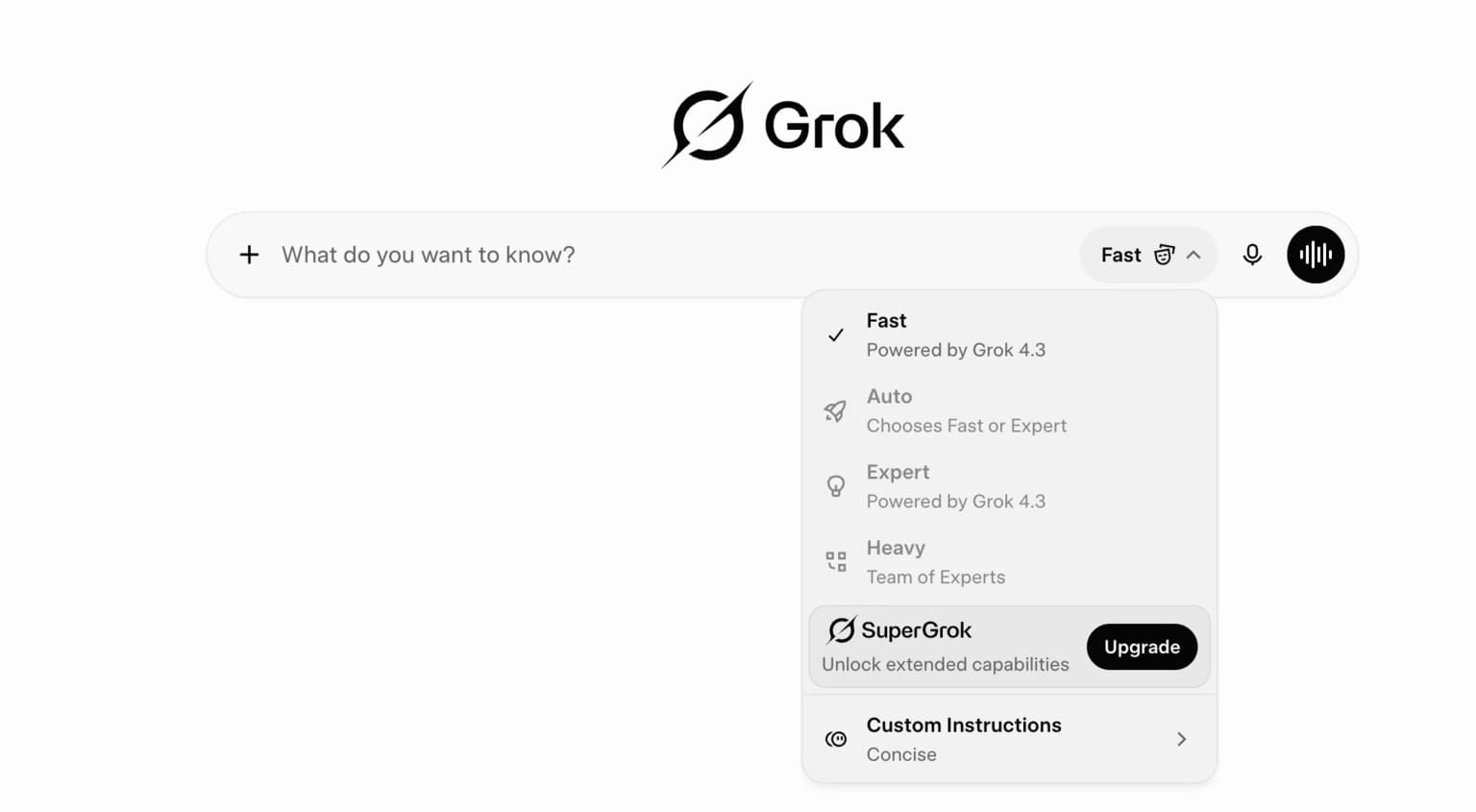
The model now accepts video files up to 5 minutes long at 1080p, generates downloadable PDFs and spreadsheets directly from a conversation, and runs on an Auto / Fast / Expert mode selector that controls how hard it thinks about a given prompt.
Three Things That Make Grok 4.3 Genuinely Different
1. The 1 Million Token Context Window That Actually Works
Grok 4.3 standardizes 1 million tokens of context across the API with no output cap, which is roughly 2,000 pages of text in a single prompt. I tested this by feeding it the equivalent of a full quarterly earnings deck plus three years of public filings for one company, and asking for a competitive summary. It handled it cleanly with consistent recall across the entire document.
That said, the 1M number isn’t magic. Grok 4.20 still offers a 2 million token tier for the rare workflow that needs even more, and Claude’s 200K window often beats both Grok versions on accuracy and coherence within smaller documents. The 1M context on Grok 4.3 is real and useful, not a silver bullet.
2. Multimodal Inputs and Outputs Built Into the Chat
For the first time, Grok handles full multimodal inputs in a way that feels equal to ChatGPT and Claude. You can upload video clips up to 5 minutes long and get summaries, transcript extracts, or scene-by-scene analysis. You can ask it to generate a PowerPoint deck from a document, and it builds a populated, downloadable file you can open in PowerPoint or Google Slides.
The PDF and spreadsheet generation is the real productivity unlock for me. Asking Grok 4.3 to “turn this analysis into a one-page PDF report” and getting back a formatted file in seconds is the kind of small thing that compounds across a workday.
3. Real-Time X Data Plus DeepSearch
This is still the biggest single reason to pick Grok over ChatGPT or Claude. Grok 4.3 reads live X data and runs DeepSearch across the broader web, which means it answers questions about what’s happening right now better than any other major chatbot. For breaking news, current product launches, market sentiment, or anything tied to the last 24 hours of public conversation, Grok 4.3 has a structural advantage that doesn’t show up on benchmark scores.
Grok 4.3 Pricing Breakdown
Grok pricing has gotten complicated. There are five tiers across xAI’s official plan page, and which one is right for you depends on whether you mostly want chat access, full feature access, or API integration.
| Plan | Cost | Grok 4.3 Access | Best For |
|---|---|---|---|
| Free (X account) | $0 | Limited basic access | Casual testing |
| X Premium | $8/month | Standard Grok access | Light X users who want chat |
| SuperGrok | $30/month | Full Grok 4.3 with DeepSearch and Think | Researchers and journalists |
| X Premium+ | $40/month | Full Grok plus all X features (no ads, etc.) | X power users who also want Grok |
| SuperGrok Heavy | $300/month | Frontier model access, priority routing | Enterprise and heavy API users |
API pricing is where Grok 4.3 really stands out. Input tokens cost $1.25 per million and output tokens cost $2.50 per million. That’s roughly half the cost of GPT-5.5 and a fraction of Claude Opus 4.7’s API pricing. For developers building AI features into apps, Grok 4.3 is one of the cheapest serious options on the market. For a deeper look at what changed in GPT-5.5 vs GPT-5.4, our breakdown covers why OpenAI raised API prices alongside the version bump.
Grok 4.3 vs ChatGPT vs Claude: Where Each One Wins
| Task | Best Choice | Why |
|---|---|---|
| Real-time information / breaking news | Grok 4.3 | Live X data plus DeepSearch beats anything else |
| Long document analysis | Grok 4.3 or Claude | 1M context for Grok, better coherence for Claude |
| Coding (production-grade) | Claude Opus 4.7 | Highest SWE-bench scores, best code quality |
| Creative and long-form writing | ChatGPT or Claude | Better prose quality and tone control |
| Image generation | ChatGPT (GPT-5.5) | Native image gen still ahead of Grok’s Imagine |
| API cost for high-volume apps | Grok 4.3 | $1.25/M input is the lowest of the major models |
| Video and document workflows | Grok 4.3 | 5-minute video input, native PDF and Slides export |
What the table makes clear is that Grok 4.3 has carved out a real niche. It’s not the best at everything, but it’s the best at a few things that matter. For coding-heavy work, our Claude Opus 4.7 review covers why Anthropic still leads that space. And if you’re weighing Grok against Google’s option for research and long-context work, our Gemini vs ChatGPT comparison shows where Google’s multimodal lead becomes the deciding factor.

Where Grok 4.3 Falls Short
No honest Grok 4.3 review skips the weak spots, and there are several worth knowing before you pay $30. The biggest weakness is creative writing quality. Grok 4.3 outputs are competent but blunt. The model has a snarky, opinionated default voice that some readers love and others find tiring. For long-form blog content, marketing copy, or emails that need to land softly, ChatGPT and Claude consistently produce better drafts. I tested the same prompts across all three, and Grok’s output read more like a fast take than a polished draft.
Coding is the second weak spot. Grok 4.3 handles straightforward coding questions and small refactors well, but it falls behind Claude Opus 4.7 on complex multi-file projects and large-scale debugging. If your main use case is software development, Claude is the better $20.
The third issue is ecosystem and integrations. ChatGPT has Custom GPTs, plugins, voice mode, and a massive third-party ecosystem. Claude has solid IDE integrations and Anthropic’s growing API tooling. Grok is improving but still lighter on external integrations, especially for users who don’t already live on X.
One smaller note: Grok’s “uncensored” reputation is overstated for the 4.3 release. The model still refuses obviously harmful requests, but it does engage more freely with edgy or controversial topics than ChatGPT. Whether that’s a feature or a bug depends entirely on your use case.
Who Should Actually Pay for SuperGrok?
Pay $30/month for SuperGrok if:
- You spend serious time on X and want Grok integrated into your workflow
- You’re a journalist, researcher, or analyst tracking real-time information
- You regularly work with video files or need PDF and Slides generation
- You want a third AI alongside ChatGPT or Claude for specific use cases
Skip SuperGrok and stay free if:
- You’re a light user who can get by with the free X Premium Grok access
- Your main use is creative writing, coding, or image generation (the wrong tool for those)
- You already pay for ChatGPT Plus or Claude Pro and don’t need a third AI
If you’re brand new to paid AI tools and trying to decide where to spend $20 to $30 per month for the first time, our guide to the best free AI tools in 2026 is the better starting point before committing to any subscription.
Frequently Asked Questions
Is Grok 4.3 better than ChatGPT?
For real-time information, breaking news, and X data analysis, yes. For creative writing, coding, and the broader plugin and voice ecosystem, ChatGPT is still the stronger pick. Most users who already pay for ChatGPT Plus won’t gain enough from switching, but Grok 4.3 is a worthy second AI for specific tasks.
Is SuperGrok worth $30 a month?
For active X users, journalists, and researchers, yes. The 1M context window, video file support, DeepSearch, and real-time X data are genuinely useful for those workflows. For casual chat use or creative writing, $30 is harder to justify when ChatGPT Plus and Claude Pro both run $20 with stronger creative output.
Can I use Grok 4.3 for free?
Yes, with limits. Free X accounts get basic Grok access, and X Premium ($8/month) unlocks more standard Grok usage. Full Grok 4.3 with DeepSearch, Think mode, and the highest usage limits requires SuperGrok ($30/month), X Premium+ ($40/month), or SuperGrok Heavy ($300/month).
What’s the difference between Grok 4 and Grok 4.3?
Grok 4.3 has a 1M token context window (versus 260K on Grok 4), scores 53 on the Artificial Analysis Intelligence Index (versus 42 for Grok 4), supports video file inputs up to 5 minutes, generates PDFs and PowerPoint decks natively, and costs significantly less per API token. It’s a meaningful upgrade across the board.
What is Grok 4.3 best at?
Real-time information from X, breaking news analysis, long-document context work (up to 1M tokens), video file summarization, native document generation (PDF, spreadsheets, slides), and high-volume API workloads where price per token matters. It’s not the best at creative writing or production coding.
Is Grok 4.3 safe to use?
Yes for general use. xAI has refusal logic for clearly harmful requests, and Grok 4.3 is similar to ChatGPT and Claude on that front. The model does engage more freely with edgy topics than its competitors, which some users see as a feature. Always verify Grok’s outputs on factual or sensitive topics, just like you would with any AI model.
Grok 4.3 Review 2026: My Final Verdict
After two weeks of daily testing, I rate Grok 4.3 at 7.5 out of 10 overall, with a higher 9 out of 10 for X power users, journalists, and high-volume API developers. It’s the first Grok version that earns a real recommendation rather than a “yeah, give it a try” caveat.
The 1M context window, the multimodal inputs, the document generation, and the aggressive API pricing add up to a model that’s genuinely competitive with ChatGPT and Claude on the things it’s good at. It’s not the best general-purpose AI, but it’s the strongest specialist in its category.
If you’re a SuperGrok subscriber today, the upgrade to 4.3 is automatic and worth it. If you’re choosing your first paid AI subscription, ChatGPT Plus or Claude Pro at $20 is still the safer default for most people. If you’re already paying for one of those and want a third AI for real-time work and high-volume API tasks, Grok 4.3 is the strongest argument xAI has made yet.
For more on how the major AI tools stack up, see our Perplexity AI review for the research-focused alternative, or our GPT-5.5 vs Claude Opus 4.7 comparison if you’re deciding between the two heavyweights.