Last reviewed: May 6, 2026
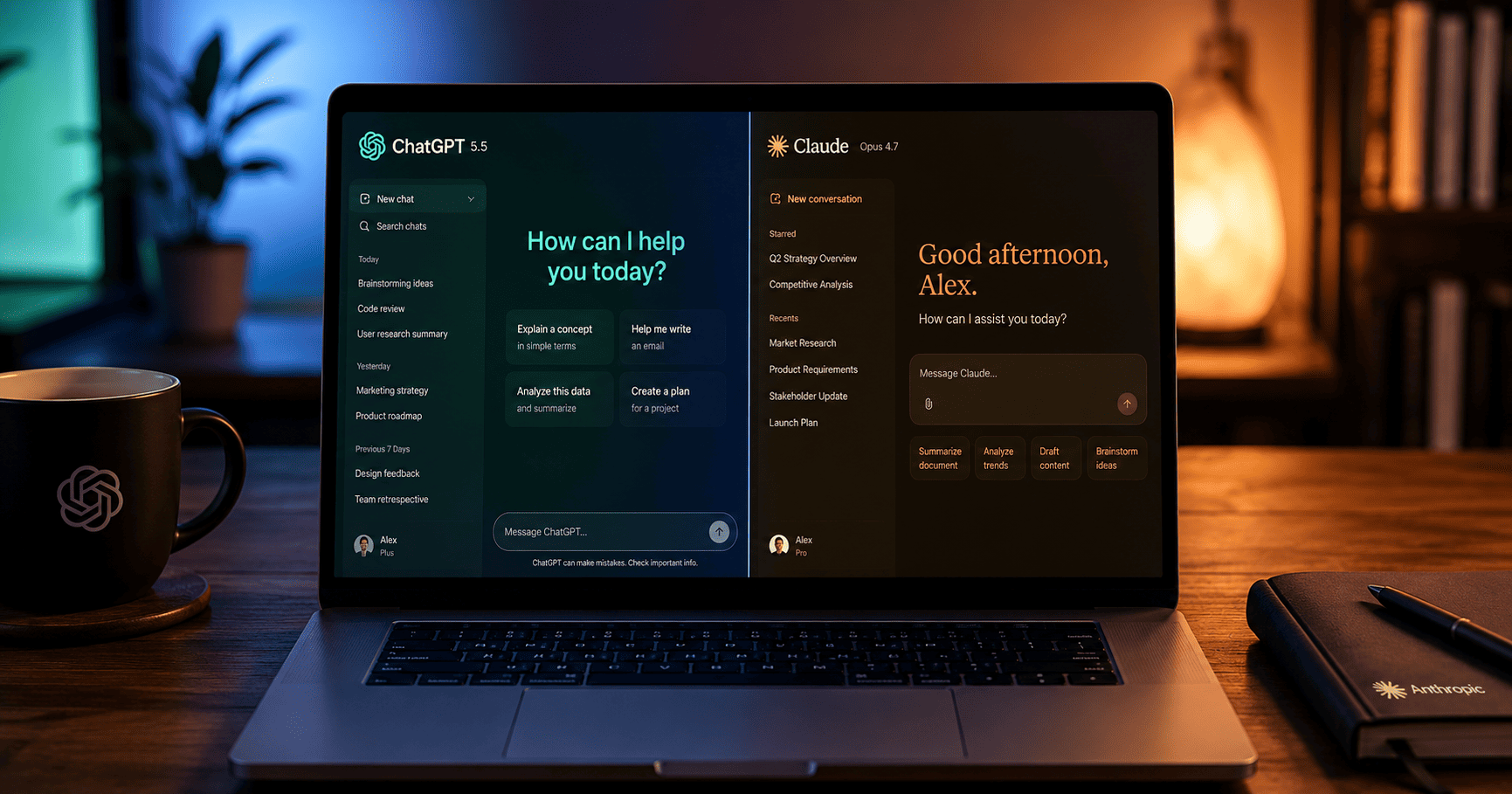
GPT-5.5 vs Claude Opus 4.7 is the most contested AI matchup of 2026. Both flagship models launched within a week of each other in April, both cost $20/month for the consumer plan, and both score within five points of each other on most benchmarks. After two weeks of running both side by side on the same prompts, my honest verdict: Claude Opus 4.7 wins for coding (64.3% vs 58.6% on SWE-bench Pro) and long-form writing where nuance matters. GPT-5.5 wins for terminal work, computer use, voice mode, and the broadest plugin ecosystem. For developers and writers, Claude is the smarter $20. For everything else (image generation, voice mode, real-time web search), ChatGPT Plus still leads. If you can afford $40/month and use AI heavily, run both. They each cover blind spots the other has.
The Honest Question You Should Ask First
Most people get the AI subscription decision wrong because they ask the wrong question. They ask “which AI is better?” There is no answer to that question in 2026. Both are excellent. Both will handle 95% of everyday tasks identically.
The right question is: “What do I actually use AI for, 80% of the time?” Answer that honestly and the choice between GPT-5.5 and Claude Opus 4.7 becomes obvious in about 30 seconds.
I’ll show you exactly how to figure that out. But first, let’s get the basics out of the way so you know what we’re comparing.
GPT-5.5 In One Paragraph
GPT-5.5 is OpenAI’s flagship model, released April 23, 2026. It’s the agentic generation of ChatGPT, built specifically to handle long, multi-step tasks where it has to plan, use tools, and keep working without constant guidance. It scores 82.7% on Terminal-Bench 2.0, has native voice mode, generates images via DALL-E, browses the live web, and plugs into thousands of Custom GPTs and integrations. ChatGPT Plus costs $20/month and gives you access to GPT-5.5 plus all the multimodal features. If you want a deeper look at what’s new in this version, I covered it in detail in our GPT-5.5 vs GPT-5.4 breakdown.
Claude Opus 4.7 In One Paragraph
Claude Opus 4.7 is Anthropic’s flagship model, released April 16, 2026, one week before GPT-5.5. It’s the most capable Claude model available, with a redesigned reasoning engine, sharper vision (3x the resolution of Opus 4.6), and benchmark-leading coding performance. It scores 87.6% on SWE-bench Verified and 64.3% on SWE-bench Pro, both higher than any other publicly available model. Claude Pro costs $20/month and includes Claude Code (a CLI coding agent) and Claude Design (an AI design tool) at no extra charge. The full breakdown is in our Claude Opus 4.7 review, and Anthropic has since shipped Opus 4.8 with even stronger SWE-bench Pro scores (69.2%), and we put it head to head with OpenAI’s flagship in our updated Opus 4.8 vs GPT-5.5 comparison.
The 5 Things That Actually Matter
Forget feature lists. When you’re choosing between two $20/month AI subscriptions, only five things really matter. Here’s how each model performs on them, based on two weeks of side-by-side testing.
1. Coding Performance
This is where the gap is biggest, and it’s clearly tilted toward Claude. When I ran 25 real coding tasks on both models (mix of Python, JavaScript, and SQL queries), Claude produced working first-try code on 22 of them. GPT-5.5 hit 18. The kinds of tasks where Claude pulled ahead: anything involving multi-file refactors, debugging existing codebases, and writing test suites. GPT-5.5 was actually faster on quick one-line fixes, but slower to ship full features that worked end-to-end.
The benchmark numbers back this up:
| Coding Benchmark | Claude Opus 4.7 | GPT-5.5 | Winner |
|---|---|---|---|
| SWE-bench Verified | 87.6% | ~80% | Claude |
| SWE-bench Pro | 64.3% | 58.6% | Claude |
| Terminal-Bench 2.0 | 69.4% | 82.7% | GPT-5.5 |
| OSWorld (computer use) | ~72% | 78.7% | GPT-5.5 |
Translation: Claude wins on the kind of coding work most developers actually do. GPT-5.5 wins when you need an AI to drive a terminal or operate desktop software autonomously.
2. Writing Quality
Both models write well. The difference is texture. I asked both to draft the same 600-word product email, then a long-form blog intro, then a tricky polite refusal email. Claude’s drafts felt more lived-in. GPT-5.5’s felt cleaner but more generic. Three out of three times, I picked Claude’s draft as the starting point and edited from there.
For creative writing where you want polish and image generation in the same chat, GPT-5.5 wins. For technical writing, business documents, and anything that needs to sound like a real human, Claude wins.
3. Pricing (And the Honest Math)
Both Pro tiers are $20/month. But what you actually get for that $20 differs significantly:
| What You Get | Claude Pro ($20/mo) | ChatGPT Plus ($20/mo) |
|---|---|---|
| Flagship model access | Claude Opus 4.7 | GPT-5.5 |
| Coding agent (CLI) | Claude Code (included) | Sold separately |
| AI design tool | Claude Design (included) | No equivalent |
| Image generation | No | Yes (DALL-E) |
| Voice mode | No | Yes (Advanced) |
| Real-time web search | Limited | Full |
| Custom GPTs / Plugins | No | Yes (huge library) |
| API output (per 1M tokens) | $25 | $30 |
For developers, Claude Pro wins on raw value. Claude Code alone is worth more than $20 if you’d otherwise pay for separate coding tools. If you prefer an AI editor with parallel agents over a terminal-based tool, our Cursor 3 review covers the leading IDE-based alternative. For everyone else, ChatGPT Plus packs in more features (image generation, voice, plugins, web search). Different jobs, different value.
4. Multimodal Features
This is where ChatGPT pulls cleanly ahead. GPT-5.5 has native image generation (DALL-E + GPT Image 2), advanced voice mode for hands-free conversations, real-time web browsing, and the largest plugin library of any AI. Claude Opus 4.7 has none of these. It does have stronger vision (3.75 megapixel image analysis vs ChatGPT’s lower cap), so if you’re analysing screenshots or design files, Claude actually wins on image input. But for image OUTPUT, voice, and live web search, ChatGPT is the clear pick.
5. Speed and Reliability
Both models are fast. GPT-5.5 starts streaming responses about 20-30% faster on short prompts. Claude is meaningfully faster on long agentic tasks because it uses fewer LLM calls per task (7.1 average vs 16.3 on the older Opus). What surprised me most: Claude Opus 4.7’s reliability. In two weeks of testing, GPT-5.5 timed out or gave a half-finished response 3 times. Claude did it once. Small sample, but consistent with what other developers are reporting.
GPT-5.5 vs Claude Opus 4.7: My Scoring on Each
Here’s how I’d score each model across the five categories above. This isn’t a benchmark, it’s an honest opinion after using both heavily for two weeks.
| Category | Claude Opus 4.7 | GPT-5.5 |
|---|---|---|
| Coding | 9 | 7 |
| Writing | 9 | 7 |
| Pricing Value (for developers) | 9 | 7 |
| Pricing Value (for general use) | 7 | 9 |
| Multimodal (image, voice, web) | 5 | 9 |
| Speed and Reliability | 9 | 8 |
| Overall | 48/60 | 47/60 |
It’s basically a tie overall. Which is exactly the point. Pick based on what you actually do, not the total score.
Who Should Pick Which
Here’s the practical breakdown of GPT-5.5 vs Claude Opus 4.7 based on what you actually do with AI day-to-day. Be honest with yourself, then match your top use cases to the strengths below.
Pick Claude Opus 4.7 if you:
- Write code regularly and want the best coding model available
- Do long-form writing, technical writing, or business documents
- Work with long documents, contracts, or large codebases
- Want a coding agent (Claude Code) bundled into your $20
- Care about reliability over feature breadth
- Don’t need image generation or voice mode
Pick GPT-5.5 if you:
- Need image generation alongside text in the same chat
- Want voice mode for hands-free conversations
- Need real-time web search for news and current events
- Use Custom GPTs or want access to thousands of plugins
- Do creative writing, marketing copy, or social content
- Want one tool that does a bit of everything
Pick Both ($40/month) if you:
- Use AI as a serious work tool
- Want Claude for coding and writing, ChatGPT for everything else
- Are a developer who also creates content
If $40/month is too much, the smartest hack: use ChatGPT free (still gets you GPT-5.5 with limits) plus Claude Pro for $20. You get most of both for half the price. Or look at our roundup of free AI tools you should try in 2026 for budget alternatives. And to see where Gemini fits alongside both, our full ChatGPT vs Claude vs Gemini pillar covers the 3-way pricing math.
Where These Two Fit in the Bigger AI Picture
GPT-5.5 and Claude Opus 4.7 are not the only flagship AI models worth considering in 2026. Google’s Gemini 3.1 Pro wins on multimodal work and Google Workspace integration. DeepSeek V4 nearly matches both at a fraction of the API cost. xAI’s Grok 4.3 has carved out the real-time and X-data niche with a 1M token context window. And tools that wrap these models into autonomous AI agents are reshaping what “using AI” even means.
Frequently Asked Questions
Is Claude Opus 4.7 better than GPT-5.5?
For coding, writing, and reliability, yes. Claude scores 64.3% on SWE-bench Pro versus GPT-5.5’s 58.6%, and developers consistently rate Claude higher for shipping production code. For multimodal features, voice, image generation, and the broadest ecosystem, GPT-5.5 wins. They’re built for slightly different strengths.
Should I get ChatGPT Plus or Claude Pro?
If you write code or do technical writing most of the time, Claude Pro is the better $20. If you want image generation, voice mode, real-time web search, or plugins, ChatGPT Plus is the better fit. For most professionals using AI seriously, running both at $40/month total is worth it.
Which AI is better for coding in 2026?
Claude Opus 4.7, by a meaningful margin. It scores higher on every major coding benchmark (SWE-bench Verified, SWE-bench Pro), produces fewer hallucinated API calls, and ships with Claude Code (a free CLI coding agent) included in the $20/month plan. About 70% of developers now prefer Claude for coding work in 2026.
Which AI is better for writing?
Claude wins for long-form, technical, business, and nuanced writing. GPT-5.5 wins for creative writing, marketing copy, social content, and anything where image generation in the same chat is useful. For pure prose quality, Claude generally produces less robotic output.
Can I use GPT-5.5 and Claude Opus 4.7 for free?
Both have free tiers. ChatGPT free includes GPT-5.5 access with daily message limits. Claude.ai free includes Opus 4.7 with a small daily message cap (then auto-switches to Sonnet). The free tiers are enough to test both before committing to paid. For wider free options, see our best free AI tools roundup.
Why does GPT-5.5 cost the same as Claude Opus 4.7 if Claude wins on coding?
Consumer pricing is identical at $20/month because both companies are competing for the same subscriber base. The differences show up in API pricing for developers (Claude is cheaper per output token at $25/M vs GPT-5.5’s $30/M) and in what’s bundled with each plan (Claude includes Claude Code; ChatGPT includes DALL-E and voice).
Final Thoughts
The honest verdict from this GPT-5.5 vs Claude Opus 4.7 comparison: there’s no universal winner, and the score is essentially tied. Claude wins for coding, writing, and developer value. GPT-5.5 wins for multimodal features, ecosystem breadth, and general-purpose use. The right choice depends almost entirely on what you actually do with AI.
Be honest with yourself about your top three use cases. Match those to the strengths of each model. If you’re a developer or serious writer, Claude is the smarter $20. If you want one tool that handles everything from chat to images to voice, ChatGPT Plus is the better pick. If AI is core to your work, run both at $40/month. The differences between them are real enough that having access to both meaningfully improves what you can do.
Want to see how these two stack up against the wider AI landscape? Our Claude vs ChatGPT 2026 comparison covers the broader Anthropic vs OpenAI battle, and our GPT-5 vs GPT-4 comparison shows how OpenAI’s models have evolved over time.