Last reviewed: May 9, 2026.
Note: This comparison is for informational purposes only. Pricing and features change frequently in this category. Always check the official sites for Lovable, Bolt.new, and v0 by Vercel before purchasing.
This Lovable vs Bolt vs v0 comparison comes from two weeks I spent building the same three apps across all three AI app builders. Lovable is the easiest for non-coders. Bolt.new gives developers the most flexibility. v0 produces the cleanest React UIs of any AI builder available right now. The honest verdict: there’s no universal winner, and each tool wins for a specific use case. Lovable wins for non-technical founders building MVPs fast. Bolt.new wins for developers who want full-stack control and the most generous free tier. v0 wins for frontend developers in the Vercel ecosystem who care about UI quality above everything else. Pricing is similar across the three: free tiers on all platforms, paid plans starting at $20 to $25 per month. The hidden cost most reviews skip is security. AI app builders ship code with a 40 to 45% vulnerability rate, so plan for a security review before going live.
What These Three AI App Builders Actually Do
Before the comparison, a quick definition. AI app builders take a plain English prompt (“build me a landing page with email signup”) and generate working code, deployable apps, or both. The quality of the output depends heavily on the prompt. See our guide on how to write better AI prompts for the rules that apply to app builders too. They’re different from AI coding assistants like Cursor 3, Copilot, and Claude Code because they target the full app, not the code editor.
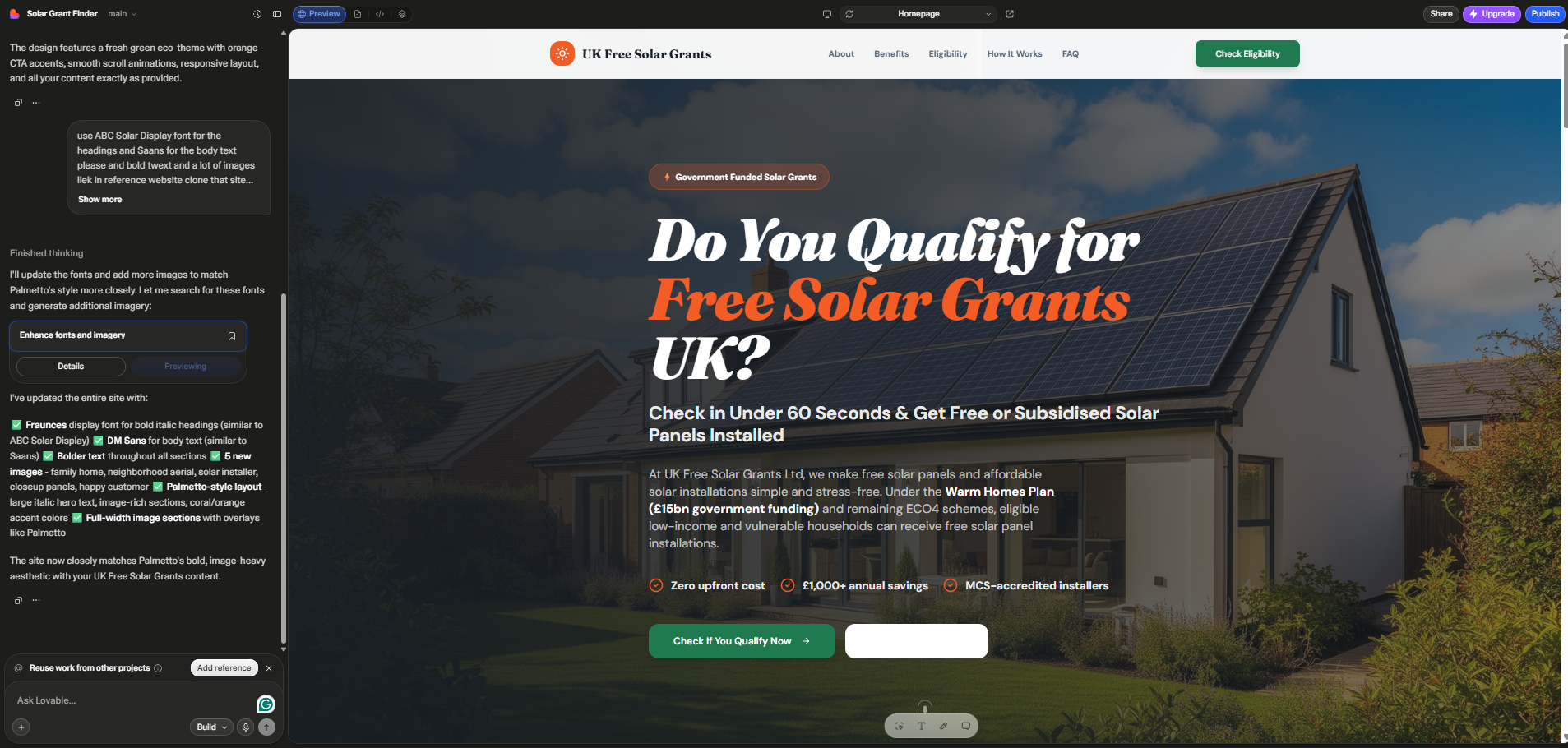
Lovable is a chat-first app builder that produces full-stack React + TypeScript + Tailwind apps with Supabase as the default backend. It hit $20 million ARR in two months, the fastest growth of any AI app builder so far. Best fit: non-technical founders, designers, and indie makers shipping MVPs.
Bolt.new is a browser-based AI development environment built by StackBlitz. It runs an in-browser dev runtime (WebContainers), supports more frameworks than the other two combined, and added Bolt Cloud for hosting, auth, and databases in 2026. It crossed $40 million ARR in five months. Best fit: developers who want flexibility and a real coding environment.
v0 by Vercel generates production-quality React components and full-stack Next.js apps from prompts. It’s deeply integrated with Vercel’s hosting and Shadcn UI, and produces the most visually polished output of the three. Best fit: frontend-focused developers and design-driven teams already in the Vercel ecosystem.
I Tested All Three on Three Real Builds
What separates this Lovable vs Bolt vs v0 review from a feature-list summary is that I actually built. Three projects, all three tools, same starting prompts. Here’s what happened.
Build 1: A SaaS Landing Page with Email Signup
Simple test. Same prompt across all three: “Build a SaaS landing page for a project management tool, with hero section, three features, pricing table, and email signup form.”
v0 finished first. The output looked like something a $5,000 design studio would ship. Clean Shadcn components, proper typography hierarchy, working dark mode toggle, accessible form elements. About 90 seconds.
Lovable took about 4 minutes. Output was good but generic, the kind of landing page you’ve seen a thousand times. Email signup wired into Supabase out of the box, which v0 doesn’t do natively.
Bolt took the longest at about 6 minutes and asked clarifying questions along the way. Output was clean and editable, with a full project structure I could keep building on locally.
Winner for this build: v0 on visual quality, but Lovable wins if you want a working signup that actually saves emails without extra setup.
Build 2: A Frontend Dashboard with Charts
Tougher test. “Build an analytics dashboard for a fitness tracker app: 4 stat cards, a line chart for weekly progress, a bar chart for workouts per category, dark theme.”
v0 nailed this. Used Recharts, proper data structures, responsive layout, looked professional. The kind of output you could ship to a client. About 2 minutes.
Lovable got the layout right but the chart styling felt amateur. I burned 8 credits asking for visual tweaks before getting something I’d ship. The credit consumption is real and adds up fast.
Bolt generated a fully working dashboard with realistic mock data and explained the data flow as it went. Felt the most “developer-friendly” of the three. About 4 minutes.
Winner: v0 again, with Bolt as a close second for technical clarity.
Build 3: A Full-Stack Todo App with Auth
The real test. “Build a todo app with email/password authentication, where each user sees only their own todos, with categories, due dates, and a search filter.”
Lovable shipped this in about 8 minutes with Supabase auth, row-level security, and a working UI. I clicked deploy and it was live. This is exactly what Lovable was built for.
Bolt took about 15 minutes with multiple back-and-forth iterations. The end result worked but I had to manually configure Supabase credentials and tweak a few things. More control, more setup.
v0 struggled here. Frontend was beautiful, but the backend integration was incomplete. I needed to wire up most of the auth myself. v0 is genuinely better suited for components than full-stack apps right now, despite Vercel adding sandbox runtime in 2026.
Winner: Lovable by a wide margin. This is its sweet spot.
Lovable vs Bolt vs v0 Pricing Math
| Plan | Lovable | Bolt.new | v0 by Vercel |
|---|---|---|---|
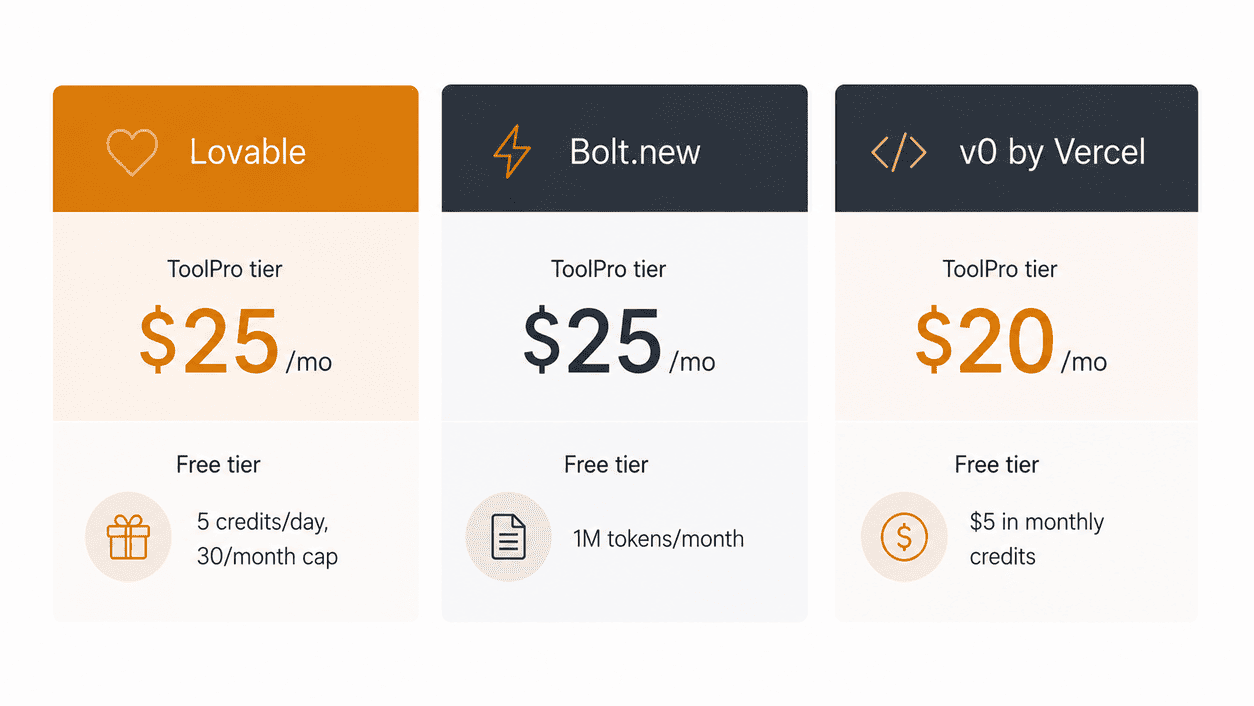
| Free tier | 5 credits/day, capped at 30/month | 1M tokens/month | $5 in monthly credits |
| Pro / Premium | $25/month | $25/month | $20/month |
| Team | $50/month (Business) | $30/user/month | $30/user/month |
| Business / Enterprise | Custom | Custom | $100/user/month + Enterprise |
| Pricing model | Credit-based (unpredictable) | Token-based (somewhat predictable) | Token-based (variable per generation) |
The Bolt.new free tier is the most generous of the three. 1 million tokens per month is enough to ship several real prototypes before you’re forced to upgrade. Lovable’s 30 credits per month runs out fast on anything beyond a basic landing page. v0’s $5 monthly credit is closer to a sample than a real free tier.
For paid plans at $20 to $25 per month, the cost is similar across all three. The real cost variance shows up when AI gets stuck in fix-one-break-another loops. Lovable users frequently report burning 60 to 150 credits on a single layout issue, which on Pro can mean an extra $10 to $25 in unplanned spend per month.
Where Each One Wins (Quick Reference)
| Use Case | Best Pick | Why |
|---|---|---|
| Non-technical founder building an MVP | Lovable | Chat interface, full-stack output, Supabase built in |
| High-quality React UI for an existing project | v0 | Best-looking output, native Shadcn UI support |
| Developer wanting full-stack control | Bolt.new | Most framework support, real dev environment, generous free tier |
| Mobile app development | Bolt.new | Only one of the three with React Native and Expo support |
| Frontend dashboard or marketing site | v0 | Cleanest visual output, fastest generation |
| Full-stack app with auth and database | Lovable | Tightest Supabase integration, easiest deployment |
| Lowest entry cost to start | Bolt.new | 1M free tokens per month is the most generous tier |
The Hidden Cost: Security Vulnerabilities
This is the part most AI app builder reviews skip and it shouldn’t be. Independent testing in 2026 found that all three tools ship code with a 40 to 45% vulnerability rate. That covers everything from missing input validation to exposed API keys to SQL injection risk.
The pattern I noticed: the AI is great at making things work and bad at making things safe. Default Supabase configurations from Lovable often skip row-level security on certain tables. Bolt’s generated APIs sometimes lack rate limiting. v0’s beautiful frontend forms often don’t sanitize input before sending it to the backend.
None of this is a deal-breaker. It’s a planning issue. Budget 20 to 30% of your build time for a security review before any AI-generated app goes near real users. If you’re not technical enough to do that yourself, hire a developer for a 2-hour audit before launch. Cheaper than a data breach.
Who Should Pick Which One?
Pick Lovable if:
- You’re a non-technical founder shipping an MVP to validate an idea
- You need authentication, database, and deployment without thinking about it
- You want the chat-first interface that doesn’t expect you to read code
- You can afford the credit-based pricing and accept the unpredictability
Pick Bolt.new if:
- You’re a developer who wants AI-assisted full-stack work in a real dev environment
- You want the most generous free tier to evaluate before paying
- You need framework flexibility (Next.js, Astro, Remix, mobile via Expo)
- You want to keep the option of taking the code local and shipping it yourself
Pick v0 if:
- Your main goal is high-quality React UI components or polished frontend pages
- You’re already in the Vercel ecosystem and want native deployment
- You care more about visual quality than backend completeness
- You’re building dashboards, landing pages, or design system components
Honest tip: many serious teams use a combination. v0 for individual components → Lovable for the overall app structure → a dedicated AI coding tool like Claude Code for production cleanup. Each tool plays to its strength. Our Claude Opus 4.7 review covers the model that powers a lot of this final-stage cleanup work.
Frequently Asked Questions
Which is the best AI app builder in 2026?
There’s no single best AI app builder. Lovable wins for non-technical founders shipping MVPs. Bolt.new wins for developers who want full-stack flexibility and the most generous free tier. v0 wins for frontend developers focused on UI quality. Pick based on your skill level and what you’re building, not on which one is “best” overall.
Is Lovable better than Bolt and v0?
For non-technical users building full-stack MVPs, yes. Lovable’s Supabase integration and chat-first interface make it the easiest to ship a real working app without coding. For developers, Bolt.new often wins because it offers more control. For frontend work, v0 produces better-looking output. The “better” answer depends on who you are and what you’re building.
What’s the difference between Lovable, Bolt, and v0?
Lovable is chat-first and ships full-stack apps with Supabase. Bolt.new is a browser-based dev environment with the broadest framework support and a real coding interface. v0 generates the highest-quality React UI components and frontend pages, deeply integrated with Vercel and Shadcn UI. All three turn prompts into working code, but they target different users and use cases.
Is v0 free?
Yes, with limits. The v0 free plan includes $5 in monthly credits, access to the v0-1.5-md model, GitHub sync, and Vercel deployment. It’s enough to test the platform but not build a real app at scale. The Premium plan at $20 per month is required for any serious workflow.
How much does Lovable cost?
Lovable has a free tier with 30 credits per month. Pro is $25 per month and Business is $50 per month. The credit-based pricing means actual costs vary based on how often the AI gets stuck in fix-and-rebuild loops. Many users report monthly bills running $10 to $25 above the base plan due to credit overage.
Can I move my code from Lovable to Bolt or v0?
Yes for Lovable and Bolt. Both ship the full codebase to a GitHub repo you own, so you can take it anywhere. v0 generates copy-pasteable code by default, but you can also export full projects. None of these tools lock you into a proprietary format, which is a meaningful advantage over earlier no-code platforms.
Lovable vs Bolt vs v0: My Final Verdict
After two weeks of testing all three on real builds, my final scoring breaks down like this: Lovable 8/10 for non-technical founders, Bolt.new 8/10 for developers, and v0 9/10 for frontend work. None of them is universally best. All three are genuinely good at the specific job they’re built for.
If I had to pick one to recommend to most readers, it would be Lovable. The reason: most people reading an AI app builder comparison aren’t experienced developers. They’re founders, marketers, designers, and operators who want to ship something working. Lovable is the most accessible of the three for that audience, and the full-stack output means you actually finish a project, not just a frontend.
If you already write code daily, Bolt.new is the better pick. The browser-based dev environment, the framework flexibility, and the generous free tier add up to a tool that respects how developers actually work.
If your role is design-heavy or you live inside the Vercel ecosystem, v0 is hard to beat for visual quality. It’s the tool I’d reach for if I needed a beautiful landing page or a polished dashboard fast. If design is your main job, our guide to the top AI design tools covers dedicated options worth pairing with it.
Whatever you pick, do not skip the security review. A 40 to 45% vulnerability rate across all three is too high to ignore. Build the app, then have someone audit it before any real user touches it.
For more on the broader AI tools landscape, see our guide to the best free AI tools in 2026, or our beginner’s guide to AI agents if you’re newer to building AI workflows.