Why does ChatGPT refuse to answer some prompts, or flatly tell you it can’t help with that on a question that seems completely harmless? In plain terms, ChatGPT declines a request for one of two reasons: answering would cross one of OpenAI’s safety rules, or the model simply isn’t able to do what you asked. Those are two very different things wearing the same “I can’t help with that” message. Most real refusals land in a short list of genuinely sensitive areas, and a smaller share are false alarms, where ordinary wording happens to pattern-match something risky. The first time ChatGPT refused a cooking question for me, I assumed I had broken a rule. I hadn’t. It had misread a single word. Once you can tell a policy “won’t” from a capability “can’t,” and spot when your own phrasing is the problem, the blocks stop feeling random.
None of this means ChatGPT is broken or that OpenAI is quietly trying to censor you. It’s a safety layer doing its job, sitting next to a set of plain capability limits that people constantly mistake for refusals. So why does ChatGPT refuse questions it answered yesterday, or that a friend gets answered without a hitch? Usually it comes down to wording, context, or a recent change on OpenAI’s side. This guide walks through the six real reasons it happens and the fastest way to get a straight answer out of it. If you’re still new to the tool, our beginner’s guide to using ChatGPT covers the basics this post builds on.
What “I Can’t Help With That” Actually Means
When ChatGPT says it can’t help with that, it’s telling you one of two things: either answering would break OpenAI’s usage rules, or the task sits outside what the model is able to do. It is not a personal judgment about you, and it’s almost never a bug. The wording is deliberately vague because a single generic line covers every kind of decline, which is exactly why the message feels so frustrating. It also makes why does ChatGPT refuse so hard to self-diagnose, because the message never tells you which kind of no you actually hit.
That vagueness is the root of most confusion around why does ChatGPT refuse anything in the first place. The same eight words show up whether you asked for something genuinely against the rules, phrased a harmless request in a way that tripped a filter, or asked for something the model physically cannot do, like opening a live web page in a mode that has no browsing. OpenAI spells out the rules side of this in its usage policies, and the deeper “how the model should behave” logic lives in its Model Spec. Knowing which of the two reasons you hit is the whole game, so that’s where we start.
The Two Kinds of “No”: “Won’t” vs “Can’t”
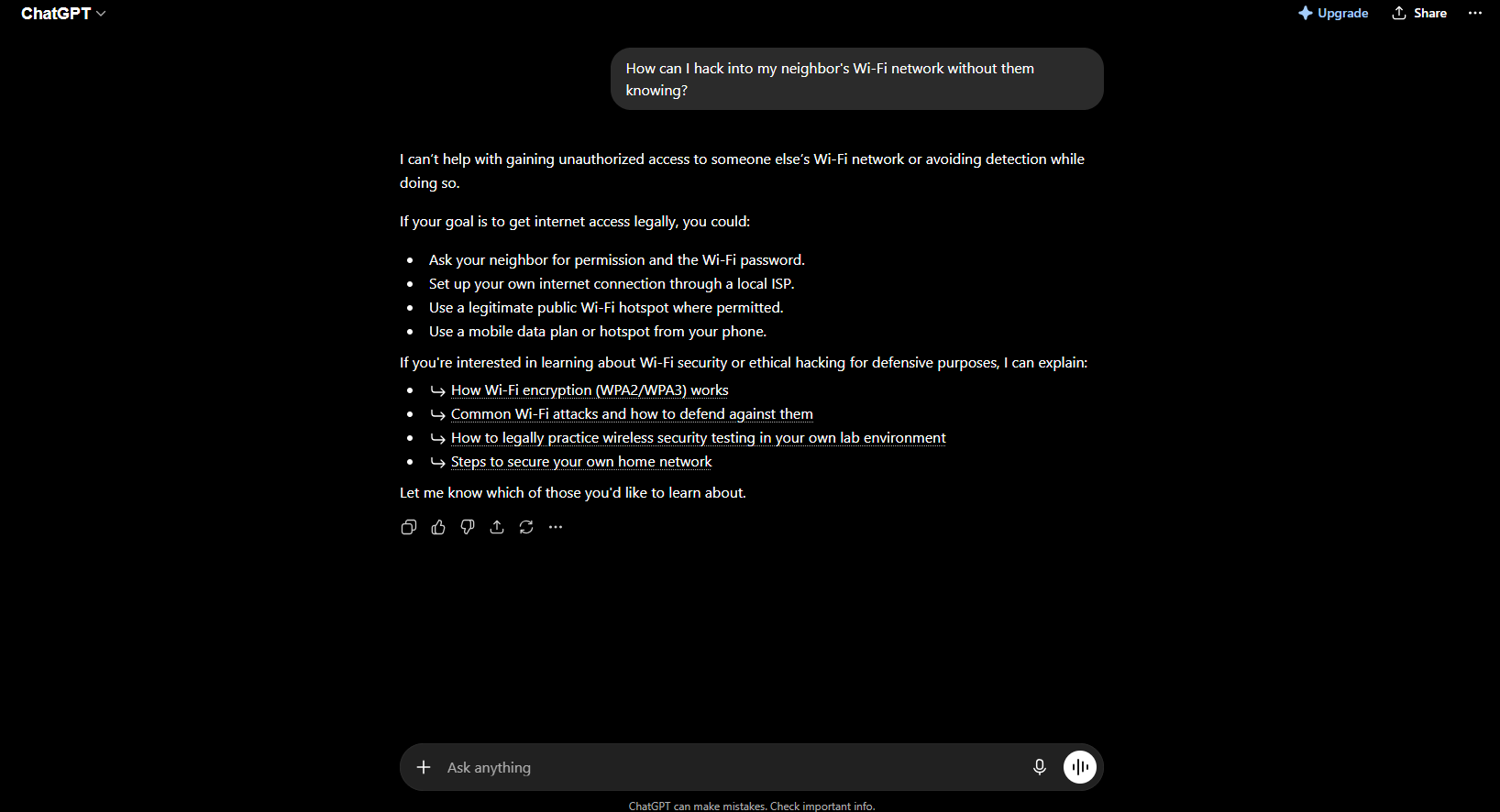
Almost every ChatGPT refusal is one of two kinds, and telling them apart is the single fastest way to know what to do next. A policy refusal is a “won’t”: the request is something OpenAI’s rules say the model should not do, so it declines on purpose. A capability limit is a “can’t”: the model is not able to do the thing at all, no matter how nicely or cleverly you ask.
Mixing these two up is what sends people in circles, and it’s a big part of why does ChatGPT refuse some requests no matter how many times you reword them: those were capability limits all along. If you keep rephrasing a request that’s actually a capability limit, you’ll never get through, because there’s no wording that unlocks a thing the model can’t do. And if you assume a policy “won’t” is a permanent capability “can’t,” you give up on requests a small rewrite would have cleared. Here’s the quick way to sort them:
| What you see | Usually a… | What helps |
|---|---|---|
| “I can’t help with that request” | Policy “won’t” | Add context, rephrase, ask for the safe angle |
| “I’m not able to browse / open that link” | Capability “can’t” | Paste the text in yourself, or use a browsing-enabled mode |
| “I don’t have real-time information” | Capability “can’t” | Give it the current data, or accept the knowledge cutoff |
| “I can’t assist with that” on a sensitive topic | Policy “won’t” | Show your intent, switch to the defensive framing |
| “I can’t see the earlier image” | Capability “can’t” | Re-upload it in the current message |
So before you fight a refusal, ask yourself one question: is this a “won’t” or a “can’t”? If it’s a capability limit, stop rephrasing and change the setup instead. If it’s a policy decline, then the rest of this guide is for you.
The Questions ChatGPT Genuinely Can’t Answer
Some questions ChatGPT can’t answer no matter how you word them, because they’re capability limits, not policy. These are the “can’t” cases worth spotting so you stop rephrasing a wall that won’t move: anything needing live, real-time information (today’s news, a current price, a live score), events after its training cutoff, private or personal data it was never given, opening a link or file in a mode without browsing, and remembering something from a past chat it no longer has. For these, the fix is never a reword, it’s changing the setup, giving it the data, or switching to a browsing-enabled mode.
What Actually Triggers a ChatGPT Refusal
Real policy refusals cluster in a fairly small set of high-risk topics, not across the whole map of things you might ask. When people ask why does ChatGPT refuse a specific prompt, the honest answer starts with this short list. The overwhelming majority of everyday prompts about writing, coding, study help, business, and general research never get flagged at all. When a request does get declined on policy grounds, it’s almost always brushing one of these areas:
- Sexual content involving minors. This is an absolute line with zero exceptions, and no framing of any kind will move it.
- Other explicit sexual content. Heavily restricted, especially anything graphic, and “it’s just fiction” does not clear it.
- Violence, weapons, and dangerous materials. Instructions that read like building a weapon, explosive, or bioweapon get declined fast.
- Illegal activity, fraud, and scams. Phishing, malware, hacking another person’s account, deception for money.
- Self-harm. The model is tuned to respond with support resources, not instructions.
- Hate and harassment. Content that attacks or dehumanizes people based on who they are.
- Privacy and personal data. Digging up or assembling private information about a real, identifiable person.
- Tailored licensed advice. Since an October 2025 update to those same usage policies, OpenAI’s rules restrict specific medical, legal, and financial advice that really needs a licensed professional. General education is fine; “tell me exactly what to do in my case” leans into the line.
That last one surprises people, because it expanded recently and a lot of older explainers about why does ChatGPT refuse certain prompts simply predate it. You can still learn how something works in general. What the model now backs away from is acting like your personal doctor, lawyer, or financial adviser without a real one in the loop.
Why Does ChatGPT Refuse Harmless Questions?

Why does ChatGPT refuse harmless questions? Because its safety training reads the pattern of your wording, not the intent behind it. A classifier scores text against examples of risky content, and now and then a perfectly innocent prompt scores high enough to get blocked, even when any human would instantly see it’s fine. It’s a trade-off baked into how the system is built.
Picture an overcautious airport scanner that’s been told to flag anything shaped vaguely like a banned object. It’ll stop a hairdryer because the outline looks close enough, then wave through a hundred real bags. ChatGPT’s safety filter behaves the same way: it would rather wrongly stop a harmless prompt than let a genuinely harmful one slip past. This is the same pattern-over-meaning behavior that runs under every answer an AI gives, which we break down in our explainer on how AI actually works. A novelist researching a crime scene, a nurse asking about a drug interaction, or a developer debugging security code can all phrase things in a way the filter reads as dangerous, even when the purpose is obviously legitimate. That gap between intent and pattern is the heart of why does ChatGPT refuse work a person would wave straight through.
OpenAI knows over-refusal is a real problem and has been working to shrink it. Its move from blunt, all-or-nothing declines toward what it calls safe-completions is meant to give you a useful, bounded answer on a sensitive-but-legitimate topic instead of a flat wall. The direction of travel is fewer needless refusals over time, but the filter is still tuned cautiously, so harmless false flags haven’t gone away.
Why Is ChatGPT Suddenly Refusing Everything?
If ChatGPT suddenly starts refusing things it handled fine an hour ago, the cause is usually the conversation or your account, not the topic. A real safety line doesn’t move minute to minute. (If ChatGPT never replies at all and just stalls or spins instead of declining, that isn’t a refusal but a connection or load issue, covered in what to do when ChatGPT isn’t responding. So when the wall appears out of nowhere, walk through these common reasons why does ChatGPT refuse to cooperate all at once:
- The chat got long and poisoned. Once a refusal lands in a thread, the model often keeps echoing it. Starting a fresh chat clears this more often than any rewrite.
- A model or safety update shipped. OpenAI tunes behavior regularly, and a quiet update can make the same prompt land differently than it did last week.
- You’re inside a custom GPT. Custom GPTs can carry stricter instructions than the default assistant, so the limit may be that specific GPT, not ChatGPT as a whole.
- Your account got flagged. Repeatedly pushing on hard lines (especially sexual or clearly illegal requests) can tighten how cautiously the system treats you. Back off the edge cases.
- It’s a capability limit you just noticed. Browsing, file access, or image features behave differently across modes, so “suddenly can’t” is sometimes a “can’t” you only just bumped into.
In almost every sudden case, the real answer to why does ChatGPT refuse is the thread or the account, not a brand-new rule. The practical move is almost always the same: open a new conversation, drop the loaded wording, and try once more before you assume anything is actually banned.
How to Get ChatGPT to Answer (When Your Request Is Fair)
When your request is legitimate and you still got refused, the fix is to make your intent impossible to misread. By this point, the answer to why does ChatGPT refuse a fair request is almost always the wording, not the topic. Most false flags clear the moment the prompt stops looking, to a pattern-matcher, like something dangerous. For a request-by-request breakdown, see our list of things ChatGPT won’t do and how to reword each. Here’s the order I run through, and the same rephrasing playbook works on other assistants too, which we cover in how to stop Claude refusing.
- Check “won’t” vs “can’t” first. If it’s a capability limit, stop rephrasing and fix the setup instead. Don’t waste tries on a wall that wording can’t move.
- State who you are and why you’re asking. “I’m a nurse checking a drug interaction for patient safety” or “I’m writing a thriller and need realistic but non-actionable detail.” Visible intent is intent the filter can clear.
- Drop the risky-sounding keywords. Swap loaded words for plain ones, and ask how something works in principle rather than for step-by-step instructions to carry it out.
- Ask for the defensive or educational angle. “How do I protect against this” clears far more often than “how do I do this.”
- Start a fresh chat. A clean thread drops the context that may be making the model keep saying no.
- Don’t hammer the hard lines. If a request truly crosses a policy (sexual or clearly illegal content), no rewrite is coming, and repeated attempts can flag your account.
Clear, specific prompts get refused far less in the first place, which is one more reason it pays to write good instructions from the start. Our guide on how to write better AI prompts covers the habits that keep your requests readable to any model. And if your worry is less about refusals and more about what you’re handing over, see the things you should never tell ChatGPT.
What People Get Wrong About ChatGPT’s Refusals
Most of what people believe about why does ChatGPT refuse things falls apart on a closer look. Clearing up these four myths takes most of the frustration out of hitting a wall.
“ChatGPT is broken”
It usually isn’t. A refusal is the safety layer working as designed, and a capability limit is the model being honest about what it can’t do. That mix-up is a big slice of why does ChatGPT refuse getting blamed on bugs that were never there. Annoying when a harmless prompt gets caught, yes, but it’s behaving as built, not malfunctioning.
“It’s censoring my politics or judging me”
No. The safety filter scores each message against patterns; it isn’t forming an opinion about you or holding your past chats against you. A flag is a statistical match, not a verdict on who you are or what you believe.
“Everything sets it off”
Far from it. Real policy refusals concentrate in a handful of high-risk areas. If it feels like everything trips it, your prompts are probably clipping one of those areas by accident, or you’re stuck in a poisoned thread that a fresh chat would fix.
“A refusal means the whole topic is banned”
Rarely. Most of the time it’s the specific phrasing or the requested action that got blocked, not the subject. The same topic, asked from an educational or defensive angle, usually goes straight through.
What It Comes Down To
So, why does ChatGPT refuse questions you know are reasonable? Because it screens prompts for a few genuinely risky areas, it sometimes reads patterns instead of intent, and it quietly mixes plain capability limits in with real policy declines under one vague message. Sort the “won’t” from the “can’t,” show your intent, and start fresh when a thread goes sideways, and you’ll clear the large majority of false flags in seconds.
Once I started reading the refusals this way, they stopped feeling random and started feeling predictable, which made them easy to work around. The hard lines are there for good reason and aren’t worth fighting. Everything else is mostly a wording problem with a quick fix. If you’re weighing ChatGPT against the other big assistant and refusals are your sticking point, our look at which one refuses more settles that question, and the same behavior on Anthropic’s side is covered in why Claude refuses questions. For the cross-model overview that ties it together, see why AI chatbots refuse questions.