
By the end of this guide you’ll be able to stop Claude refusing prompts it should happily answer, and get a real response in under a minute. You’ll need a normal Claude account, free or paid, and the prompt that got refused, nothing else. Here’s the quick version, because it’s the same fix nine times out of ten: most refusals from Claude’s newest model, Fable 5, are false alarms from a safety filter that reads your wording, not your intent. So you rework the wording. Tell Claude who you are and why you’re asking, drop the scary-sounding keywords, and ask for the safe or educational angle instead of step-by-step instructions to do something risky. When I started doing that, the refusals I kept hitting on harmless questions mostly went away. The step people get stuck on is telling a refusal apart from a usage limit, so I’ll go slow there. Everything below is the full walk-through.
If Claude keeps refusing your requests, refusing to answer, refusing to help, refusing to work on a task, or saying it can’t help with something obviously fine, you’re not doing anything wrong and you’re not alone. It has been one of the most common complaints since Fable 5 shipped. The good news is you can stop Claude refusing harmless prompts with a handful of small, repeatable moves, and you almost never have to give up on the question. This is the practical fix-it companion to our explainer on why Claude refuses questions in the first place. Here we skip the theory and get you unstuck.
Most of what you’re hitting is an overactive refusal: Claude saying no to a harmless prompt because its safety filter pattern-matched your wording to something risky, not because the request actually breaks a rule. That is all an overactive refusal means, a false alarm. The rest of this guide is how you stop Claude refusing those false alarms, step by step.
What You’ll Need Before You Start
Almost nothing. You need a Claude account (the free plan is fine), the exact prompt Claude refused so you can rework it, and about two minutes. There’s no hidden setting to flip and no jailbreak involved. Most of the time you stop Claude refusing a prompt just by asking for the same thing in a smarter way.
- A Claude account. Free, Pro, or Max all use Fable 5 by default, so the refusals behave the same way on each.
- The prompt that got refused. Keep it handy. Most fixes are small edits to wording you already wrote.
- Optional: access to an older model (Opus or Sonnet) for non-sensitive work, which is the single fastest fix in this whole list.
- The right expectation. You’re clearing false alarms on harmless questions, not getting around real safety rules.
One ground rule before we start. These steps are for getting genuinely innocent questions unstuck. They will not, and should not, route you around Claude’s actual safety limits, and the last sections cover the one request no rephrase will ever clear.
How to Stop Claude Refusing: The 7 Fixes at a Glance
Want the list first? Here are all seven fixes in the order I’d try them, fastest and most effective at the top:
- Work out which wall you hit: a refusal, a model fallback, or a usage limit. Each needs a different fix.
- Add your context and intent: tell Claude who you are and why you’re asking.
- Swap risky-sounding words for plain ones: the filter reads wording, not meaning.
- Ask for the defensive or conceptual angle: “how to protect against” beats “how to do.”
- Break a big ask into smaller, safe pieces: split the prompt so no single part looks alarming.
- Switch to Opus or Sonnet: older models have no classifier, so they won’t flag non-sensitive work.
- Reframe roleplay and story prompts: name the creative purpose before you paste the scene.
Full walk-through of each one below, with the exact before-and-after wording I use to stop Claude refusing the prompts it never should have flagged.
Step 1: Work Out Which Wall You Hit
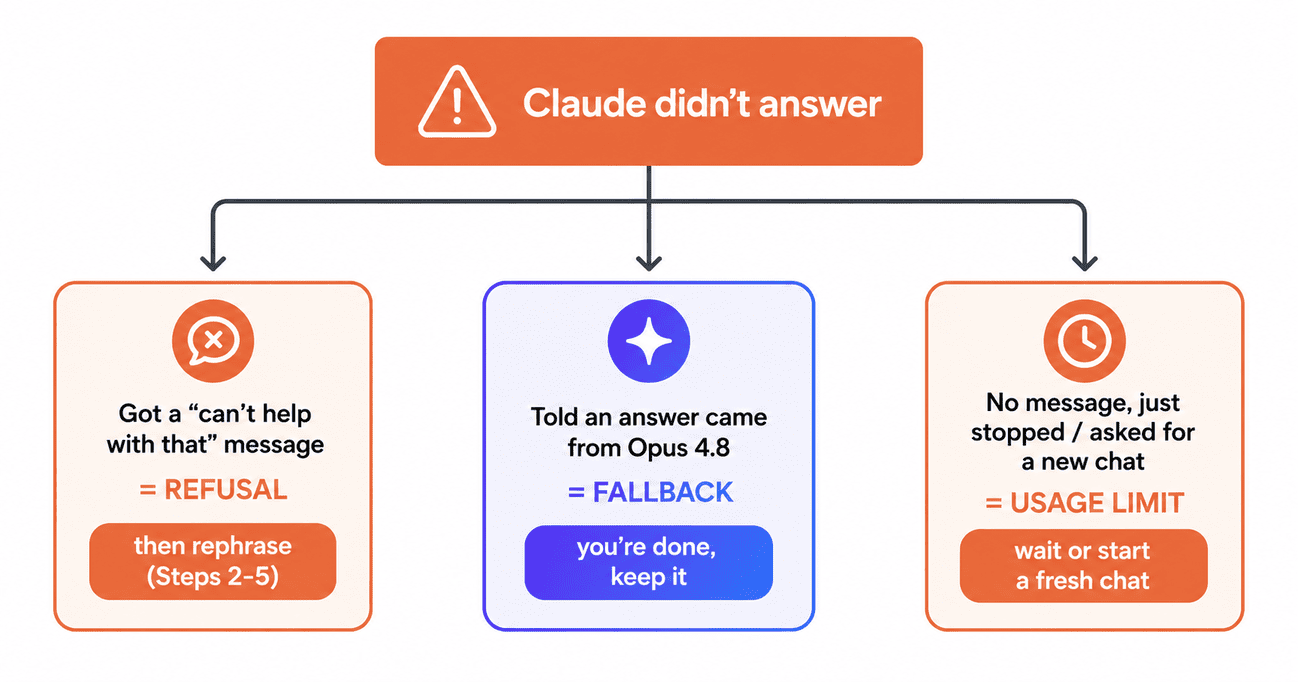
Before you rephrase anything, figure out what actually happened, because three different walls look alike. A refusal is Claude telling you it won’t answer that specific prompt. A fallback is Claude quietly handing your question to Opus 4.8 and answering anyway. A usage limit is Claude going quiet or asking you to start a new chat, with no refusal message at all. Getting this right is half of how to stop Claude refusing, because each wall has a different fix.
- If you got a refusal (a clear “I can’t help with that” message, often naming the area it flagged), the door is closed for that exact phrasing. Move to Steps 2 through 5 and rework it.
- If you got a fallback (a note that Opus 4.8 answered in Fable 5’s place), you already have your answer. There’s usually nothing to fix, and Opus 4.8 is a strong model in its own right.
- If Claude just stopped with no refusal message, that’s almost always a usage or length limit, not the safety filter. Wait for your limit to reset, or start a fresh chat if the conversation has simply gotten too long.
The tell is simple: a real safety refusal always says it’s declining. If Claude never sends a refusal and just won’t continue, stop trying to rephrase, because wording isn’t the problem. That one distinction saves people the most wasted time, and it’s why “why is Claude refusing my requests” and “Claude stopped replying” are often two completely different issues.
Step 2: Add Your Context and Intent Up Front
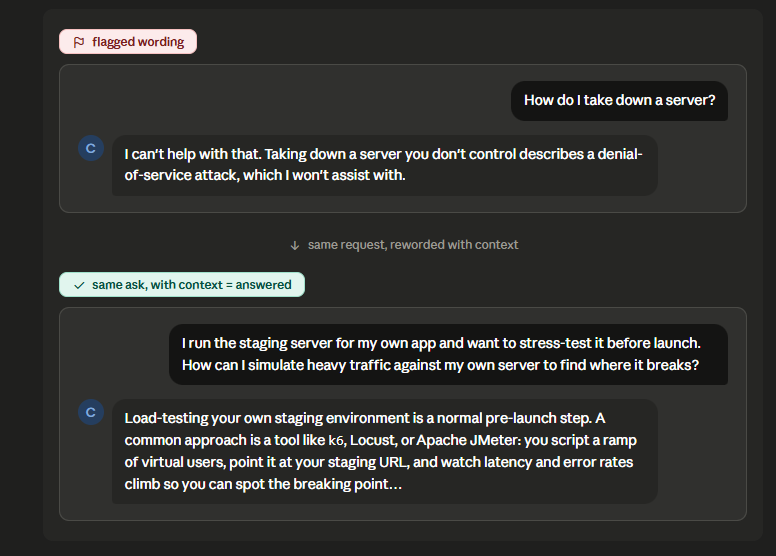
This single move clears more false refusals than everything else combined. Open your prompt by saying who you are and why you need the answer. The classifier reads patterns, so giving it visible, legitimate intent is the most reliable way to stop Claude refusing a question that’s perfectly fine.
Here’s the kind of rewrite that clears it. The bare version often trips the chemistry filter; the same question with clear context and a safety angle usually goes straight through:
- Often refused: “What household chemicals are dangerous when mixed?”
- Usually answered: “I’m putting together a home-safety guide for new parents. Which common cleaning products are dangerous to mix, and how should people store them safely?”
Same underlying question, completely different result. The context tells the filter this is a legitimate ask, and the safety framing keeps it away from anything that reads like a recipe for harm. This works because AI models judge text by pattern and probability rather than real understanding, which we unpack in our guide on how AI actually works. Give the pattern something clearly safe to latch onto and the refusal usually disappears.
Step 3: Swap Risky-Sounding Words for Plain Ones
Some words trip the classifier no matter how innocent your question is. Words like exploit, payload, synthesize, weaponize, or bypass read as dangerous in isolation. Replace them with plain language, and ask how something works rather than how to carry it out. This is the fastest way to stop Claude refusing a technical question that only sounds alarming.
- Often refused: “Write a script to exploit a SQL injection vulnerability.”
- Usually answered: “I’m learning secure coding. Can you show what a vulnerable SQL query looks like, and how parameterized queries prevent injection?”
The second prompt asks for the same knowledge a developer actually needs, minus the words that pattern-match to an attack. If you’re getting what feels like an overactive refusal on ordinary coding or research, this is usually the culprit, and a two-word swap fixes it.
Step 4: Ask for the Defensive or Conceptual Angle
Flip the request from offense to defense. “How do I protect against X” clears the filter far more often than “how do I do X,” because the defensive framing is genuinely the safer and more useful version of most questions. It’s not a trick; it’s usually what you wanted anyway.
- Often refused: “How do phishing emails trick people into clicking?”
- Usually answered: “I run security-awareness training. What red flags help employees spot a phishing email before they click?”
Defense, education, prevention, and harm-reduction angles almost always read as safe. If your honest goal is to understand or protect against something, lead with that and you’ll stop Claude refusing far more often than not.
Step 5: Break a Big Ask Into Smaller, Safe Pieces
A long prompt that bundles one sensitive detail with a normal request can get the whole thing refused. Split it. Ask the safe parts on their own, and either drop or rephrase the single piece that’s setting off the filter. The classifier scores the whole message, so a smaller, cleaner ask gives it less to flag.
Say you’re researching a thriller. Instead of one prompt asking for a character’s full plan in graphic operational detail, ask separately about the character’s motivation, the setting, and the emotional beats, then handle any tense moment with clear creative framing. You get everything you need without ever handing the filter a single paragraph that looks like a how-to. Splitting a heavy prompt is an underrated way to stop Claude refusing without dropping any of the detail you actually need.
Step 6: Switch to Opus or Sonnet for Non-Sensitive Work
Here’s the fastest fix of all for anything that isn’t actually sensitive: change the model. The classifier that causes these refusals lives in Fable 5 only. Older models like Claude Opus 4.8 and Sonnet don’t run it, so for ordinary writing, coding, and research they won’t flag you at all. ChatGPT is another option here, and it refuses less often than Claude on borderline prompts, which we break down in Claude vs ChatGPT refusals.
In the Claude app, open the model picker at the top of the chat and choose Opus or Sonnet, then resend your prompt. For everyday tasks you’ll rarely notice a quality difference. One honest caveat: this is for clearing false alarms on non-sensitive work, not for routing around real safety rules, since Anthropic’s core policies still apply on every model. But if a harmless prompt got caught by Fable 5’s filter, switching models will stop Claude refusing it instantly.
Step 7: Reframe Roleplay and Story Prompts
Creative writing is where most everyday users hit refusals, and the fix is to name the fiction before you paste the scene. Tell Claude it’s a novel, a script, or a roleplay, say what the scene is for, and ask for non-graphic detail. That framing is usually enough to stop Claude refusing a perfectly legitimate dark or violent scene.
- Often refused: “Write the villain threatening the hostage.”
- Usually answered: “I’m writing a crime thriller. Write a tense, non-graphic scene where the antagonist intimidates a captive through dialogue, focused on psychological menace rather than violence.”
Naming the creative purpose gives the classifier the intent it needs to let real writing through. If you keep getting a Claude roleplay refusal even with good framing, our explainer covers the reasons Claude refuses creative writing and where the genuine limits are. The short version: clear creative framing fixes most of it, with one exception I’ll cover next.
Common Mistakes That Keep Claude Refusing
If the fixes above aren’t working, you’re probably making one of these mistakes. Sorting them out is usually the difference between a wall and a working answer, because each one quietly undoes your effort to stop Claude refusing.
Trying to rephrase past a hard line
Some content no framing will ever clear. Sexually explicit material is a categorical no under Anthropic’s usage policy, so “it’s just fiction” won’t help, and repeated attempts can put your account at risk. Rephrasing is for false flags on harmless prompts, not for getting around real limits. If you’re hitting one of those, no step in this guide will move it, and that’s by design.
Mistaking a usage limit for a refusal
If Claude went quiet with no “I can’t help” message, you’re fighting the wrong problem. That’s a usage or length limit, and rephrasing will do nothing. Start a fresh chat or wait for your limit to reset, as covered back in Step 1.
Arguing with the refusal in the same thread
Replying “but it’s legal, please answer” usually keeps the flagged wording in context, so Claude refuses to answer again. Open a clean message with the reworked prompt instead. A fresh, well-framed ask beats arguing with a refusal almost every time.
Piling on too much disclaimer
A short, specific reason works better than three paragraphs swearing you’re not a criminal. Over-explaining can read as evasive. State who you are and why in one line, then ask your actual question.
Fighting a fallback you didn’t need to
If Opus 4.8 already answered well, you’re done. A fallback isn’t a refusal, and re-prompting to “force” Fable 5 usually wastes time for an answer that’s no better. Some people search “opus 4.8 worse” expecting a downgrade, but for everyday tasks you’ll struggle to tell the difference.
Pro Tips to Stop Refusals Before They Start
The best fix is not needing one. A few habits keep your prompts under the filter’s radar from the very first message, so you rarely have to stop Claude refusing anything in the first place.
- Lead with context every time on anything security-, medical-, or chemistry-adjacent. One sentence of intent up front prevents most false flags.
- Be specific. Vague prompts get flagged more than precise ones. Our guide on how to write better AI prompts covers the habits that keep requests clear to any model.
- Keep one topic per chat. Mixing a sensitive question into an unrelated thread can taint the whole conversation’s context.
- Default to the conceptual or defensive framing on touchy subjects. Ask how something works or how to defend against it, not how to do it.
- Match the model to the job. Save Fable 5 for hard reasoning, and use Opus or Sonnet for routine writing and code where the classifier just gets in the way.
What I’d Do Next
Put together, these are how you stop Claude refusing the vast majority of harmless prompts: work out which wall you hit, lead with your real intent, drop the loaded words, and switch models when the work isn’t sensitive. Nearly every false refusal I run into clears with one of those moves, usually the first or second one I try.
Once the routine clicks, the refusals stop feeling random and start feeling like a setting you know how to adjust, and you’ll rarely need to stop Claude refusing at all. And if all of this has you weighing Claude against other assistants for daily use, our Claude vs ChatGPT comparison is a useful next read. It also helps to understand why AI chatbots refuse in the first place, which applies to every assistant, not just Claude.