Written 7 September 2026, four days after GPT-6 Astra shipped. OpenAI is still rolling this model out in phases, so check the linked safety docs before relying on any specific behaviour.
GPT-6 Astra restrictions are narrower than the launch coverage suggests. OpenAI released Astra as a limited preview on 3 September 2026 and opened it to paid ChatGPT users the following day, and most reporting described that release as a deliberately “restricted version” that rejects prompts in areas like cybersecurity. That framing is doing a lot of work. OpenAI’s own safety documentation says the model is less likely to refuse harmless requests than what came before it, not more. Both statements are true at once, because the restriction is aimed at a small set of high-capability domains while the general refusal behaviour got looser. The thing most coverage gets wrong is treating this as two versions of a model. It isn’t. It’s one model with a line that moves depending on who is asking.
I spent an afternoon with OpenAI’s deployment safety documentation instead of the launch write-ups, mostly because the Claude refusal work I did earlier this year taught me that the safety docs and the press release rarely tell the same story. They don’t here either. Below is what the documentation actually says about GPT-6 Astra restrictions, why most people reading this will see fewer refusals rather than more, and the specific kinds of work that genuinely run into the wall.
What GPT-6 Astra Actually Shipped, and When
GPT-6 Astra went live as a limited preview on 3 September 2026 and reached a public stable release on 4 September, with access opening to ChatGPT Plus and Business subscribers on 5 September. It is available through ChatGPT on the Plus, Pro, Business and Enterprise tiers, through the OpenAI API directly, and through Microsoft Azure and AWS Bedrock. The rollout is phased rather than instant, which is why two people on the same plan may not see it at the same moment.
On the API side, standard pricing runs $10 per million input tokens and $50 per million output tokens, with cached input at $1 per million. Requests above 272,000 input tokens move to a higher band. Those numbers matter less for the average ChatGPT user than which plan you are actually on does, but they tell you where OpenAI has positioned the model: this is the expensive flagship, not the everyday workhorse.
The part that drove the headlines, and the source of nearly every confused claim about GPT-6 Astra restrictions since, was the framing around cybersecurity. OpenAI’s announcement presents Astra as state of the art at software engineering, computer use and scientific work, and separately says its most advanced cyber capabilities will reach a narrower group first, with wider defensive access following through a programme it calls Daybreak.
The GPT-6 Astra Restrictions Everyone Misread
The most repeated claim about GPT-6 Astra restrictions is that OpenAI shipped a “restricted version” of Astra to the public. That phrasing appears across the launch coverage, including CNBC’s report on the announcement, and it has been repeated into a fact. Read the safety documentation and a different picture shows up.
What OpenAI’s own materials describe is not a stripped-down public build sitting alongside a full-strength private one. It is one model, with additional production safeguards, and a refusal threshold that is adjusted according to how a user is assessed. That is a meaningfully different architecture from “here is the safe copy and here is the real one”, and it explains something readers keep running into: two people can send the same request to the same model and get different answers.
None of this makes the reporting dishonest. “Restricted version” is a reasonable shorthand for a complicated rollout, and OpenAI did genuinely gate its strongest cyber capabilities. But shorthand hardens into belief, and the belief now circulating about GPT-6 Astra restrictions is that everyone got a lobotomised model. That is the part worth correcting.
There Is No Separate Restricted Model, There Is a Moving Line
The clearest statement in the safety documentation is that Astra’s refusal boundary is adjustable per user rather than fixed. OpenAI writes that “for users flagged as potentially high risk, we have additionally trained in the ability to adjust the model’s refusal boundary to be more conservative and cover a broader range of dual use risks.” Read that slowly, because it reframes the whole story.
This is the detail that makes GPT-6 Astra restrictions so hard to summarise in one sentence. A fixed restriction applies the same ceiling to everyone. A moving boundary means your experience of the model depends partly on signals about you and your usage, not only on what you typed. That is why “does GPT-6 Astra refuse more?” has no single answer. For most accounts the honest answer is no. For an account that has tripped risk signals, the answer can be yes, on a wider range of topics than the published categories suggest.
This is also the most practically useful thing in the documentation, and almost nobody has written about it. If you hit a wall on Astra that a colleague doesn’t hit on the same prompt, the difference may not be your phrasing. It may be your account. That is a genuinely new dynamic, and it is worth knowing before you spend an hour rewording a request that was never going to land.
What GPT-6 Astra Actually Refuses
The GPT-6 Astra restrictions cluster into a handful of named domains, and they are the same domains every frontier lab now guards. The GPT-6 Astra system card groups its safety work into the areas below. Nothing here should surprise anyone who has followed model safety for the last two years, which is itself the point: the restricted domains are narrow and predictable.
| Domain | What the safety work targets |
|---|---|
| Cybersecurity | The model’s capacity to find previously unknown security flaws, and to take harmful cyber actions through misuse or misalignment |
| Biological and chemical | Evaluated at OpenAI’s “Critical” capability threshold, with a separate trusted-access route for legitimate biology research |
| Violence and self-harm | Requests drawn from real production traffic and adversarial red-teaming |
| Sexual content | Tightest for users under 18, alongside eating disorders and age-restricted goods |
| Deception | Misleading representations and user manipulation |
| Misinformation | Hallucination and factual-accuracy work rather than hard refusals |
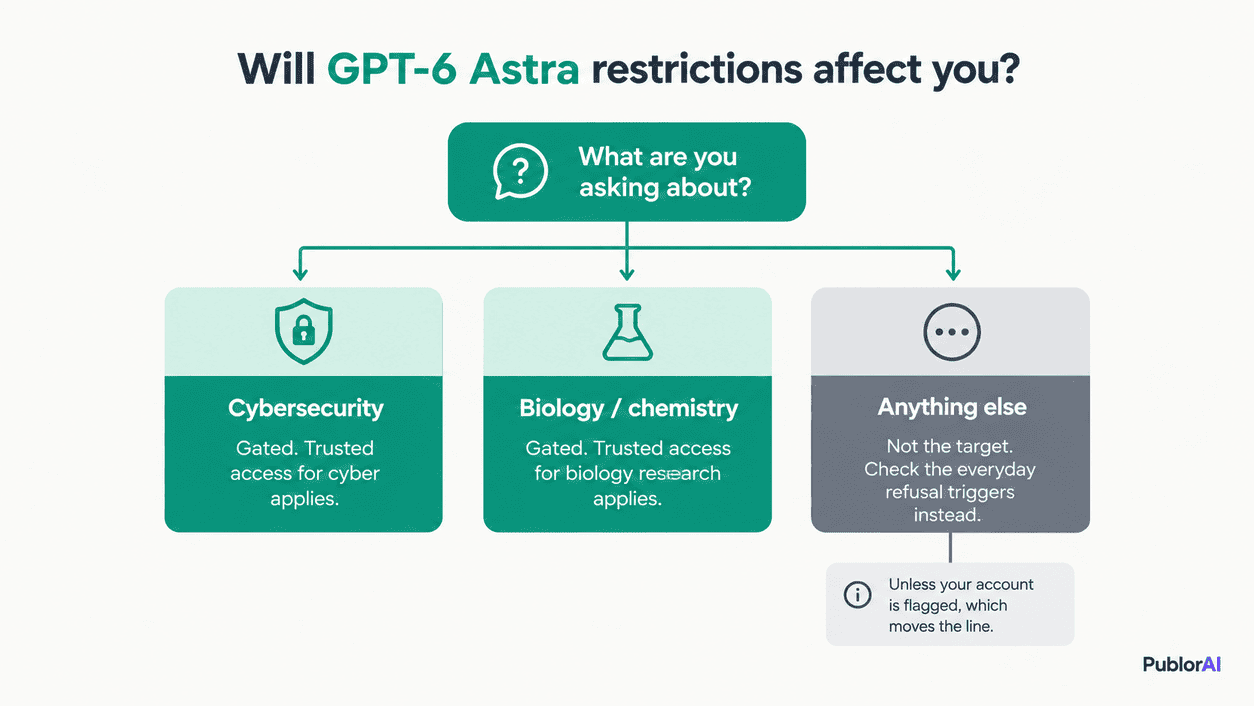
Two things stand out about how the GPT-6 Astra restrictions are actually scoped. The first is that only the top two carry a formal gated-access programme, which OpenAI runs as trusted access for cyber and for biology research. The second is that the bottom two are not really refusal categories at all. They are accuracy and honesty work that happens to sit in the same document, and lumping them in with the cyber restrictions is part of how the “heavily restricted model” impression formed.
Why Most People Will See Fewer Refusals, Not More
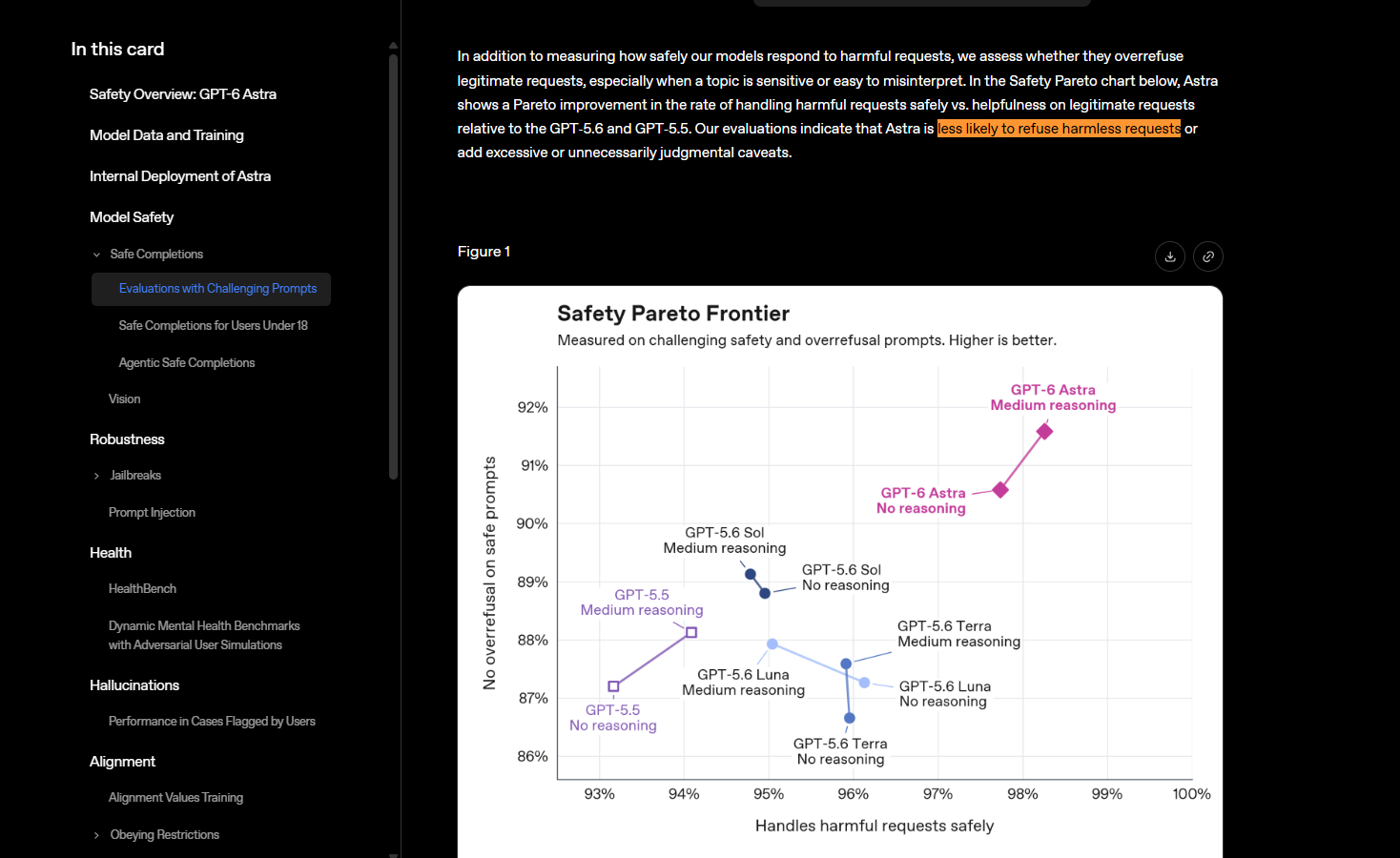
OpenAI’s documentation makes a direct claim that runs opposite to the headlines: Astra “achieves a Pareto improvement in safely completing unsafe requests and avoiding unnecessary refusals to harmless requests,” and is “less likely to refuse harmless requests or add excessive or unnecessarily judgmental caveats.” In plain terms, the company says it moved on both axes at once rather than trading helpfulness for safety.
Think of it like an airport that replaced random pat-downs with better scanning. Ordinary travellers move through faster and get stopped less, because the system got better at telling a laptop charger from a threat. At the same time a specific, narrow watchlist gets more scrutiny than it used to. Nobody would describe that airport as “restricted” for the average traveller, but the headline “airport adds new security restrictions” would still be technically accurate.
That is the shape of the GPT-6 Astra restrictions as OpenAI describes them. If your work is ordinary writing, analysis, coding, research or planning, the documented direction of travel is fewer of those irritating over-cautious refusals, not more. Whether the model delivers on that in daily use is a separate question, and one I have not tested, because I do not have hands-on access to Astra yet. I am reporting what the documentation claims, not what I have measured. If you want the version of this I did measure, the Claude side is covered in my guide to stopping Claude refusing, where the refusal rates came from actual prompt runs.
Who Actually Hits the GPT-6 Astra Restrictions
Very few ordinary users will ever meet the GPT-6 Astra restrictions, and the people who do tend to share a pattern: their legitimate professional work overlaps a guarded domain. Here are the three profiles most likely to run into a wall, based on which domains OpenAI actually gates.
The security professional. This is the clearest case. Penetration testers, vulnerability researchers and red-teamers do work that looks, prompt by prompt, almost identical to the thing the cyber restrictions exist to stop. Writing a proof-of-concept exploit for a known vulnerability is routine, billable, defensive work, and it is also precisely what the gate is built around. Expect friction, and expect the trusted-access route to matter more than clever phrasing.
The life-sciences researcher. Biology and chemistry sit at OpenAI’s critical threshold, so a graduate student asking a legitimate synthesis question can land in the same bucket as someone with bad intent. OpenAI runs a trusted-access programme for biology research specifically because it knows this, which is an admission that the blunt version of the filter catches real work.
The person whose account got flagged. This is the one nobody expects, and it follows directly from the moving boundary described above. If your usage has tripped risk signals, your refusal threshold is more conservative across a wider range of dual-use topics, on requests that would sail through on someone else’s account. There is no published appeal path for this, which is worth knowing.
Everyone else, and that is the overwhelming majority of people reading this, is not the target of the GPT-6 Astra restrictions at all. If you are getting refused on ordinary requests, the cause is far more likely to be one of the everyday triggers I covered in why ChatGPT refuses questions than anything specific to Astra.
The Line in the Safety Docs That Undercuts Every Benchmark Headline
Buried in the evaluation section is a caveat that deserves far more attention than it has had. OpenAI states that “because these evaluations focus on difficult cases and long-tail risks, their results should not be interpreted as estimates of how frequently these behaviors occur in typical production use.” That sentence quietly disarms most of the numbers written about this model in the last four days.
Safety evaluations are built from deliberately hard, adversarial cases. They are stress tests, not surveys. So when a figure from that testing gets lifted into a headline as though it describes what happens when you open ChatGPT on a Tuesday, the number has been moved out of the context that gave it meaning. That is true of refusal figures and safe-completion figures in both directions, the flattering ones and the alarming ones.
I flag this because it is the single most useful piece of media literacy for reading any model launch, not just this one. When you see a percentage attached to GPT-6 Astra restrictions this week, the first question is whether it came from adversarial testing. If it did, it does not tell you what your Tuesday looks like, and the company that published it says so directly.
How OpenAI’s Approach Differs From Anthropic’s
The two labs have landed on visibly different answers to the same problem, and the difference is one of placement. Anthropic leans on safety classifiers that sit around the model and evaluate traffic, which is why Claude’s refusal behaviour varies so sharply between models in the same family. OpenAI’s documentation for Astra emphasises training the boundary into the model itself and then adjusting where that boundary falls per user, with production safeguards layered on top.
In practice that produces two different failure modes. A classifier-shaped system tends to produce refusals that feel abrupt and disconnected from the conversation, because something outside the model made the call. A boundary trained into the model tends to produce refusals that feel more reasoned but are harder to argue with, because there is no separate component to route around. Neither is obviously better. They fail differently, and knowing which one you are talking to changes what is worth trying.
The convergence matters more than the difference, though. The GPT-6 Astra restrictions gate the same narrow domains Anthropic gates, both labs run trusted-access programmes for legitimate professional work in those domains, and publish safety documentation that says roughly the same thing in different vocabulary. I wrote about that convergence across all the major chatbots in the pillar guide on why AI chatbots refuse, and Astra is another data point for it rather than a departure.
Four Misreadings of GPT-6 Astra Restrictions
Four claims about GPT-6 Astra restrictions are circulating widely and do not survive contact with the documentation. Worth clearing up before they harden further.
“OpenAI released a crippled public model.” The documentation describes one model with production safeguards and a per-user adjustable boundary, not a stripped public build shipped alongside a full-strength private one. The gating is real, but it is domain-specific and access-programme shaped, not a blanket downgrade.
“Astra refuses more than GPT-5.5.” OpenAI claims the opposite for harmless requests and frames it as an improvement on both axes at once. You are welcome to be sceptical of a company grading its own homework, but “it refuses more” is not what the source says, and nobody repeating it is citing a measurement.
“The cyber restrictions will be lifted soon.” The stated direction is expanded access for defensive work through a named programme, not removal. Wider access under a trusted-access regime is a different thing from an unrestricted model, and conflating the two sets up a disappointment.
“This is just OpenAI being cautious after bad press.” The gated domains match what every frontier lab now guards, and the pattern predates this launch. This is an industry-wide convergence on the same short list, which is a more interesting story than a PR reaction and a better predictor of what the next model from anyone will do.
What I’d Watch Next
The number worth waiting for is not in any launch article, because it does not exist yet. What matters is the gap between OpenAI’s claim that Astra refuses harmless requests less often and what people actually report over the next few weeks of real use. That gap, in either direction, will tell you more than the system card can.
Two things I will be watching specifically. First, whether the complaint wave arrives, and if it does, whether it comes from the gated professional domains or from ordinary users, because those point at completely different problems. Second, whether the per-user boundary becomes visible to people, since a model that treats two accounts differently on the same prompt tends to get noticed eventually, and there is no published way to find out which side of the line you are on.
If Astra starts refusing you on work that is plainly ordinary, the cause is almost certainly one of the common triggers rather than the GPT-6 Astra restrictions described here, and the fixes are the same ones that have always worked. Start with the things ChatGPT genuinely won’t do, which separates the hard refusals from the ones that are just a rephrase away.