AI vs machine learning vs deep learning is the question that confuses most people new to AI in 2026. The short answer: they’re not three competing technologies. They’re three nested concepts. Artificial intelligence is the biggest umbrella, machine learning is one method inside it, and deep learning is one technique inside machine learning. Think of them like Russian nesting dolls. AI contains ML contains DL. I wrote this guide because every existing explanation either gets too technical too fast or skips the part where you actually understand what each one does. Here’s the plain English breakdown: AI is the goal (machines that act intelligently), machine learning is the main way we get there (machines that learn from data), and deep learning is the most powerful version of machine learning (machines that learn through neural networks with many layers). Every modern AI tool uses some combination of all three. If you want the bigger picture of how AI actually works end to end, our explainer breaks down the whole process.
The Quick Answer (For People Who Want It Now)
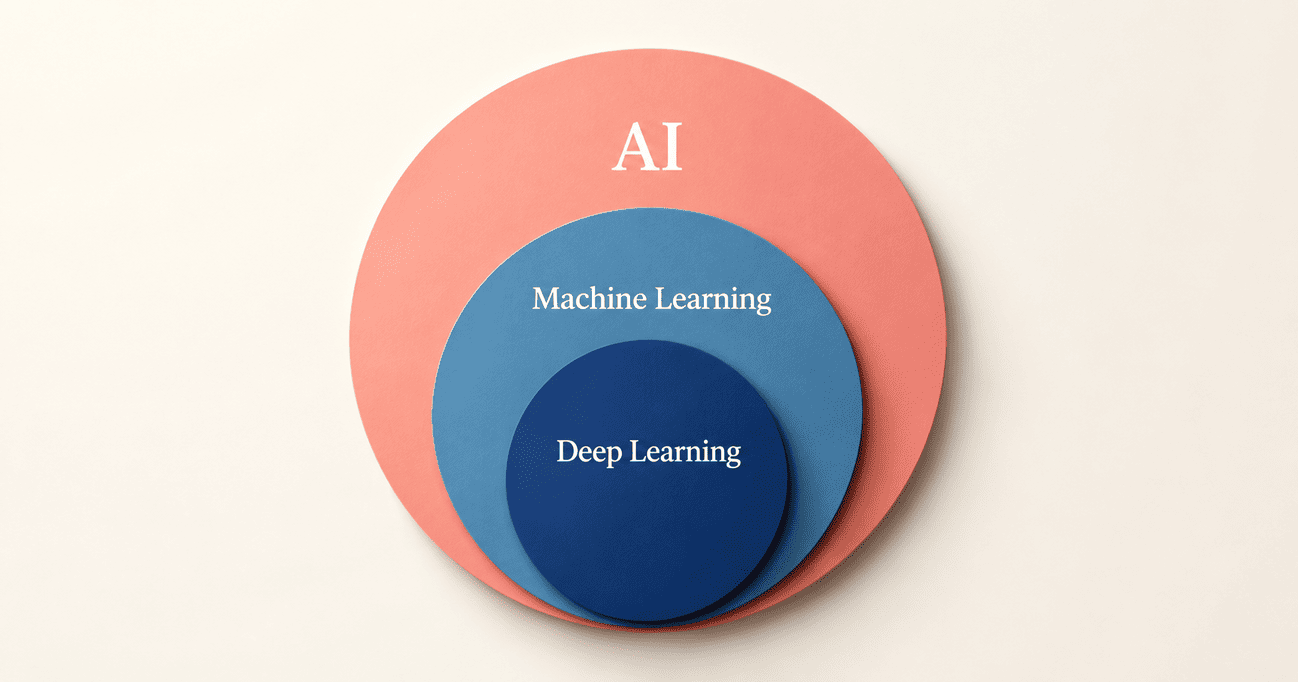
The AI vs machine learning vs deep learning hierarchy is simpler than the jargon makes it sound. Imagine three boxes nested inside each other. The biggest box is labeled “Artificial Intelligence.” Inside that is a smaller box labeled “Machine Learning.” And inside that is the smallest box labeled “Deep Learning.”
That’s the entire relationship in one image. AI is the broadest concept. Machine learning is one approach to building AI. Deep learning is one specific technique within machine learning.
You can have AI without machine learning (older rule-based systems like early chess programs). You can have machine learning that isn’t deep learning (spam filters, recommendation engines). But you can’t have deep learning that isn’t both AI and machine learning. The hierarchy only flows in one direction.
The reason these three terms get used interchangeably in news and marketing is that almost every AI tool you use today (ChatGPT, Claude, Midjourney, Cursor) sits at the intersection of all three. They’re all AI. They all use machine learning. And almost all the modern impressive ones use deep learning specifically.
What Is Artificial Intelligence?
Whenever I explain this to people, I always start with the simplest definition. Artificial intelligence is the broadest of the three terms. It refers to any machine or software that performs tasks we’d normally associate with human intelligence. That includes recognizing speech, understanding language, making decisions, recognizing images, playing games, and learning from experience.
The key word is “any.” AI doesn’t have to learn from data. It doesn’t have to use neural networks. A program that follows hand-coded rules to play chess is technically AI. A simple decision-tree script that decides whether to approve a loan based on three numbers is AI. The bar is “performs an intelligent task,” not “learns the task itself.”
This is why the term gets stretched in marketing. Every software product can claim to use AI somewhere because the definition is broad. IBM’s framing is one of the cleanest in the industry, and it matches what most academic sources teach. If you want a deeper foundation on what AI actually means and the three real types, our beginner’s guide to artificial intelligence covers it from scratch.
What Is Machine Learning?
Machine learning is a specific approach to building AI. The defining feature: instead of programming rules manually, you give the system data and let it learn the patterns itself.
The classic example is email spam filtering. The old approach was to write rules: “if the email contains the word VIAGRA in the subject line, flag as spam.” That worked for a while, then spammers started writing V1AGRA. So you wrote more rules. Then they wrote V|AGRA. The rules never ended.
The machine learning approach is different. You feed the system thousands of emails labeled spam or not-spam, and let it figure out the patterns on its own. It might learn that emails with all caps in the subject line, suspicious sender domains, and specific phrasing patterns are likely spam. You never wrote those rules. The system found them.
Machine learning works for spam filters, recommendation engines (Netflix, YouTube, Amazon), fraud detection, weather forecasting, and thousands of other applications. Most of it doesn’t use neural networks. Most of it would be invisible if you didn’t know to look for it.
What Is Deep Learning?
Deep learning is one specific technique within machine learning. It sits at the most specialized end of the AI vs machine learning vs deep learning stack. It uses artificial neural networks with many layers (hence “deep”) to learn extremely complex patterns from huge amounts of data.
What makes deep learning different from regular machine learning is that the system can extract its own features from raw data. Regular machine learning often requires a human to define what to look for (“count how many capital letters are in the subject”). Deep learning skips that step. Feed it raw text, raw images, raw audio, and the network figures out what patterns matter on its own.
This is why deep learning powers most of the impressive AI tools you’ve heard about. Image generation (Midjourney, DALL-E), voice recognition (Siri, Alexa), language models (ChatGPT, Claude), self-driving cars, real-time translation. All of these need to handle messy, unstructured data at massive scale, and only deep learning has cracked it cleanly.
The trade-off: deep learning needs huge amounts of data (often billions of examples) and serious compute power. A spam filter using regular machine learning can train on a laptop. A deep learning language model needs a data center. Google Cloud’s breakdown of the data and compute trade-offs is worth reading if you want the technical depth.
AI vs Machine Learning vs Deep Learning: The Real Difference
| Feature | Artificial Intelligence | Machine Learning | Deep Learning |
|---|---|---|---|
| Scope | Broadest (the umbrella) | Subset of AI | Subset of machine learning |
| How it works | Any technique that makes a machine seem intelligent | Learns patterns from data | Uses neural networks with many layers |
| Data needed | Variable (can use rules, no data) | Thousands to millions of examples | Millions to billions of examples |
| Compute needed | Variable (low for rule-based) | Modest (often runs on a laptop) | Heavy (needs GPUs / data centers) |
| Human input | Programmer writes rules or system | Human defines what features matter | System learns features on its own |
| Real example | Rule-based chess engine, voice assistant | Spam filter, Netflix recommendations | ChatGPT, Midjourney, self-driving cars |
| When to use | Any intelligent automation | Pattern recognition with structured data | Complex tasks with raw, unstructured data |
The biggest takeaway from this AI vs machine learning comparison: when news headlines talk about “AI” they almost always mean deep learning. When a product says it uses “machine learning” it might mean either traditional ML or deep learning. When something says “AI” generically, you can’t tell from the label what’s actually under the hood.
Real-World Examples of Each (You Already Use Them)
The AI vs machine learning vs deep learning split gets easier to grasp once you see each one in real products you use daily. Here’s the breakdown by category.
Pure AI (Rule-Based, No Learning)
- The thermostat that follows a schedule you set
- Calculator apps with built-in formulas
- Older chess programs (before deep learning)
- Tax software that applies rules from the tax code
- Industrial robots following pre-programmed paths
Machine Learning (Learns From Data, Not Always Deep)
- Email spam filters (Gmail, Outlook)
- Netflix and YouTube recommendation algorithms
- Credit card fraud detection
- Weather forecasting models
- Spotify’s Discover Weekly playlist
- Google Maps traffic prediction
Deep Learning (Neural Networks, Modern AI)
- ChatGPT, Claude, Gemini, Grok (large language models)
- Image generators like Midjourney and DALL-E
- Voice assistants (Siri, Alexa, Google Assistant)
- Real-time translation (Google Translate)
- Face recognition (iPhone Face ID)
- Self-driving cars (Tesla, Waymo)
- The AI app builders covered in our Lovable vs Bolt vs v0 comparison
Those three lists capture the AI vs machine learning vs deep learning split in everyday tools you actually touch. If you’ve used any product that “understands” raw text, images, or speech, you’ve used deep learning. If you’ve used software that learned your preferences over time, you’ve used machine learning. If you’ve used any digital tool that automated something, you’ve used AI.
Which One Powers Today’s AI Tools?
Mapping AI vs machine learning vs deep learning onto actual 2026 products clears the confusion immediately. Almost every popular AI tool in 2026 is powered by deep learning, specifically a type called large language models (LLMs) or large multimodal models (LMMs). ChatGPT runs on GPT-5.5. Claude runs on Opus 4.7. Gemini runs on Gemini 3.1 Pro. All of these are deep learning systems trained on massive amounts of text and code.
But that doesn’t mean older machine learning is dead. The recommendation engine deciding what shows up on your social feed is probably classical ML, not deep learning. The fraud detection on your credit card transactions is often classical ML. The autocomplete on your phone keyboard might be either.
The best way to think about it: deep learning is what’s exciting in 2026 because it can do things that were impossible 10 years ago (writing essays, generating images, holding conversations). Classical machine learning is what’s quietly running in the background of almost every internet service you use, doing the unglamorous work nobody talks about.
For a deeper look at how the most capable deep learning model on the market today actually performs, see our Claude Opus 4.7 review. For the broader category of agentic AI built on top of these models, our guide to AI agents covers the next layer of the stack.
Frequently Asked Questions
What’s the difference between AI and machine learning?
The AI vs machine learning split is the most common confusion in this whole topic. AI is the broad goal of building intelligent machines. Machine learning is one specific approach to that goal, where the system learns patterns from data instead of being programmed with rules. All machine learning is AI, but not all AI uses machine learning. Older rule-based systems are AI without being machine learning.
Is deep learning a type of AI?
Yes. Deep learning is a specific technique within machine learning, which is itself a subset of AI. So deep learning is both machine learning and AI at the same time. The hierarchy is: AI contains machine learning, and machine learning contains deep learning.
Is ChatGPT AI or machine learning or deep learning?
All three. The AI vs machine learning vs deep learning question disappears once you remember they’re nested. ChatGPT is an AI product, built using machine learning techniques, specifically deep learning with a large language model architecture. When you hear “ChatGPT is AI,” that’s true but vague. More precisely, ChatGPT is a deep learning system, which is a type of machine learning, which is a type of AI.
Do I need to learn machine learning before deep learning?
For most people, yes. Machine learning teaches the foundational concepts (training data, features, models, evaluation) that deep learning builds on. Jumping straight into deep learning without those basics often leads to confusion. The standard learning path is statistics first, then machine learning, then deep learning.
Which one is most used in 2026?
By tool count and headlines, deep learning. Every major AI product launched in 2026 uses deep learning. By total real-world usage, it’s a closer race. Classical machine learning still powers most spam filters, recommendation engines, and fraud detection systems. Deep learning gets the attention. Classical machine learning quietly does the bulk of the work.
Can you have machine learning without AI?
No. Machine learning is by definition a subset of AI. Any system that learns from data to make predictions or decisions falls under the AI umbrella. The reverse isn’t true: you can have AI (rule-based systems) that doesn’t use machine learning.
Final Thoughts: Why the Distinction Actually Matters
What I’ve learned from explaining this to friends and readers over the years: most people will never need to know the technical difference between machine learning and deep learning. But knowing the hierarchy helps you read AI news with a clearer head. When a company claims to “use AI,” that could mean anything from a rule-based script to a frontier deep learning model. When they say “we use machine learning,” they’re being slightly more specific. When they say “powered by deep learning” or “trained on a neural network,” they’re at the cutting edge of what’s possible right now.
The other reason the distinction matters: it helps you spot AI hype. A startup claiming their product is “powered by AI” tells you nothing real. A startup explaining they use deep learning trained on a specific dataset for a specific task tells you something concrete. The more specific the claim, the more likely it’s a real product instead of a marketing buzzword.
Now that the AI vs machine learning vs deep learning hierarchy makes sense, the news headlines and product claims will read very differently. If you’re newer to AI tools and want a practical starting point, our guide to the best free AI tools in 2026 covers the most useful free options that all happen to run on deep learning. They’re free, they work, and now you understand exactly what’s powering them.