Last reviewed: May 7, 2026.
Note: This review is for informational purposes only. Pricing and features may change. Always check Perplexity’s official site before purchasing.
This Perplexity AI review 2026 comes from two weeks I spent testing both the free and Pro tiers daily. Perplexity isn’t a chatbot. It’s an AI-powered search engine that gives you direct answers with clickable source citations instead of a list of links. The short verdict: for research, it’s genuinely one of the best AI tools available right now. You get real-time web access, cited sources, and a Deep Research mode that digs through 100+ pages in under five minutes. Where it falls short is creative and reasoning work. For writing or coding, ChatGPT or Claude are still better choices. The free plan is generous, with unlimited basic searches and 5 Pro queries per day. Pro at $20 per month adds unlimited Pro searches, access to GPT-5, Claude Sonnet 4.6, and Gemini 2.5 Pro, plus file uploads and image generation. For casual users, free is fine. For researchers, students, or anyone who fact-checks constantly, Pro pays for itself quickly.
What Perplexity AI Actually Is (And Why It Is Not a Chatbot)
Most people who try Perplexity for the first time expect it to work like ChatGPT. It doesn’t. ChatGPT is a conversational AI built for generating text and reasoning through problems. Perplexity is built around one job: finding accurate, up-to-date information and showing you exactly where it came from.
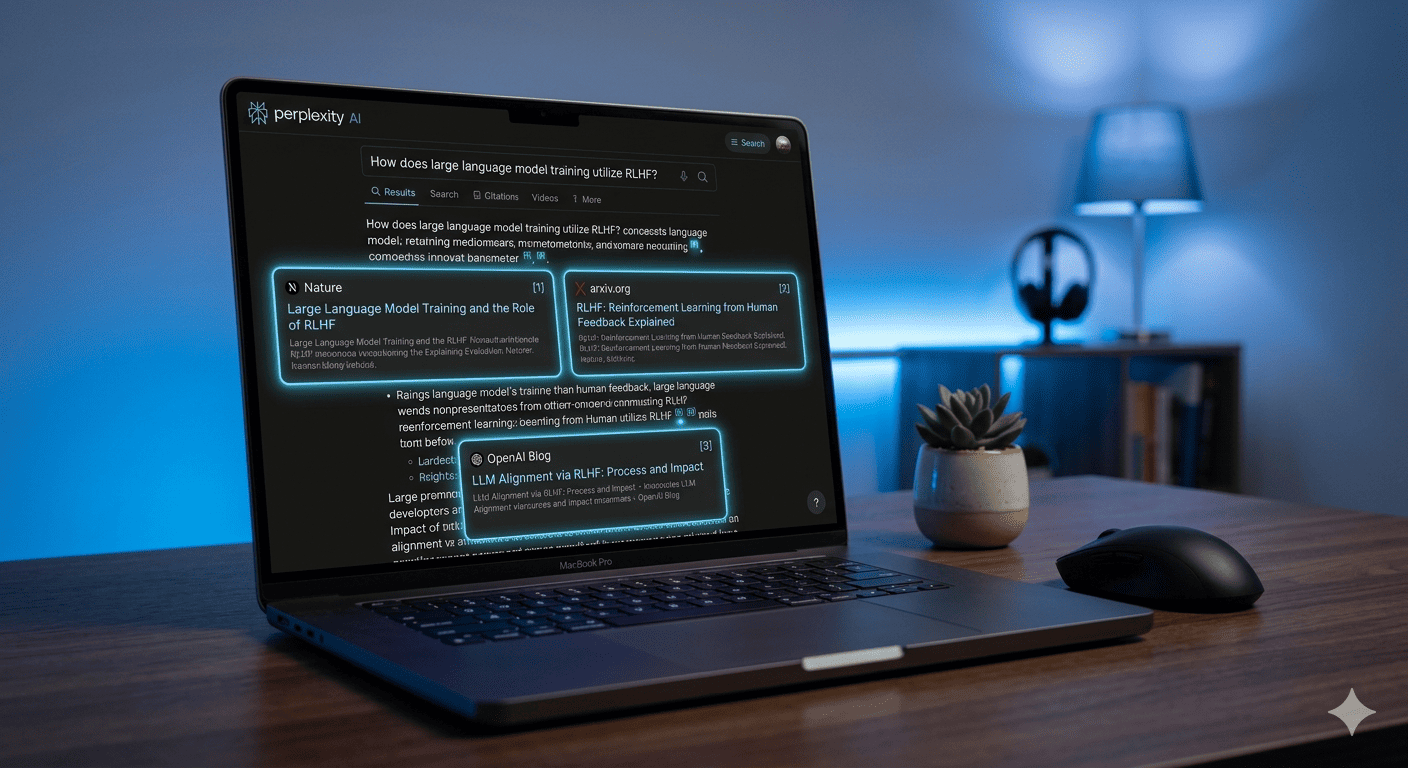
Every answer Perplexity gives comes with numbered citations you can click. You see the source, the URL, and the specific part of the page it pulled from. That’s the feature that sets it apart from every other AI tool on the market. It’s not doing creative writing. It’s doing what a very fast research assistant does.
Founded in 2022 and valued at over $21 billion as of early 2026, Perplexity AI has grown from a search experiment into a full platform. It now includes Deep Research, a multi-model selector called Model Council, a free Comet browser, and a growing enterprise tier. The free version alone draws tens of millions of monthly users. By 2026, it’s become one of the best AI search engine alternatives to Google for anyone doing research-first work.
If you are putting together your broader AI toolkit, our guide to the best free AI tools in 2026 puts Perplexity alongside the other tools worth considering before you spend anything.
I Tested It for Two Weeks: Here Is What I Found
What makes this Perplexity AI review 2026 different from most is that I tested it on research I actually needed, not toy prompts. I ran it as my primary research tool for two full weeks, covering AI tool analysis, competitor research, and staying current on fast-moving topics. Here is what stood out.
The Everyday Search Experience
The first thing I noticed was the speed. Answers come back almost instantly, and unlike Google, you are not spending five minutes clicking through links trying to piece together the answer yourself. Perplexity does that assembly work for you.
For most informational queries, the answers were solid. I tested it on things I know well: AI tool pricing, SEO strategies, recent product launches. The sources were usually accurate and on-point. The issue I kept running into is a specific failure mode: Perplexity cites real URLs but sometimes misquotes or misrepresents what the source actually says. The URL is real. The claim attributed to it isn’t always accurate.
A Columbia Journalism Review benchmark test found a 37% citation error rate on the free tier and 45% on Pro. That number surprised me. It means roughly 1 in 3 responses has some level of citation inaccuracy. For casual browsing, that is manageable. For anything you are going to publish or act on, you need to click through and verify the source directly.
Deep Research: The Feature That Changes Things
Deep Research is where Perplexity earns its Pro price. When I ran a Deep Research query on a competitive analysis topic, it visited over 80 web pages, cross-referenced data points, flagged a few contradictions, and delivered a structured report with sections and citations in about four minutes. Doing that manually would have taken me two to three hours.
Perplexity’s own benchmarks put Deep Research at 21.1% accuracy on the Humanity’s Last Exam test and 93.9% on the SimpleQA benchmark, outperforming several OpenAI and Google models on those specific tasks. Real-world use is always messier than benchmarks, but the gap is real. Deep Research consistently produces better first-draft research reports than anything else I have used.
If you already pay for Claude, this matters: Deep Research on Pro runs on Claude Opus 4.5 and 4.6 under the hood. So you’re effectively getting Anthropic’s most capable reasoning models doing your research. If you use a dedicated Claude subscription, there’s some overlap in what you’re paying for. See our Claude Opus 4.7 review to get a sense of how that model performs on its own.
Model Council: More Useful Than I Expected
Perplexity added Model Council in February 2026. It lets you run the same query through multiple AI models simultaneously and compare the responses side by side. On Pro, you can choose between GPT-5, Claude Sonnet 4.6, Gemini 2.5 Pro, Grok 4.3, and Perplexity’s own Sonar model.
I went in skeptical about this feature and came out genuinely impressed. Instead of maintaining separate subscriptions for different models, you get multi-model access from one dashboard. It’s not a full replacement for dedicated ChatGPT or Claude subscriptions if you use those tools heavily, but for content creators who occasionally want to compare how different models handle the same question, it covers a lot of ground at no extra cost over the base Pro plan.
Perplexity Free vs Pro vs Max: What You Actually Get
| Feature | Free | Pro ($20/month) | Max ($200/month) |
|---|---|---|---|
| Basic searches | Unlimited | Unlimited | Unlimited |
| Pro searches | ~5 per day | Unlimited | Unlimited |
| Advanced models (GPT-5, Claude, Gemini, Grok) | No | Yes | Yes |
| Deep Research | No | Yes | Yes (enhanced) |
| File and image uploads | Limited (3/day) | Yes | Yes |
| Image generation | No | Yes | Yes |
| Model Council | No | Yes | Yes |
| Perplexity Pages (shareable reports) | No | Yes | Yes |
| Comet browser | Free (all tiers) | Free | Free |
Annual billing brings Pro down to about $16.67 per month ($200 per year), which is the better deal if you plan to stick with it. The jump to Max at $200 per month is built for power users running dozens of Deep Research sessions every day. Almost no individual user actually needs Max.
The free plan is more capable than it looks on paper. Five Pro searches per day sounds restrictive, but basic searches are unlimited. If your use case is mostly quick factual lookups with no file uploads needed, the free Perplexity AI plan handles it well enough to delay paying indefinitely.
Where Perplexity Lets You Down
The hallucination problem is the biggest thing to understand going in. A 37 to 45% citation error rate sounds alarming, and it is something to stay aware of. But Perplexity’s specific failure mode is different from ChatGPT’s. ChatGPT sometimes invents facts from nothing. Perplexity usually cites real URLs but can misquote or selectively pull from the source in a way that distorts the original meaning. The citation gives you a sense of trust that is not always deserved.
The practical fix is simple: click through the sources on anything important before you use the information. Do not take the summary at face value for anything you plan to publish, submit, or act on. Once you build that habit, Perplexity becomes a much safer tool to use.
Outside of accuracy, Perplexity is weak at creative tasks. Ask it to write a blog post or draft marketing copy and the output is generic. It doesn’t have the conversational depth of ChatGPT or the prose quality of Claude. If your main need is content creation, Perplexity is the wrong primary tool. Our Claude vs ChatGPT breakdown for 2026 covers the comparison for writing tasks directly.
The mobile experience is also rougher than desktop. The Comet browser (free on all platforms as of March 2026) improves things, but for serious research sessions, desktop is still where Perplexity performs best.
Perplexity vs Google vs ChatGPT: Where Each One Wins
| Task | Best Choice | Why |
|---|---|---|
| Quick fact lookup with cited source | Perplexity | Direct cited answer, no link-clicking |
| Deep research and report writing | Perplexity Pro | Deep Research hits 100+ sources in minutes |
| Blog posts, emails, creative writing | ChatGPT or Claude | Better prose quality and conversational depth |
| Coding help | Claude or ChatGPT | Perplexity is not built for code |
| Local search (restaurants, directions) | Real-time location-aware results | |
| Staying current on AI and tech news | Perplexity | Real-time web access with source citations |
| Multi-model output comparison | Perplexity Pro | Model Council runs GPT-5, Claude, Gemini side by side |
The most efficient AI setup in 2026 is not picking one tool and forcing it to do everything. Use Perplexity for finding and verifying information. Use ChatGPT or Claude to turn that information into something. These tools solve different problems, and the best AI users in 2026 run both rather than treating this as an either-or decision.
Who Should Actually Pay for Perplexity Pro?
Pay for Pro if:
- You do research for more than an hour a day (journalists, analysts, students, content creators)
- You are regularly hitting the 5 Pro searches per day cap on the free tier
- You want access to multiple top AI models without paying for separate subscriptions
- You need to upload and analyze PDFs, documents, or images regularly
- Deep Research would save you meaningful time every week
Stay on the free plan if:
- You use Perplexity for occasional quick lookups, not daily research
- You already pay for ChatGPT Plus or Claude Pro and just want a search supplement
- Your main use case is writing, coding, or image generation. Perplexity is the wrong tool for those regardless of which tier you’re on
Frequently Asked Questions
Is Perplexity AI better than Google in 2026?
For informational research, yes. Perplexity gives you a direct cited answer instead of a page of links to click through. Google still wins for local searches, shopping, and anything location-based. Most heavy internet users end up running both tools for different tasks rather than replacing one with the other.
Is Perplexity Pro worth $20 a month?
For daily researchers and students, yes. The Deep Research feature alone can save hours per week. If you only use it for occasional lookups, the free plan covers enough that paying is hard to justify. Annual billing at $200 ($16.67 per month) is the smarter deal if you commit to it long-term.
Does Perplexity AI hallucinate?
Yes, and the type of hallucination matters. Perplexity usually cites real URLs but sometimes misquotes or distorts what the source actually says. A Columbia Journalism Review benchmark found a 37% citation error rate on the free tier and 45% on Pro. Always click through and verify sources on anything you plan to publish or act on.
Can I use Perplexity AI for free?
Yes. The free tier gives you unlimited basic searches and around 5 Pro searches per day. It does not include advanced models, Deep Research, file uploads, or image generation. For casual research and quick lookups, the free plan is genuinely enough for most people.
What is the difference between Perplexity free and Pro?
Free gives you unlimited basic searches with Perplexity’s standard model and about 5 Pro searches per day. Pro adds unlimited Pro searches, access to GPT-5, Claude Sonnet 4.6, Gemini 2.5 Pro, and Grok through Model Council, plus Deep Research, file and image uploads, image generation, and Perplexity Pages for shareable research reports.
Is Perplexity better than ChatGPT for research?
For sourced research specifically, yes. A 2026 benchmark showed Perplexity citing sources accurately in 78% of complex research queries compared to ChatGPT’s 62%. For writing, coding, and creative tasks, ChatGPT and Claude are still the stronger choice. The two tools complement each other more than they compete.
Perplexity AI Review 2026: My Final Verdict
After two weeks of daily testing across both tiers, I rate Perplexity 8 out of 10 for researchers and content creators and 5 out of 10 for general use. It is the best AI-powered search tool available right now, and it is not particularly close. Deep Research is a genuine time-saver. Model Council adds meaningful value for Pro users who want multi-model access without paying for separate subscriptions.
The hallucination problem is real and should not be glossed over. A 37 to 45% citation error rate means you cannot take any answer at face value without checking the source. That is not a deal-breaker, but it does add a verification step that Google-style users are not used to building into their workflow.
The free tier is strong enough that casual users have zero reason to pay. The Pro plan at $20 per month (or $200 per year) is worth it if research is a real part of your daily work. If you are building an AI toolkit from scratch, Perplexity Pro pairs well with Claude or ChatGPT rather than replacing either one. Use Perplexity to find and verify. Use Claude or ChatGPT to write and create.
That combination covers most of what content creators and knowledge workers actually need in 2026. For more on where the other major AI tools fit, see our full Claude vs ChatGPT comparison or our beginner’s guide to AI agents if you are newer to building an AI workflow. If you want a budget-friendly open-source alternative to the $20 models Perplexity uses under the hood, our complete DeepSeek V4 review covers a frontier-tier model that costs a fraction of GPT or Claude.